
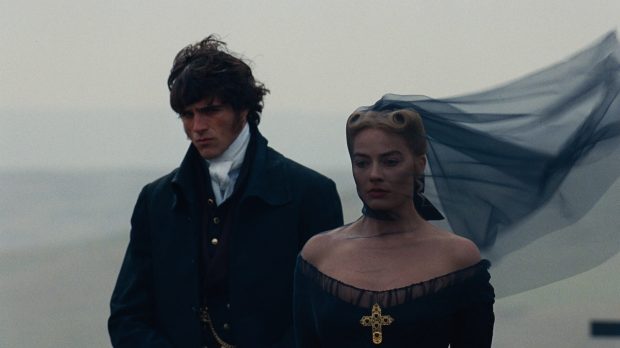
Wuthering Heights is not interested in selling audiences a sweeping, traditional romance. Under the direction of Emerald Fennell, this adaptation transforms Emily Brontë’s gothic classic into something feverish, excessive, and emotionally volatile—a film less about love and more about the terrifying hunger to possess another person completely.
From the moment Jacob Elordi’s Heathcliff appears onscreen, the film pulses with obsession. Not the soft, cinematic kind usually packaged as romance, but something uglier and more consuming. Heathcliff doesn’t simply love Catherine—he builds his entire identity around her. Every slight, every rejection, every act of cruelty festers until it mutates into vengeance. His devotion becomes corrosive, poisoning everyone around him, including himself.
Margot Robbie plays Catherine with a restless intensity that makes her feel both magnetic and destructive. She understands Heathcliff completely, which is precisely what makes their relationship so dangerous. Their connection feels less like destiny and more like two people recognizing the worst parts of themselves in each other and refusing to let go.
What makes this adaptation compelling is how unapologetically toxic it allows that obsession to become. Fennell doesn’t sanitize the emotional brutality of the story or try to modernize it into a healthier romance. Instead, she leans fully into the gothic madness. The windswept landscapes, shadowy interiors, and suffocating close-ups all reinforce the sense that these characters are trapped inside emotions too large for them to survive.
The film’s visual style is deliberately overwhelming at times—lavish costumes, stark lighting, dramatic camera movements—but that excess works in the movie’s favor. Obsession itself is excessive. It distorts reality. It turns longing into destruction. Every artistic choice seems designed to mirror the emotional chaos consuming the characters.
What’s especially striking is how Wuthering Heights refuses to separate love from cruelty. Heathcliff and Catherine are not soulmates in the conventional sense; they are emotional mirrors, reflecting each other’s rage, loneliness, pride, and desperation. The film argues that obsession can feel holy to the people experiencing it, even as it destroys entire lives around them.
By the end, the movie leaves behind the feeling of a tragic romance and becomes something closer to a ghost story about emotional inheritance—how unchecked obsession lingers long after death, haunting generations. It’s messy, melodramatic, and at times almost unbearably intense, but that’s exactly why it works.
This version of Wuthering Heights understands something many adaptations avoid: obsession is not beautiful because it is healthy. It’s compelling because it is catastrophic.


DID YOU ENJOY WHAT YOU JUST READ? IF YES, THEN SUBSCRIBE TO THE BLOG, GIVE THE POST A LIKE, OR LEAVE A COMMENT! NEW POSTS ARE UP EVERY TUESDAY & THURSDAY!

