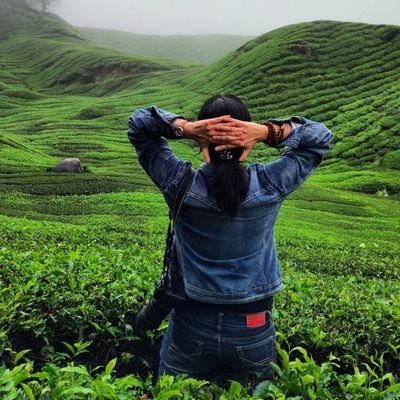
Joni Chng is a horror author with many of her stories appearing in various anthologies.
Can you talk about your latest book or story and what readers might find appealing about it?
I’ll just recommend my three latest published short stories:
Becoming the Deathless, published in the Into the Dread Unknown anthology in 2025, if you love Slavic mythology. This is a villain origin story sort of retelling of how Koschei the Deathless attained his immortality. It’s the first retelling I ever did, and I had fun with it.
Next, check out my first fantasy story published, Moonlight City of the Hidden Ones in A Spoonful of Malaysian Magic by Malaysian indie publisher, Teaspoon Publishing. It has extensive world building that will be explored in my future work.
My third recommendation is Faceless Portraits in The Big Book of Malaysian Horror Stories. I thought I invented a phobia for my protagonist when I wrote this story in the midst of the pandemic lockdown. It was only when I was giving this recommendation that I learned from a quick Google search of “fear of faceless people” about masklophobia – an irrational fear of people with hidden, obscure and absent faces, often rooted in an inability to read emotions, creating feelings of uncertainty and danger. I’m proud to say I was quite on point with my main character, but there’s more to his avoidant personality and masklophobia in the story. This anthology was published in 2022, with my story being one of 20 (but the illustration for my story is the cover art). If you want to explore horror beyond western media, I highly recommend it.
What’s a book you can’t stop recommending?
Misery by Stephen King. It’s technically and conceptually brilliant and a good introductory book for those getting into King’s work and horror fiction in general. It was my first King book. It is a must-read for aspiring writers looking to improve their craft. The first few pages that introduce us to the protagonist and his predicament are so masterfully written that you can feel a sort of phantom pain from the descriptive prose alone.
It also shows that horror can come in so many forms that it needn’t have a ghost or serial killer.
Can you explain your writing process? What inspires you?
I tend to work within my own pocket universe, which I continue to build and expand with each story I write. This fictional universe of mine is an alternative to our current reality; there is magic, there are mythical and divine beings, and weird science. Every time I start a new project, whether it’s a book or short story, I go into this universe and see what kind of stories can be told from there, with its laws are at play. So, with a very few exceptions, if you see any of my stories published in anthologies and journals, know that they all take place in the same universe.
Inspiration comes to me everywhere, really. Culture, history, myths, folklore, the latest scientific discovery, from observation, even something mentioned in passing in a conversation or a comment under a social media post can spark an idea. You can’t be a good storyteller without a curiosity and a certain love for the pursuit of knowledge. Every rabbit hole I ventured down is a potential building block for my universe.
Is there a snack or drink that gets you into a writing mindset?
Usually just morning coffee before I start working. I make it a point to not eat while I work; it’s not a good habit conducive to focus, not to mention having food around your workspace can be a messy disaster waiting to happen. What if you get crumbs in your keyboard or worse, spill something over your work? So, yeah…not recommended.
Are there any horror tropes you especially love in books or films?
I have a special love for religious horror or holiday horror (that is not Halloween), just about anything that juxtaposes a happy occasion with something dreadful and morbid. There’s something so undeniably unsettling about finding a deeper darkness behind what’s supposed to be sacred, holy and joyful. And once you see it, you cannot un-see it.
My particularly favorite is something called the “clashing of red and white” often done in Chinese language media. In Chinese, a “red affair” refers to auspicious, happy events associated with celebration, usually weddings, with red being an auspicious color. Meanwhile, white is the color of mourning. A “white affair” refers to sombre events associated with death. So, the ghost bride is a common trope. There’s also a belief in Chinese culture that if a person is killed dressed in red, the spirit will return to seek revenge. What would make for a more wrathful spirit than being killed on one’s wedding day, right?
Visually, with the traditional Chinese wedding procession, the bride is carried to her husband’s house seated inside a box-like sedan chair. It’s not that different from a funeral procession with the deceased being carried in a coffin (essentially another box). When you think about it, a wedding is symbolically a woman’s funeral, where her identity and personhood dissolves.
Who’s your favorite final girl?
I have a few, but for now, the one I can think of is Margot, in the movie, The Menu, played by Anya Taylor-Joy. She survives because of her empathy for the villain and quick-thinking.
Are you currently working on anything new?
I’m currently on the last leg of revisions for my first novel and hoping to start shopping for a publisher by mid-2026. It is an urban fantasy, set in Malaysia where I live. It will be the first book in a series of standalone but interconnected novels set in the same universe. It has fae folks, Chinese Gods, Hindu Gods and vampires walking among humans. That’s all I’ll say about it without giving away too much.
For a taste of this corner of my universe, read my aforementioned short story, Moonlight City of the Hidden Ones.
You can find more of Joni’s writing here: jonichng.substack.com

DID YOU ENJOY WHAT YOU JUST READ? IF YES, THEN SUBSCRIBE TO THE BLOG, GIVE THE POST A LIKE, OR LEAVE A COMMENT! NEW POSTS ARE UP EVERY TUESDAY & THURSDAY!
 The Inkblotters