Book Review: This Cruise Sucks by Nico Bell

PLOT SUMMARY:

What has eight arms, two tentacles, and one gnarly appetite? A Vampire Squid.

While enjoying a much-needed cruise vacation, Nora and her friend Tori spend their days downing endless umbrella cocktails and their nights rockin’ out to gnarly bands—mainly Vampire Weekend. The 24-hour buffet is constantly calling their names, but unfortunately, something answers the call—a giant squid with an appetite for cruise passengers. But Nora and Tori have other problems.

Their status as BFFs is hanging on by bikini thread, and this vacay should have given them time to repair it. But no. Of course, an annoying monstrous creature from the depths of the dark ocean just had to rise up to the surface, feast on terrified humans, and ruin their girl bonding time.

Thanks a lot, Captain Sucky Legs.

GRADE: A

REVIEW:

What I love about Nico Bell’s books is how she perfectly balances fun and fear—her stories are packed with creepy thrills and genuinely well-written characters. This one is no exception, and honestly, it’s the ideal summer beach read (though fair warning: it might make you think twice about cruise ships and squids).

Best friends Tori and Nora are living it up on a cruise, jamming to Vampire Weekend, when things take a wild turn—they’re attacked by a giant vampire squid. Yes, really. From there, it’s nonstop action, packed to the gills (pun absolutely intended) with horror, heart, and high-stakes survival.

The friendship at the center of it all keeps you grounded, even when the gore starts flying—and there’s plenty of that too. It’s the kind of gory, scary fun that begs to be made into a movie. I’d be first in line for it!

If you’re looking for a horror story that’s fast-paced, original, and just a blast to read, this one’s a must.

*Thank you so much to the author for a digital copy of this book in exchange for an honest review!

DID YOU ENJOY WHAT YOU JUST READ? IF YES, THEN SUBSCRIBE TO THE BLOG, GIVE THE POST A LIKE, OR LEAVE A COMMENT! NEW POSTS ARE UP EVERY TUESDAY & THURSDAY!

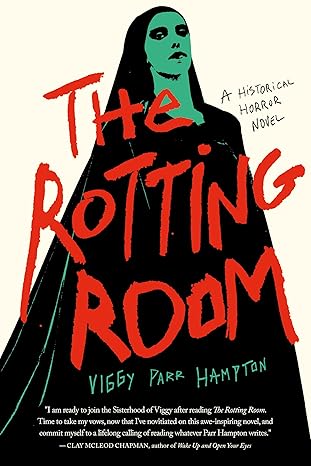
Book Review: The Rotting Room by Viggy Parr Hampton

God is not present in this place.

PLOT SUMMARY:

Sister Rafaela, a newcomer to the cloistered Sisters of Divine Innocence, yearns for redemption from her horrific past. However, her new abbey, bound by a vow of silence and a disturbing burial ritual, hides its own sinister secrets.

When a mysterious stranger arrives and dies soon after, her body resists decomposition, sparking fevered claims of sainthood among the nuns… but Rafaela suspects something far darker.

As the abbey teeters on the edge of madness, Rafaela and local priest Father Bruno race to uncover whether the Sisters of Divine Innocence are graced by a divine miracle—or consumed by unspeakable evil.

GRADE: A-

REVIEW:

This was my first time reading Viggy Parr Hampton and wasn’t sure what to expect. However, I’ve been on a historical horror kick lately and I truly enjoyed this novel. The Rotting Room is an unrelentingly bleak and atmospheric horror novel that grips the reader from the first page. The setting, an isolated convent swallowed by shadows and unspeakable secrets, seeps into every scene with suffocating dread. Hampton masterfully crafts a world where time feels suspended, and every toll of the bell or flicker of candlelight becomes a harbinger of something deeply wrong. The rot isn’t present solely in the literal rotting room, but it’s in the characters, the history, and the very air.

The novel’s sense of unease is nearly unbearable at times, but in the best way. Hampton sustains a tone of quiet terror, opting for psychological unraveling over cheap scares. As the protagonist Rafaela explores deeper into the Sisters of Divine Innocence and the newcomer Berta, the line between reality and hallucination begins to blur. The narrative plays heavily with isolation, guilt, and memory, keeping the reader on edge throughout.

If there’s a flaw, it lies in the repetition of certain scenes, but seeing that a nun’s life is very repetitive, there was no way around it. Still, this minor issue doesn’t undercut the novel’s power. The Rotting Room is a compelling, claustrophobic descent into rot and ruin that lingers long after the final page.

DID YOU ENJOY WHAT YOU JUST READ? IF YES, THEN SUBSCRIBE TO THE BLOG, GIVE THE POST A LIKE, OR LEAVE A COMMENT! NEW POSTS ARE UP EVERY TUESDAY & THURSDAY!

Book Review: Finding Grace by Loretta Rothschild

SHE THOUGHT IT WAS FATE. I KNEW IT WASN’T….

PLOT SUMMARY:

Honor seems to have everything: she adores her bright and beautiful daughter, Chloe, and her charming, handsome husband, Tom, even if he works one hundred hours a week. Yet Honor’s longing for another baby threatens to eclipse all of it―until a shocking event changes their lives forever.

Years later, Tom makes a decision that ripples through their families’ lives in ways he could never have foreseen. As the consequences of that fateful choice unfold, two women’s paths become irrevocably intertwined. But when old love clashes with new, who will be left standing? And what happens when your secrets come back to haunt you?

Blending a page-turning moral dilemma with satisfying emotional poignancy, Finding Grace is a sweeping love story that explores the price of a new beginning, how the ghosts of our past shape our future, and whether redemption can be found in the wreckage of what we’ve lost.

GRADE: B-

REVIEW:

Loretta Rothschild’s debut novel opens with a gripping, almost cinematic first chapter that immediately pulls the reader into the heart of chaos. A tragic accident, a mysterious letter, and a haunting revelation promise a story charged with emotion and suspense. Rothschild demonstrates a strong command of atmosphere and intrigue in the opening pages, leaving readers eager to unravel the threads of the protagonist’s troubled past.

Unfortunately, that momentum doesn’t carry through the rest of the novel. As the chapters unfold, the story loses its intensity, gradually slipping into a meandering pace. What begins as a compelling mystery fades into a slow-moving narrative filled with underdeveloped plotlines and repetitive introspection. The characters, especially Grace herself, become increasingly difficult to connect with often making choices that feel inconsistent or frustratingly opaque. Secondary characters are similarly underwhelming, lacking depth or relatability.

While Rothschild clearly has a talent for setting the stage, Finding Grace ultimately fails to deliver on the promise of its opening. The emotional resonance and urgency of the first chapter dwindle as the book progresses, leaving a sense of disappointment. For readers who crave character-driven stories with a strong, sustained arc, this novel may not fully satisfy.

*Thank you so much to NetGalley & Macmillan Audio for the audiobook copy of this book in exchange for an honest review!

DID YOU ENJOY WHAT YOU JUST READ? IF YES, THEN SUBSCRIBE TO THE BLOG, GIVE THE POST A LIKE, OR LEAVE A COMMENT! NEW POSTS ARE UP EVERY TUESDAY & THURSDAY!

Book Review: Bless Your Heart by Lindy Ryan

Rise and shine. The Evans women have some undead to kill.

PLOT SUMMARY:

It’s 1999 in Southeast Texas and the Evans women, owners of the only funeral parlor in town, are keeping steady with…normal business. The dead die, you bury them. End of story. That’s how Ducey Evans has done it for the last eighty years, and her progeny—Lenore the experimenter and Grace, Lenore’s soft-hearted daughter, have run Evans Funeral Parlor for the last fifteen years without drama. Ever since That Godawful Mess that left two bodies in the ground and Grace raising her infant daughter Luna, alone.

But when town gossip Mina Jean Murphy’s body is brought in for a regular burial and she rises from the dead instead, it’s clear that the Strigoi—the original vampire—are back. And the Evans women are the ones who need to fight back to protect their town.

As more folks in town turn up dead and Deputy Roger Taylor begins asking way too many questions, Ducey, Lenore, Grace, and now Luna, must take up their blades and figure out who is behind the Strigoi’s return. As the saying goes, what rises up, must go back down. But as unspoken secrets and revelations spill from the past into the present, the Evans family must face that sometimes, the dead aren’t the only things you want to keep buried.

GRADE: A

REVIEW:

This was my first time reading a book from Lindy Ryan and it was absolutely fun! Bless Your Heart is an absolute gem, a Southern Gothic romp packed with horror, heart, and hilarity. At the center of it all are the Evans women, who are nothing short of a delight. They’re sharp-tongued, fiercely loyal, and totally unapologetic about their witchy ways. But it’s Great-Grandmother Ducey who absolutely steals the show. She’s tough as nails, wise in that wonderfully unfiltered elder way, and has more sass in her pinky finger than most people have in their whole body. Honestly, I’d read a whole spinoff just about her.

The story mixes scares and snark effortlessly. One minute you’re shivering from a ghoul attack, the next you’re laughing out loud at a perfectly timed one-liner or sarcastic spell. Speaking of ghouls, Ryan gives them a fresh twist that feels original and creepy in all the best ways. They’re not your garden-variety undead; there’s a lore here that’s genuinely cool and elevates the horror.

What makes this book really work is the sense of family and love that grounds all the supernatural chaos. The Evans women might fight monsters, but they do it together—and with style. It’s spooky, it’s funny, and it’s got heart. Highly recommend, especially for fans of Grady Hendrix.

I strongly recommend diving into this one as an audiobook—the narrator doesn’t just read the story, she brings it to life. Every character leaps off the page (or speaker), from Ducey’s razor-sharp wit to the eerie growl of the ghouls. It’s an electrifying performance that pulls you straight into the heart of the chaos. You won’t just listen—you’ll live it.

*Thank you so much to NetGalley & Macmillan Audio for the audiobook copy of this book in exchange for an honest review!

DID YOU ENJOY WHAT YOU JUST READ? IF YES, THEN SUBSCRIBE TO THE BLOG, GIVE THE POST A LIKE, OR LEAVE A COMMENT! NEW POSTS ARE UP EVERY TUESDAY & THURSDAY!

Summer 2025 Reading Trends: What Everyone Will Be Flipping Pages For

There’s something magical about summer reading. Whether you’re poolside with a fizzy drink, on a breezy porch swing, or curled up in a too-cold, over-air-conditioned café, a good book just hits differently in the summer.

So if you’re wondering what to read—or what everyone else will be reading—this summer, here’s your guide to the biggest reading trends of Summer 2025. Spoiler: it’s a juicy mix of cozy, thrilling, romantic, and surprisingly real.

Let’s dive in 📚☀️

1. Romantasy Is Still Ruling Our Hearts (and Bookshelves)

If you thought the romantasy wave (that perfect blend of romance + fantasy) was over, think again. It’s booming. Think mythical creatures, powerful heroines, forbidden love, and world-building so rich you’ll miss it when you close the book.

Books with “grumpy mage + sunshine warrior” dynamics? Obsessively bookmarked. Enemies-to-lovers across kingdoms? Can’t get enough.

Hot sub-trend: Retellings of classic myths and fairy tales with a romantic twist.


2. Cozy Fiction & “Low-Stakes Drama” Is on the Rise

After years of high-intensity thrillers and heavy topics, readers are craving comfort. Enter: cozy fiction. Small-town settings, quirky characters, and plots where not much happens—but in the best way.

Think:

  • A recently divorced baker finding herself (and maybe a handsome florist).
  • A bookshop by the sea with a mysterious owner and a slow-burn romance.
  • A 70-year-old woman solving crimes with her cat and a cup of tea.

It’s feel-good, no-pressure, “just one more chapter” reading.


3. Nonfiction That Reads Like Fiction

This summer, readers want to learn and be entertained. Cue the rise of narrative nonfiction—true stories told in a way that reads like a page-turner.

Top picks:

  • Personal memoirs with humor, honesty, and heart (think: modern Nora Ephron vibes).
  • True crime, but with thoughtful reflection rather than shock value.
  • Science, psychology, and history books that explain the world in bite-size brilliance.

4. Global Voices & Translated Lit Are Taking Center Stage

Readers are expanding their horizons—literally. More people are reaching for translated fiction, stories from underrepresented cultures, and non-Western narratives. Expect to see buzz around books originally written in Korean, Spanish, and Arabic, along with Indigenous authors finally getting their spotlight.

It’s the summer of fresh perspectives—and it’s long overdue.


5. Books That Feel Like TikToks (in a good way)

Short chapters. Snappy pacing. Messy but lovable main characters. Welcome to the age of internet-influenced fiction.

These are the books that go viral for a reason:

  • Fast, funny, relatable.
  • Perfect for short attention spans.
  • Full of emotional moments you will highlight and post about.

And yes, they still hit you in the feels.


6. AI, Time Travel & “Almost Sci-Fi” Are Heating Up

Summer 2025’s wildcard genre? Speculative fiction that feels just one step ahead of reality.

Stories about near-future tech, AI gone rogue (or falling in love?!), climate-adapted societies, and time travel with emotional consequences are everywhere—and surprisingly addictive.

If you love Black Mirror, The Midnight Library, or anything that makes you go “wait… could this actually happen?”—this is your summer genre.


Lastly, Read What Feels Good

Whether you’re team fantasy, nonfiction nerd, or a sucker for soft romances, this summer is all about finding your comfort read. There’s no pressure to be “caught up” or reading what everyone else is. But if you are curious what’s trending—these are the titles and vibes making waves.

So, grab your sunglasses, a blanket, and maybe an iced latte. Summer 2025 is stacked with stories just waiting for you to crack them open.

DID YOU ENJOY WHAT YOU JUST READ? IF YES, THEN SUBSCRIBE TO THE BLOG, GIVE THE POST A LIKE, OR LEAVE A COMMENT! NEW POSTS ARE UP EVERY TUESDAY & THURSDAY!
Book Review: House of Beth by Kerry Cullen

Haunted by the past, she finds the ghost is real.

PLOT SUMMARY:

After a heart-wrenching breakup with her girlfriend and a shocking incident at her job, Cassie flees her life as an overworked assistant in New York for her hometown in New Jersey, along the Delaware. There, she reconnects with her high school best friend, Eli, now a widowed father of two. Their bond reignites, and within a few short months, Cassie is married to Eli, living in his house in the woods, homeschooling the kids, and getting to know her reserved neighbor, Joan.

But Cassie’s fresh start is less idyllic than she’d hoped. She grapples with harm OCD, her mind haunted by gory, graphic images. And she’s afraid that she’ll never measure up to Eli’s late spouse, who was a committed homemaker and traditional wife. No matter what Cassie does, Beth’s shadow still permeates every corner of their home.

Soon, Cassie starts hearing a voice narrating the house’s secrets. As she listens, the voice grows stronger, guiding Cassie down a path to uncover the truth about Beth’s untimely death.

GRADE: B-

REVIEW:

Kerry Cullen’s House of Beth offers a fresh and compelling twist on the ghost story genre, blending elements of gothic mystery with psychological depth. The novel follows Cassie Jackson, a bisexual woman grappling with obsessive-compulsive disorder, who returns to her New Jersey hometown after a traumatic event in New York. There, she reconnects with her high school best friend, Eli, now a widowed father of two. As their relationship deepens, Cassie becomes entangled in the lingering presence of Eli’s late wife, Beth, whose ghost seems to haunt their home and Cassie’s psyche.

Cullen’s portrayal of Cassie’s internal struggles is poignant and evocative, capturing the complexities of identity, grief, and the search for belonging. The narrative’s dual perspectives—Cassie’s and Beth’s—add layers of intrigue and ambiguity, blurring the lines between reality and the supernatural. The atmospheric setting and the gradual revelation of Beth’s story create a hauntingly immersive experience.

However, as the novel progresses, some readers may find the plot’s developments increasingly implausible and disjointed. The introduction of late-stage twists can feel abrupt, detracting from the story’s earlier emotional resonance. Despite these narrative shifts, House of Beth remains a thought-provoking exploration of the boundaries between the living and the dead, and the stories we inherit and create.

*Thank you so much to NetGalley & Simon & Schuster for a digital copy of this book in exchange for an honest review!

DID YOU ENJOY WHAT YOU JUST READ? IF YES, THEN SUBSCRIBE TO THE BLOG, GIVE THE POST A LIKE, OR LEAVE A COMMENT! NEW POSTS ARE UP EVERY TUESDAY & THURSDAY!
Book Review: The Butcher’s Daughter: The Hitherto Untold Story of Mrs. Lovett by David Demchuk and Corinne Leigh Clark


“They only ever remember the barber. Never the woman who cleaned up after him.”

PLOT SUMMARY:

London, 1887: At the abandoned apartment of a missing young woman, a dossier of evidence is collected, ordered chronologically, and sent to the Chief Inspector of the London Metropolitan Police. It contains a frightening correspondence between an inquisitive journalist, Miss Emily Gibson, and the woman Gibson thinks may be the infamous Mrs. Lovett—Sweeney Todd’s accomplice, “a wicked woman” who baked men into pies and sold them in her pie shop on Fleet Street. The talk of London Town—even decades after her horrendous misdeeds.

As the woman relays the harrowing account of her life in the unruly and perilous streets of Victorian London, her missives unlock an intricate mystery that brings Miss Gibson closer to the truth, even as that truth may cost her everything. A hair-raising and breathtaking novel for fans of Sarah Waters and Gregory Maguire, The Butcher’s Daughter is an irresistible literary thriller that draws richly from historical sources and shines new light on the woman behind the counter of the most disreputable pie shop ever known.

GRADE: A

REVIEW:

The Butcher’s Daughter: The Hitherto Untold Story of Mrs. Lovett is a darkly enthralling reimagining of a familiar tale, breathing vivid life into the shadowy corners of Victorian London through the eyes of a woman long dismissed as a footnote in the Sweeney Todd legend. The authors craft a richly layered portrait of Mrs. Lovett—not just as a pie-maker with a macabre secret, but as a deeply human, complex figure shaped by hardship, ambition, and survival.

The novel is gripping from the first page, blending historical fiction with gothic suspense in a voice that is both lyrical and razor-sharp. Lasley deftly explores the power dynamics of class, gender, and violence, allowing readers to sympathize with Lovett without excusing her choices. The pacing is impeccable, and the atmosphere—fog-laced alleys, greasy kitchens, and shadowed cellars—is as immersive as it is haunting.

What makes this book so engaging is its ability to transform a well-known villain into a compelling protagonist whose story demands to be heard. The Butcher’s Daughter is as deliciously dark as one of Mrs. Lovett’s infamous pies—and just as impossible to resist. A must-read for fans of historical fiction with a gothic twist.

I experienced this as an audiobook and truly recommend checking it out in this format as it made the story and characters come to life, all the narrators were very brilliant.

*Thank you so much to NetGalley & Hell’s Hundred for the audiobook copy of this book in exchange for an honest review!

DID YOU ENJOY WHAT YOU JUST READ? IF YES, THEN SUBSCRIBE TO THE BLOG, GIVE THE POST A LIKE, OR LEAVE A COMMENT! NEW POSTS ARE UP EVERY TUESDAY & THURSDAY!

Book Review: Incidents Around the House by Josh Malerman

When one thing leaves your house or heart, it makes room for another to take its place. This is why it’s unwise to make solid statues inside. A statue takes up space without moving, without flowing, without growing.

PLOT SUMMARY:

To eight-year-old Bela, her family is her world. There’s Mommy, Daddo, and Grandma Ruth. But there is also Other Mommy, a malevolent entity who asks her every day: “Can I go inside your heart?”

When horrifying incidents around the house signal that Other Mommy is growing tired of asking Bela the question over and over, Bela understands that unless she says yes, her family will soon pay.

Other Mommy is getting restless, stronger, bolder. Only the bonds of family can keep Bela safe, but other incidents show cracks in her parents’ marriage. The safety Bela relies on is about to unravel.

But Other Mommy needs an answer.

GRADE: B-

REVIEW:

Incidents Around the House by Josh Malerman is a chilling novel that delivers a claustrophobic, psychological horror grounded in the mundane. Told from the perspective of young Bela, the story captures the eerie atmosphere of a home slowly being overtaken by an unseen presence. The “creepy entity” that Bela sees—and her parents do not—lurks at the edges of their house, at first ambiguous and unsettling, then increasingly menacing. Malerman plays expertly with perspective, making readers question what is real and what is imagined.

The novel excels in tone and mood. The tension is slow-building, and the child’s voice is authentically rendered, adding a layer of vulnerability. The idea of a malevolent figure quietly “moving in” is deeply unnerving, made worse by the adults’ dismissal of Bela’s warnings.

However, while the setup is gripping, the middle portion becomes repetitive. The narrative relies on similar beats—Bela sees the entity, her parents so see the entity and continue trying to escape it—which dilutes the suspense over time. The lack of escalation or variety in how the threat manifests causes the tension to plateau before the conclusion. Still, Incidents Around the House is a creepy, well-written tale, just one that might have benefitted from tighter pacing or a bit more narrative progression.

*Thank you so much to NetGalley & Del Rey for a digital copy of this book in exchange for an honest review!

DID YOU ENJOY WHAT YOU JUST READ? IF YES, THEN SUBSCRIBE TO THE BLOG, GIVE THE POST A LIKE, OR LEAVE A COMMENT! NEW POSTS ARE UP EVERY TUESDAY & THURSDAY!

Out Now: Panico! Marie Antoinette’s Journey During the Reign of Terror by Azzurra Nox

The dream is dead.

And all that’s left is the nightmare.

Step into the heart of revolutionary France with Panico! Marie Antoinette’s Journey During the Reign of Terror—a gripping, gothic reimagining of the doomed queen’s final days. Blending historical horror with psychological suspense, the poetry collection paints a haunting portrait of Marie Antoinette as she navigates betrayal, fear, and the crumbling world around her. With lush prose and chilling atmosphere, this poetry collection explores the blurred lines between reality and madness as the guillotine looms ever closer. Perfect for fans of eerie historical fiction, Panico! is a visceral descent into the mind of a queen on the edge of history—and sanity.

Purchase your copy of the book HERE!

DID YOU ENJOY WHAT YOU JUST READ? IF YES, THEN SUBSCRIBE TO THE BLOG, GIVE THE POST A LIKE, OR LEAVE A COMMENT! NEW POSTS ARE UP EVERY TUESDAY & THURSDAY!

Excerpt: A Campus on Fire by Patrick O’Dawd

1

Tess Azar’s notes on Rose Dearborn:

Tall. Sharp green eyes. A small, pointed nose. Pale. Red hair, worn down, falls just below her shoulders, framing her compact face. Her posture is pristine, and she appears to be flexing, though that may be her natural state. Her hands are folded, left over right. She sports an unblemished French manicure and light pink lipstick that you’d never notice unless you were looking for it. She has two earrings on her left ear, both in the lobe, and one on her right. They’re all diamonds, and I’m sure they’re real. She wears a light blue Oxford shirt. It looks like it was designed for her frame—towering and athletic, without succumbing to bulk. Over the shirt, she wears a light jacket, tan and slim fitted, with bronze buttons. It looks like it was born to be a man’s jacket but changed its mind when it met her.

She had me from the start. It was her wave. It showed the world she came from, the sophistication, the poise, the casual superiority. It was a wave that had been passed down, refined, choreographed. A stiff hand, a pirouette, a fold. It was elegant in its learned simplicity.

She paired it with a vacant, performative smile. It wasn’t for me. It was for the watchers. It told the world that she wasn’t, despite appearances, one of those people. She was, in fact, a normal person, perhaps even a kind one.

I nodded my acknowledgment and matched her smile. Mine was professional, a journalist’s smile, continuing the performance we were engaged in.

We were meeting at an outdoor café on campus. One of those places where students bring their laptops and pretend to work. It’s not a place to work, not true work. It’s a place to be seen to be working.

 She stood as I sat, a prosaic gesture that nonetheless endeared her to me.

I felt the cool spring breeze and heard birds singing in a tree nearby. A woman shouted in the distance, and I didn’t even turn to look. I assumed it was playful. I used to be able to assume that.

“Tess,” she said, not a question but a statement of fact. “And you’re Rose?”

“Yes.” She smiled and took a sip of her coffee. She placed it down, and I noticed it was uncovered, no lid in sight.

I looked at my own cup, a lipstick-stained plastic lid of shame sitting atop it. I felt her eyes on it, felt the judgment. I shouldn’t have had a lid. I should’ve told them I didn’t want one. Lids were plastic, single-use plastic. They were death. They were climate change. They were a stain upon you as a person.

I tore it off, and the steam burned my hand. I didn’t flinch, too afraid it would be another strike against me. Rose looked like the type of person who never flinched, who never got sick or hurt. She looked like she went to the cape on the weekends and played tackle football with her brothers and more than held her own.

I pulled out my notebook, almost knocking over my coffee as I did so. The cup rattled, but I grabbed it before it tipped and smiled an apology. I opened to a fresh page, and, as I always did when beginning an interview, I took down a description.

“Are you writing a novel?” Her voice was cold and clipped, formal and challenging.

I blushed, and my skin turned a few shades darker. I’m sure she noticed. Rose looked like she never blushed. Or at least never out of embarrassment. I imagined she did on occasion, but with a purpose.

I hid in my notebook. “No, I, uh, well…”

I hated myself. It was odd for me. I wasn’t like that. I wasn’t a stammering, stumbling fool. I wasn’t often awed. I was the one in a relationship who was distant. I was the one who was unaffected by the end of the affair, the one who needed to be wooed.

But there was something about her, an aura, a magic. Some- thing that changed me, disrupted me. I both hated and loved it. Longed to be free of this pull and to never leave it. One could chalk it up to the difference in age—Rose was twenty-one to my nineteen, but it was more than that. She had something. Something I wanted.

I twirled my pen around a finger and clicked it. It was a nervous habit, one that would take years to tame. Rose watched, a cryptic smile in her eyes. I placed my phone on the table and set it to record. “Do you mind?”

She shook her head, but I could feel her quiet disapproval. “I just like to get the setting down,” I said and motioned to

my notebook. I calmed myself by sipping the spring air, a slight scent of grass being cut somewhere in the distance. ““I was taught that if you have the time, you should overwrite, even in journalism. Easier to cut later. ‘Never trust your memory’ is what my professor says.”

This wasn’t true. My professors would be appalled by my long, florid notes. They advocated direct, blunt ones. But I wasn’t writing for them. Not anymore. I’d already developed my own strategies, my own style, and my notes were part of that.

She met my eyes, an intrigued look cresting across her face. I’ll never forget that look and the feeling that accompanied it, tracing up my spine and nesting in my skull. I felt my embarrassment disappear. I remembered who I was. I remembered that I was someone, and she knew it.

“Well.” She drank her coffee. I followed her lead. Mine was still too hot, and it scalded my throat. “I guess whatever you’re doing, it’s working.”

And there it was. The reason she’d come. It was a hint, a slight lead, but we both knew where she was taking the conversation. I may have my objective, my questions, my story, but she didn’t care. She wanted to discuss it. She met me so she could discuss it.

“I still have a lot to learn —”

“But to have an article receive national attention as a sophomore.” She cut me off with the ease of someone used to doing it. “My guess is it won’t be long before the job offers start coming.”

They already had, but she didn’t need to know that. Not yet. You need to save things. You need to build a relationship with patient precision if you want it to last.

I nodded and went back to my notebook. I should’ve steered the conversation, transitioned from my success to the work- shop. But I couldn’t, I wanted to press on, I wanted to talk more about my article. I wanted to astonish her and luxuriate in that astonishment.

That’s all it took. A little acclaim, a little attention, and, as I’m sure she’d planned, I’d forgotten my questions, my story.

“Now.” She unstacked her hands and moved one toward mine. “I’m not a journalist, just a fiction writer, but I felt your piece transcended the subject and demonstrated an uncanny ability to be informative, engaging, and unique. I couldn’t put it down, and more to the point, I found myself rereading it even after knowing the story, which I feel is a true test of great writing. Your work doesn’t read like journalism. It reads like fiction, good fiction.”

I felt the familiar warmth of praise pulse through me.

Her assessment was pretentious and vapid, it said nothing. It raised my own work by comparing it to the vaunted heights of fiction and, in doing so, denigrated journalism, but I didn’t care. “Thank you.” I tried to temper my grin. “I appreciate that.

It was a good article, and I was pleased with the exposure it received. That’s an important issue that I think will continue to pervade our society.”

I was trying to match her. Her intellectual snobbery, her placid distance, her broad generalities.

“So.” She leaned forward, and I found my eye tracing down to the opening of her shirt. I caught a glimpse of lace and looked away, landing on her forearm. It was exposed, and

 I could just make out a pale purple bruise. She noticed and dropped her arm beneath the table. “I have to ask. How did you get the interview? How did you get him to agree to that? To say all that?”

I nodded and leaned back. This was what they always asked. This was what made the article. This was why it garnered national attention, why everyone was talking about it, why I was someone.

Hearing her ask the same, tired question settled me.

I ran a finger along the seam of my pants and looked around, debating whether to do it, whether to take the leap. I felt the brief flutter of nervous excitement that we all come to know at some point.

I paused and felt my heart rattle. It felt wrong. She should be the one to ask me out, not the other way. I didn’t even know if she was gay. But somehow, I did. I could tell. I could feel an opening. This was my chance. She was curious, everyone was. I had a story, I had cache, I was someone, if only for a moment. So, I leapt. “How about this? You have dinner with me tomorrow night, and I’ll tell you how I got the interview. Deal?”

The question hung in the air as it always does, time elongating—heavy and thick with anxiety but exhilarating. All the world is packed into that pause between the question and the answer.

“What, like a date?” She tilted her head, a smile leaking out of the side of her mouth, a slight hue dampening her cheeks.

I nodded.

Someone shouted at a table not far from us, and chairs scraped against the ground.

“All right,” she said, her smile spreading. “Deal.”

And just like that, the anxiety exploded into a million shards of light. I was ebullient. I was phosphorescent. I was invincible. After that, I tried to stay present, tried to listen to what she said, to not think about the future that was already being crafted

in my mind.

But it was no use, I was gone. My mind was adrift. There were winters skiing and summers sailing. There were literary arguments and good coffee. There was an initial frigid period with her family. A tense scene with her grandfather where he reverted to his old prejudices, dismissing the whole of me based on the half that was Lebanese, but I won him over by talking history and baseball. I became one of them. And later, there were galas and houses full of antiques and rich wood.

“I guess you’re not here to talk about your article, are you?” She shifted back. “You’re here to talk about Jack.” Her face fell, her hands fidgeted in her lap. The color left her cheeks. The radiance of our previous conversation still lingered, but it was just a residual taste. We’d moved on.

I nodded but said nothing. Being a journalist is a lot like being a therapist. You need to draw them out. You need to make them comfortable and then let them talk.

“Terrible, just horrible.” She looked like a different person, like an actor trying to play Rose in a marginal play. “Such a waste.”

I let the silence linger, hoping she’d continue. When she didn’t, I eased into it. “Did you know him well?”

She nodded, and took her forefinger and thumb and pinched the bridge of her nose as if that could stop the tears and the pain. “Yes, of course. We all… I mean, you know about it, right? About the workshop? Dr. Lobo?”

I did. Everyone knew about the workshop. It was a creative writing group on campus, not an official workshop, whatever that means, just a group of students whom an acclaimed professor had taken an interest in.

Dr. Lobo’s workshop. Sylvia’s kids. The Creative Writing Cult.

Sylvia Lobo’s second novel, A Wake of Vultures, was an instant classic. She was teaching here as an associate professor when she wrote it, and after its publication, she became an instant celebrity. Now she teaches creative writing and gives few lectures. I took one during my first semester. Someone had dropped right when I was registering, otherwise, I’d have never

gotten in. It was on the erosion of the past in literature. Novels set during times of change with characters who are stuck in the past and grappling with the future. It was an eighty-person class, and I don’t think I said more than three words all year.

“Yeah,” I said. “I know about Dr. Lobo.”

“Have you read any of her work?” The energy that had left us returned.

“I’ve read A Wake of Vultures and Jezebel.”

Rose tried to hide her excitement and nodded to herself. I could tell I’d passed a test. “I’ll give you Chariot Races and Bubblegum. If you like those, we can go from there. If not…”

More tests. But that was all right. For her, I would take them.

“You’re all very close, right?”

“Yes, Sylvia’s big on that. We’re all working toward the same goals and have the same interests, and it’s essential that we spend time together. She says it makes for better writing. Look at Paris in the twenties. Do you think it was an accident so many great writers were there at the same time?”

I took my time and wrote this down verbatim. It sounded rehearsed.

“Some people even…” She laughed. “…say we’re a bit of a cult.”

Her laughter stopped, and I made sure not to smile. This wasn’t a joke. This was a repudiation of a nasty piece of gossip. I’d have to be careful with that. I’d have to watch that I never hinted at the cultish atmosphere of the workshop.

People had good reason to call them a cult. They took all the same classes, not just Sylvia’s, but everything—history, science, even phys ed. They got coffee together at the same time every day. The same table, the same café, the same black coffee, the same far-off look while they drank. They ate lunch together. They ate the same things for lunch. They ate with purpose. Refined but rapid. They walked the same, hurried steps announcing their presence, clearing a path. They talked the same. The same talking points, the same articles referenced, the same political issues discussed, same positions held with fervor. They used the same words. They spoke at the same frantic pace. Their hands moved with their every word, painting a mute portrait of their argument. They used the same pens, same notebooks, read the same books, watched the same movies, chewed the same gum, smoked the same colorful French cigarettes, not because they were addicted, but because it stoked conversation and helped with the writing process.

They were the same. They were like her.

That was how she drank her coffee, how she ate, how she walked, how she spoke, how she thought.

They idolized her. They forced her works into their conversations. They cited her. Not just her published comments and writing but personal ones from conversations they’d had with her. They attributed immense weight to these citations as if mentioning her name ended all debate. If Sylvia said it, it wasn’t to be questioned. It was fact.

The cultish atmosphere of the program was why I decided to write the story. Why I was sitting there, interviewing Rose. Jack’s suicide was a part, but not the whole. I hoped to expand it, turn it into a piece on Sylvia and the workshop. Get a glimpse behind the curtain. See what was fact and what was fiction.

Rose stared at me after the cult comment. Judging me, reading my reaction. I met her stare and held it. “Well, these days, I think gossip is the sincerest form of flattery. As for Jack, I’m sorry for your loss.”

She nodded and raised a hand to her chest. “Yes, he was, well, very talented. We came in together, same class. We were both in her freshman seminar on literature’s obsession with the past.”

“I took that class.”

“Really? Not the same one though? I’m sure I’d have noticed you.”

“No, you wouldn’t have. But it must’ve been a different year,

you’re what, a senior?”

 “She teaches it every other year. You’re fortunate you got in.”

“I could say the same to you,” I said, unable to avoid the

opening to flirt.

“Hah.” She rolled her head back. She didn’t laugh. She said, hah. Spat it. “No, I sent her my writing from high school, two awful short stories about— Oh god, I don’t even want to say… one was about my high school friends and a teacher of ours, and the other was about a ski instructor. They were dreadful, but she saw something in them, something in me.”

She looked over at the sprouting trees that lined the walk, feigning to hide her satisfied smile. “She reads the work applicants send in, as do her current students, and selections are made. If she picks you, you’re assured a spot in her freshman seminar and the creative writing major and some other class- es. See, where most creative writing programs don’t really get serious until graduate school, she starts right away. Freshmen year. She believes that you need to get to a writer early, before they learn those bad habits and become just a poor imitation of some famous writer. She wants you raw, unadulterated, malleable.”

“I thought you said she teaches that seminar every other year?”

She shook her head as if I was a mistaken child. “Oh no, just that one class on literature and the past. She teaches that in even years. She teaches a different one on female writers and the diaspora in odd years.”

I nodded and smiled and waited.

She rubbed the bruise on her arm, caught herself, and dropped her hands, resuming her practiced pose of mourning. “Yes, I was close to Jack. We were in all the same classes. I was his shadow, as we called it. Like a peer editor, you read everything they write. He was my shadow too. Sylvia thought our work complemented one another’s. He was a genius, and I don’t use that word lightly. It’s a true tragedy. Not just for him and those of us who knew him but for the world. The world lost a great writer.” Another tear, she lifted a napkin to stop it. “I edited his book. The one that we—Sylvia and I—are helping to finish. You know about that, right?”

“Yeah.”

“Sylvia worked to get it published, not that it was all that difficult, it’s a brilliant novel. But she took it on. She wanted to… She knew it was what he would’ve wanted. And now, at least, that part of him will live on. A tribute of sorts.”

“I hear the money’s going to charity?”

“A suicide prevention charity. And some will go to the creative writing program here as well, help to make it official, and I think some is going other places, but I don’t have the details on that.”

“Any to his family?”

“He didn’t have family. An uncle upstate somewhere, whom he grew up with, but they weren’t close, and I think he passed away. His parents weren’t in the picture.”

“Anyone else you think I should talk to?” I was afraid to push too hard too soon. You can always come back with more questions. You can always have a second interview, provided, of course, you remain on good terms.

“People in the workshop. I can give you some names. Intro- duce you.”

“That’d be great.” I looked down at my notebook, pretending to scan it, knowing what I needed to ask. “Look, Rose, I’m sorry to ask this, but I have to. Do you have any idea why he would’ve done this? I heard he didn’t leave a note.”

A writer not leaving a note. Seemed off.

She shook her head and forced another tear. “He was”— she ran a fingernail around the rim of her now-empty coffee cup—“troubled, like many writers are. It’s true what they say, ‘genius and madness flow from the same source.’ Good work often comes from pain, and I think, not to be unkind, but I think some can court it. Wallow in it. Again, I don’t mean to… I loved Jack, and it’s a tragedy what happened, but he lived in that pain. It’s what his work was about. He’d go into it and be down there and write, and after he finished, he’d come back up. He’d live in joy for a bit. But this time, with the novel, he was down there too long. He couldn’t surface.”

This, too, felt rehearsed. Maybe not quite scripted but planned. She knew I’d ask about it, and she was ready. There’s nothing wrong with that. Meeting with a journalist is stressful, and people like to be prepared.

But still, it felt off.

“Well,” I said, “I think that’s all I’ve got for today. I might have some follow-ups, but I’m sure you’re busy.”

“Yes, I have to decide what I’m wearing for our date.” I blushed and withdrew to my notes.

“I hope we won’t have to muddy that up with this?” she said. “No, I wouldn’t think so.”

We both stood, and I stared at her, straining my eyes, as she retreated into the falling sun.


Excerpted from A CAMPUS ON FIRE by Patrick O’Dowd © 2025 by Patrick O’Dowd, used with permission by Regal House Publishing.

DID YOU ENJOY WHAT YOU JUST READ? IF YES, THEN SUBSCRIBE TO THE BLOG, GIVE THE POST A LIKE, OR LEAVE A COMMENT! NEW POSTS ARE UP EVERY TUESDAY & THURSDAY!