Short Story: Please Serve Cold by Rachel Bolton

She was what you’d call a handsome woman. Particular. Elegant. Grace was not the type to leave her house unbeautified. Hair forever coiffed in the style she’d had for the past thirty years. Timeless flattering suit skirts. A brooch pinned over her heart. Her mother taught her that once one finds a complimentary style, one must stick with it. She did not even own a pair of jeans. Slacks were to be worn under specific circumstances only. Grace thought of herself as enduring. Others saw her as tacky. But a woman approaching her seventies could not please everyone.

“This is such a lovely party, isn’t it, Henry?” She said to her husband. “Elizabeth’s a good hostess.”

Henry’s eldest daughter was in charge of Thanksgiving this year. They had been told not to bring anything. Simply to come and enjoy the food.

“Hmm,” Henry grunted and nodded. Grace refolded her hands in her lap, adjusting the sapphire of her engagement ring so it was in the middle of her finger. Her husband had not been particularly verbose that evening. Grace put it off as being uncomfortable after overeating. Then again, this was the first Thanksgiving after Marie’s death.

The party had moved from Elizabeth’s modest dining room and into the more spacious den. Grace was not fond of the color scheme. When Elizabeth and her husband, Joel, had moved in, Grace put together a binder of suggestions and gifted it to her stepdaughter. Elizabeth thanked her, but the advice was never used.

The house was crowded with over twenty people in attendance. Almost half were conveniently children. Grace liked children, and there was the old reoccurring sorrow she’d never had any of her own. Grace was not a woman to make a fuss. She’d married her first husband, William, right after college. No children followed, only William dropping dead from a heart attack at thirty-two.

A teen girl sat next to Grace, joining her in the quieter end of the room. Grace didn’t know her name, but from her hair and the shape of her jawline, she assumed she was one of Marie’s relatives. The girl started to eat Italian cookies from her plate.

“Did you enjoy the food?” asked Grace. She was making conversation. Sitting in silence wasn’t polite. She’d been raised to have manners.

Unlike the girl, who answered through a mouth full of crumbs. Grace thought about telling her how unladylike that was. But no one else had come over to talk with Grace. One must take one’s company as one can.

Henry’s son Ricky was speaking to his father. Grace believed parents should not have favorites, but as a stepmother she was allowed to. Ricky had been ten when Grace married Henry, young enough that she’d hoped he would’ve formed a son-like attachment to her. Such a sweet boy. She remembered the hand drawn Mother’s Day he’d given her, her first ever. I love you Aunt Grace. From Ricky. All the children called her Aunt Grace. The title had been Marie’s idea.

Grace brought up other topics with the girl, her travels, what did she plan for school. The girl answered her questions yet did not ask Grace any in return. She was not a woman who eavesdropped, but Grace tried to listen to what Henry and Ricky were talking about. She heard the name of a man Henry had worked with for years.

“Henry, did you say that Jack’s going to Florida?” Grace stretched her neck towards the conversation. Not to be intrusive or grotesque, to show she was really listening.

Henry raised a finger towards Grace. A request for silence. Ricky, her dear one, kept his face towards his father.

* * *

Grace walked to the kitchen. She had yet to talk to Elizabeth, to thank her for working so hard on dinner. Marie had always cooked Thanksgiving. From the turkey down to the famous strawberry cream cake. The cake’s absence was noticeable on the dessert table. No one had wanted to bake it, not without Marie’s hands to do so. Elizabeth had been good to step up. She’d been so close to her mother… Grace would offer to help wash the dishes. Protect her hands with the yellow rubber gloves and scrub, scrub, scrub.

Elizabeth was having an intense conversation with an older woman as they cleaned. With a jolt, Grace recognized it was Marie’s sister, Adaline. Grace hadn’t noticed her at the table. Why did Grace find her appearance so jarring? They’d never spoken a word to each other in twenty-five years. She didn’t matter. But Adaline knew things about Grace. She was Marie’s sister, her confidant. A woman who would know more about Grace than she ever would in return.

Grace was not a woman to dwell on the past. She cleared her throat.

“Do you need help with the dishes?”

Adaline glanced in Grace’s direction. Elizabeth kept washing.

“… she didn’t approve of the idea. But the plan was how we got through it,” said Elizabeth. The plate clinked into the drying rack.

Her aunt rubbed Elizabeth’s arm. “You have to do what you need to do.”

“Elizabeth,” said Grace. “The casserole was delicious.”

Elizabeth sprayed the sink.

“Is there anything I can help you with?” added Grace. She rolled her rings with a manicured nail.

“I think we’re all set,” said Adaline, the first time she’d spoken directly to Grace.

Elizabeth dried her hands. “Thanks for everything, Aunt Addie.”

* * *

This Thanksgiving had been an unusual one, Grace remarked as such to her husband on the drive home.

“Thanksgiving was Marie’s holiday,” said Henry.

It was true. Five months after she married Henry, Grace had Thanksgiving at Marie’s new house. Unusual, yes, to dine with your husband’s first wife. To have her serve you mashed potatoes. To eat together at the same table. Henry and Marie had wanted to be the divorced couple who stayed friends for their children’s sakes. Marie had even been the one to make Grace and Henry’s wedding go smoothly.

Grace knew she was lucky. Marie signed the divorce papers as soon as she could. Grace got to be a June bride for her second wedding. Henry’s child support and alimony payments were generous, perhaps a little too generous. Grace kept that opinion to herself. How would Henry have reacted if she said the checks seemed more like assuaging guilt than a kindness towards Marie?

The children were not disruptive before the ceremony. But once they were in the church… Henry was the groom, he had other responsibilities than to mind his brood. As the bride Grace was aware of everything. Harry had taken off his tie and couldn’t find it. Elizabeth, always the leader, sat quietly while her siblings misbehaved. Grace thought she and Harry should have known better. They were young adults then. Henry had found Abigail out smoking with her elder cousins in the parking lot. Jennifer whined like a much younger child that her shoes were too tight. Ricky crossed his arms and buried his chin in his chest. Grace was an understanding woman, but this was her wedding! A much nicer one than her first. Harry was his father’s best man. Her new stepdaughters, junior bridesmaids and the flower girl. And Ricky was to be the ring bearer. He had told Grace how excited he was.

Grace paced in the waiting room and picked at her veil.

“Could you please get your brothers and sisters to behave,” she had asked Elizabeth. The girls were a close little trio, and the bookending boys would follow their sisters. Grace was an only child. She had wanted a little sister once.

“I don’t think anything’s wrong,” said Elizabeth.

Someone, after all these years Grace still doesn’t know who, called Marie. She got the children into order. Marie was not dressed for church. Faded sunhat on her head. Her top showing off freckled shoulders. She still wore her apron, speckled with layers of paint. Ratty old sandals revealing her bare toes.

“I talked to the kids,” she had said. “Everything will be fine.”

Grace thanked her. She was an accommodating woman, the sort who could be friendly to her husband’s ex-wife. Harry found his tie. Elizabeth smiled. Abigail never smoked again. Jennifer’s shoes fit her properly. Ricky smiled as he carried the rings down the aisle.

Before she left, staying for the ceremony would’ve been too much, Grace watched Marie stroke Ricky’s head.

“Remember our agreement?” she had whispered to her son.

Grace thought of her wedding to Henry fondly. The ceremony marking the first moment she’d felt like a real partner to him. All the photos showed a happy new family. Besides, the only person to really dampen the day had been Grace’s father. Who before taking his daughter’s arm said he was glad her mother wasn’t here to see this.

* * *

Jennifer’s birthday was a week into December. Henry considered himself a lucky man since all his children ended up in the same area. Grace loved watching him play with his grandchildren. He would get on his hands and knees to play at their level, even if his arthritis flared up. Henry never missed a baptism, dance recital, game, or any chance to spend one on one time with them. He was the best Grampy. Like her stepchildren, the grandchildren called her Aunt Grace. She had hoped for a grandmotherly nickname when the first was born, but why change what has been perfectly fine for a decade at that point?

The party for Jennifer was small. Just parents, siblings, and in-laws. She and her husband had recently welcomed a surprise second child. Little Matthew was not quite four months. When the pregnancy was announced, Grace had shared her concern about Jennifer’s age. Would the child be healthy?

Jennifer scoffed. “I’m thirty-seven not forty-two.”

Everyone laughed. Forty-two. Grace had been at that age when she married Henry. Possible motherhood was fading away, but not completely gone then. There were a few hopeful weeks, then a return to regular monthly disappointment ‘til menopause. Jennifer just picked a random age. Grace’s stepdaughter had not meant the barb. She knew it in her heart.

Grandchildren were everywhere. The elder ones gathered around Henry, asking him for advice. They really listened to him, their eyes revealing only true interest. No pacifying an old man. Henry was so wise. Grace had been drawn to that from the start. The younger children ran wild, playing games Grace found indecipherable.

She was surrounded by familiar faces. Some she had been around for a quarter century. Harry. Elizabeth. Abigail. Jennifer. Their spouses. But where was Ricky? Grace decided to ask around.

She went to Harry first. Ricky followed him around like a puppy. Don’t all little boys worship their big brothers? Harry was tall, taller than his father. Grace needed to look up to speak to him.

“Harry, where’s your brother?”

Harry didn’t answer. “Cassie, don’t put that in your mouth!” He swooped down to pop a crayon away from his niece.

* * *

Abigail was pouring drinks at the minibar. Of the girls, Grace believed she was closest to her middle stepdaughter. Grace gave Abigail some practical lessons before she went off to college. It was unfortunate, but she was the plainest of her sisters. Her body was shaped with emphasis on the wrong parts. Grace had taken her shopping for graduation. Bought her clothes to flatter what she had.

“Learn to do your hair and face right, dear, and your figure won’t matter,” Grace had said at the tea house afterwards.

Abigail did wear the clothes. Grace had seen photos as proof. Yet not when she was around. And years later, she found the blouses and skirts in a pile for donation.

A cocktail shaker was between Abigail’s large hands. Grace wanted to give her rings, more than a wedding band, to make them daintier.

“I thought Ricky was coming to the party,” said Grace.

“Hey Dad,” said Abigail, as she poured into a stemmed glass. “I’ve got your martini.”

Grace wanted to tap Abigail on the shoulder, to make sure she had heard her. Grace had been raised to think that was impolite. Crass people touched each other to make a point. Instead, Grace waited patiently for Abigail to attend to her.

That moment never came.

* * *

Malcolm, Jennifers’s husband, brought Grace a cup of tea. He told her that Ricky was unable to attend his sister’s party due to work. He could not stay long to chat. He needed to change his baby’s diaper.

Grace was not a woman to mope. What was the point? Life changed whether you wanted it to or not. Her mother always said that regrets were a poison. Regret was not what bothered Grace, absence did. She thought through the haze of Marie’s final days and funeral. Grace did speak to her stepchildren, told them how she had lost her own mother, at a far younger age than all of them.

Jennifer announced she needed to go upstairs and let the baby nurse. Her older sisters guided her on each side. Sister-in-law Becky too. Malcolm’s mother was invited as well. Protectors and escorts. These women retreated into a collective privacy, as old and essential as Eve herself. One that Grace wasn’t invited to share.

Grace wouldn’t have gone. Not to feel the remnant envy of motherhood. Just to be asked would’ve been nice.

* * *

Before dessert, before Abigail brought out a shallow imitation of her mother’s strawberry cream cake, Grace had tried to spend time with the younger grandchildren. She would learn about their games, what television shows they watched, she wanted to be someone they loved.

She ended up overhearing Elizabeth’s daughter and Harry’s youngest son talking about her.

“She’s not really our aunt,” said Kaitlyn. She was exactly like her mother. An authority on all despite her position in the birth order. “She’s just the lady Grampy’s married to.”

“So she’s not Nana’s sister?” asked Steven.

Kaitlyn rolled her eyes. “Don’t be stupid.”

* * *

“Is there something going on with the children?” Grace asked Henry once they returned home. They were always the children, not his children, and definitely never our children.

Henry poured himself a nightcap. “They’re grieving their mother.”

“I know, but I thought they were acting strange.” Grace could have used a stronger word. They are acting difficult. Rude. Insulting. She declined, as Grace was not a woman to start a fight before bed.

Henry swirled the ice in his glass. “Don’t think on it, my dear.”

* * *

The next morning Grace called Ricky. It was a Saturday. He should be home. She left two voicemails, and she attempted to leave a third, but the tape ran out.

* * *

Grace felt a wave of loneliness. She wished for the first time since her marriage to Henry that she had more female friends. There were a few she exchanged Christmas cards with, but none she could call unexpectedly. Grace let her girlhood and college friends drift away. They hadn’t liked Henry. Never tried to understand their love story. I can’t believe you did that to another woman. Grace hadn’t started seeing Henry for sex. That would have been wrong. Low of her to do. It was love. Love was pure and good. Love overcame everything. And Grace was the love of Henry’s life. He had told her so himself.

Who else could she talk to? Her parents were dead, cousins far away by space and years. Maybe Marie had been her friend. Her only one. Not a usual friendship. They never went and spent time together on their own. Neither one bought the other any gifts for birthdays or Christmas. Yet the two had talked. More than just pleasantries. Longer than the polite minimum of time. Marie sent flowers and a kind note when Grace’s father passed away. When Marie was sick and none of the daughters were around, Grace did laundry for her. Folded, ironed, and put away. Wasn’t it meaningful? Wasn’t that real?

* * *

There had been Henry’s birthday dinner a month after Marie’s death. The five children treated their father to an evening out at Antonio’s in town. Grace disliked Antonio’s. The restaurant cooked her steak wrongly every time. All the dishes were oversaturated with butter. She’d get a salad, but it was a gamble if the greens would be wilted or not. It was a relief to let Henry enjoy his birthday without her.

He came home scarcely two hours later, storming in while Grace watched QVC. He muttered something under his breath. He stood by the bar cart and poured himself a drink.

“What happened?” Grace had asked.

Henry knocked back two whiskeys in quick successions.

“Henry!”

The glass shattered against the wallpaper. He had thrown it across his body dismissively. Whiskey drops rolled down to the floor. For the first time Grace was afraid of her husband.

She sat motionless on the sofa, hands clasped over her pounding heart. Henry had approached her then, slowly. He kneeled.

“I’m sorry,” he said, and kissed her hand like a supplicant.

“Would you please tell me what happened?”

He ran his thumb over her knuckles. “Nothing for you to worry about, my love.”

Grace did not ask again. She was not a woman who pried.

* * *

The cold shoulder continued. It was not just the girls or Harry and Ricky. All of Grace’s stepchildren decided to pretend she didn’t exist. How juvenile. They ignored her at church, at the grandsons’ basketball games. Grace had spoken and asked questions, and none of her stepchildren replied. No one met her gaze. The children moved around her like she was a piece of furniture. The five of them had closed ranks, only allowing their father inside.

Her husband seemed content to leave the relationship between his wife and children as is. Grace supposed inaction was easier for him. Henry only benefited from this status quo, and Grace was forced to acquiesce.

Well, she could play their game. Christmas was approaching. The occasion for another family dinner. Harry and his wife were hosting. Grace was not the sort of woman to be drastic. No screaming or crying, or worse, complaining to Henry outright. If she did, the stepchildren had their victory.

There was Marie’s famous strawberry cream cake. She was the only one who made it best, as she had created the recipe. Grace had eaten it many times over the years and knew what the cake was supposed to look like. Always covered in pink vanilla frosting with sliced strawberries in a circle on top. Three layers connected by cream cheese frosting. The cake itself was again vanilla, dyed pink by maraschino cherry juice. Grace was certain the recipe required a splash of liquor. Perhaps sherry?

Grace was an ingenious woman. She had cookbooks and a grocery store a short drive from the house. She could experiment. She’d always done well in chemistry at school. This cake was nothing and everything. The children could not ignore Grace taking from their mother. Again.

* * *

When Henry was out, Grace got to work. She’d bought an apron for the task. A nice one with pockets. Marie would have appreciated her practicality. Grace went through old family albums to find a picture of the strawberry cream cake. The frosting had to match. Fruit sliced correctly.

On the fourth try, Grace made her perfect cake.

* * *

The Christmas Eve dinner was what Grace expected it to be.

The grandchildren ate at various mismatching card tables set up in Harry’s living room. Different heights produced amusement over the placements of serving dishes. Holiday standards played on the radio, and the lights of the tree cast a colorful warm glow. To be festive, Grace wore a red skirt suit with a brooch depicting a miniature nativity scene pinned to the lapel.

The adults in the family were at the table in the kitchen. If Grace had planned the dinner, she would have put the grandchildren in there and let the adults dine in the living room. While the kitchen was spacious, the living room was far better. Harry and Becky told Henry that the kids needed more space than adults. How considerate of them.

As Grace anticipated, her stepchildren continued to deny her existence and her husband went along with this shunning. Grace had been placed between Jennifer’s husband Malcolm and Ricky. Malcolm decided to be polite and asked Grace if she wanted a scoop of stuffing, or if she needed salt for her brussels sprouts. Ricky talked over Grace, around and under her as well.

Where was the little boy she used to read to?

Grace was not a woman who sulked. She nibbled at her plate and drank a half glass of wine. The stepchildren’s behavior was not her concern. Not until just before dessert. The strawberry cream cake, freshly made without Henry noticing, was in a hat box under the tree.

Henry had asked what it was when they got into the car.

“A gift,” replied Grace.

In the box, the cake rested on a glass stand that had once belonged to Grace’s mother. A classic pearlescent white, perfect for a pink cake. Grace had done so well, all the ingredients were correct, and the liquor was a tablespoon of amaretto. This insult to their mother was unignorable. Harry, Elizabeth, Abigail, Jennifer, and Ricky, had to say something to Grace.

While she was frosting the cake, Grace sent out a promise to Marie that after tonight she would never make the strawberry cream cake again. The recipe belonged to her. Grace was merely borrowing it.

* * *

Grace did not wait for the transition between the main course and dessert. She needed them all to be seated for the maximum effect. So as second or third servings were being finished, Grace got up from the table, no one commented, and fetched her hat box. She placed it on the counter and took out the strawberry cream cake and the beautiful stand.

Grace inhaled deeply before she turned around. She would not be smug. The cake was not a punishment, but a conversation starter. The best sort. Strong and undeniable.

“Everyone, I’ve made a special cake for dessert tonight.”

The stepchildren did not respond. No heads turned. No eyebrows raised.

Grace cleared her throat, just loudly enough. “I’ve made the strawberry cream cake.” She lifted the stand to make the point.

“That’s very nice, Aunt Grace,” said Becky, sweet as a kindergarten teacher. “Why don’t you put it down and I’ll cut it for you.”

Grace tried to smile. Becky, her silly little stepdaughter-in-law, talking to her like she was a senile dotard.

“I don’t want to do that,” said Grace. “I want my stepchildren to see their mother’s cake.”

That should’ve been enough. Invoking Marie was transgressive. Now the other guests and Henry knew Grace was trying for their attention. The daughter and sons-in-law adjusted themselves in their chairs, finally uncomfortable, but silent. They must have agreed with their spouses on some level. The cake started to tremble in Grace’s hands. The stepchildren ate and conversed with each other without a care in the world. There was no woman standing with a cake in the kitchen. What stepmother? Henry glanced between his wife and his children, crunching ice in his mouth.

A feeling Grace didn’t believe she possessed grew and grew. Unknown and shocking, like growing a new limb. Why, anger was delightful! Her mother taught her a woman never shows irritability. But anger was clarifying. Anger burned away all the nonsense. Anger traveled from her chest, down her arms, and into her hands.

Now Grace was a woman who could scream.

She hurled the cake and stand onto the floor. The glass shattered spectacularly. Shards glued together by pink frosting and bits of an untouched cake laid in a wide splatter over the linoleum and Grace’s heels. The kitchen had taken a deep breath and would not let it out.

The stepchildren turned and looked at Grace, blankly. Silent stares that cut like glass.

“Ha,” said Elizabeth, only Elizabeth, and then she and her siblings went back to eating.

Grace blinked. The surety of her anger was gone. She stood as if she was naked. What had she done? She’d turned into a silly old woman. Had Elizabeth spoken at all? Grace looked at her hands. The cake. Her eyes followed the pink. She turned her art into a mess. Oh, her mother’s stand… Another heartbreak. Grace could put it back together. She was allowed to have that, right? Becky appeared in yellow gloves and started picking up, trash bag in hand. Please stop! It’s mine! Nothing came out when Grace opened her mouth.

Henry went to Grace and grabbed her wrists. She slipped out of her shoes as he pulled her up.

“For Christ sakes, Grace! What’s wrong with you? You’ve ruined your stockings!”

* * *

Rachel Bolton is a busy writer with more projects than she has time for. Her work has appeared in or is forthcoming from Apex Magazine, Women Write About Comics, Strange Girls, and more. She lives in Massachusetts with her cat. Follow her on Twitter/X and BlueSky @RaeBolt. rachelmbolton.wordpress.com.

Silk by L.E. Daniels

2010

The Carriage House Home for Aged Women

Spectacle Cove, Rhode Island

Memory is a bloody thing when you’ve lived snarled with secrets too long. As you watch the light change before sunset from your bed, everything you willed to forget gathers to dissect you to the bone.

A dull headache looms, your mouth cottons, and the stool softeners worm their way around your guts. Still, before it grows dark, you think fondly of a son who doesn’t visit much but pays for a bed beside the window, where the bay shines gold. It gives you something to look at besides yourself and you watch the shifting sea as if through a telescope from the moon.

With hearing aids out of reach on the bedside table, the low pulse of what’s left of your hearing is punctuated by distant screams and your heart responds with an arrhythmic shudder. Your fellow residents are howling. Sundowners. Their psychotic episodes plume as the sunlight fades.

Like them, you’re receding from this life piece by piece, but one thing tethers you to this bed. One thing anchors you here—more than the husband you didn’t know how to live with, then learned to live without more than sixty years ago; more than the guilt of being a less than willing mother and a disinterested son to prove it; more than spending a lifetime on factory floors envious of anyone with a high school diploma; and more than all the family you buried, whether you were speaking to them or not—none of whom, by the way, have stepped through the ether to show you the way home, if the stories from hospice nurse are even true.

It’s just you.

And every day is the same; waiting for the pain medication to send you to sleep and hope, this time, it’s for good.

You startle. A swift, dark shape shoots past your window. The painful jolt jostles your spine.

Even with dimming eyes, you know it was a barn swallow barreling into the eaves, and you swear you can hear the rattle of it roosting for the night. The tap, tap, tap of a beak and tiny, scratching feet.

Like the shadows now spreading on a dark purple bay, something calls to you—a thick, viscous groan, forcing you to remember the sacrifices you made, one by one, to the endless dark.

* * *

In 1915, you were five. You spent the summer sitting at your mother’s side within the great thrumming aisles of the Kimball Silk Mill of South Kingston, coaxing pale filaments from wet cocoons after the caterpillars were boiled alive.

Nearly bumped off yourself by polio, you spent the summer at the mill as you recovered from surgery—the doctors had snipped portions of your Achilles’ tendons in an attempt to flatten your feet. They were warped by the neurological damage of the virus, but the procedure didn’t work. You still toe-walked alongside your mother—in your big sister’s castoff boots with newspaper stuffed into the gaps under your heels—and you defied the doctor’s prognosis that you’d never walk again.

“You did all those yourself?” Mr. Ross patted your head and puffed on a cigarette. “Kid, you’re fast! You can stay on the job as long as you like!”

“She’s going to school in September,” your mother said, her voice lilting with the Italian accent she always tried to dispel, “with her brothers and sister.”

“Pity.” He continued toward his office above the factory floor. “We’ll miss ya, kid.”

He disappeared up the steps to his office as you determined to work even faster. The more cocoons you unfurled without breaking the thread, the more money your mother took home.

You were the smallest of four and your father said that of all of his children, you were the fiercest. You attended school and learned to read, but after a few fistfights in the schoolyard with kids who made fun of your limp, you were back in the mill by ten, standing in Mr. Ross’s office with the weight of your mother’s gaze upon you.

The noise from the factory floor swelled around the room until he rushed in and closed the door. The thin plywood provided some relief from the racket below and you exhaled, until the phone on his desk rattled and startled you.

“One second.” He lifted the mouthpiece and placed the receiver to his ear. “Uh-huh. Yep, get the ladder, Billy. Yep.”

The family needed the money and you weren’t cut out for the books like your sister. Your parents’ jobs and the tailoring your mother took in wasn’t enough. Your two oldest brothers had joined the Navy and hadn’t sent home any pay yet. Your sister needed tuition for secretarial school. She gave you the hand-me-down dress, handstitched by your mother, and it hung from you, boxy and itchy.

“They grow up fast, don’t they?” He replaced the receiver, straightened his navy-blue silk tie with a gold paisley print into his vest and sat behind his desk. He motioned for your mother to take the other chair.

When he asked your age, you looked him right in the eye and lied easily. “I’m twelve and I’m fast. You know I’m fast.” You stood as tall as you could and frowned like the faces you’d seen on your way in.

His smiled, softening the sharp angles of his face. “Good. That’s just what we need. What about the polio?” He pointed to your oversized boots. “You get around OK?”

“What polio?” You shot a look at your mother. She winced but you continued. “I ran up those stairs so quick you didn’t even see me do it, did you?”

He laughed as he handed your mother a paper and she folded it away into her purse, for you to read to her later.

You stole a glance from his wide office window that looked out upon the workers buzzing away on the expansive floor, the machinery spinning. You saw Billy, his floorman, expertly weaving through the aisles, a wooden ladder under one arm.

Fast. Like everyone down there.

Like you.

* * *

You joined the night shift with your mother, ensuring silk threads never broke, feeding rows upon rows of spools that never stopped twirling in their hunger for more. Your mother ran a line of looms through the night while you clopped along the wooden floor in your boots.

A few months into your job, when the moon shined dusty and fat through the long factory windows, you were replacing full spools of silk with empty ones when a peculiar movement in the rafters caught your eye. You paused at your cart. A little bird twitched in the beams above the clattering machinery. It was panting, revealing a mouth the color of marigold.

You realized that if that bird pooped into the silk, you didn’t know how much would be docked from your pay. It fidgeted on the beam, and you saw from its dark points and tawny breast that it was a swallow.

You pushed your cart against a brick pillar and opened windows against the moon-soaked night. When the sweeper kid circled a row of machines, trying to look busy with his broom, you signaled him.

“Hey, Nicky,” you shouted over the din, “get a ladder.”

You held the ladder steady against a pillar while Nick climbed, fluff and lint stuck all over his woolen short pants, his rump in your face. You passed his broom up to his waiting hand.

Nick swung at the bird, hitting it harder than you’d hoped.

It fell, stiff with terror—black, shiny button eyes flashing as it tumbled into the web of wriggling threads, tangled into taut wires of silk, little wings twisting asunder. The spools spun, twirling and whirling and the bird rolled, ugly in its writhing and threatening to pop several threads of silk all at once.

Swiftly, you left the ladder and reached into the shivering threads for the bird. You turned just in time to see Nick fall hard against the wooden slats of the mill floor, the ladder crashing on top of him. You withdrew your hand.

Cradling his head, Nick revealed bright red fingertips as blood oozed and dripped on the floorboards. When he stumbled to his feet, he left a crimson smear where he’d fallen.

Billy, the floorman appeared out of nowhere, and caught Nick as he staggered.

“You two palookas.” Billy shook Nick by a shoulder. “What’s this?”

“A bird.” You reached into the threads again, your heart pounding.

Nick looked like he was fighting off tears. Billy touched his head and sent him home.

The row of machinery paused for a whole sixty seconds. The stillness around you was like a church, even though the other rows still hummed. You parted the threads to tease the broken bird free so it could die in your hands.

When the machinery heaved into action again, a hiss filled the air and you were terrified the floorman would blame you, but he didn’t. He just pointed to the mess in your hands and said, “Don’t take it home an’ eat it. I know what you guineas are like. Clean up the floor.”

Billy walked away from you, taking the ladder with him until he paused to talk to pretty Edie in the next aisle.

The bird in your hand was soft and warm and Nick’s blood on the floor shone bright red. You bent to look closer. It was swirling, like it was cascading down a drain. The wooden floor hadn’t seen a lick of oil in ages and it was pulling the blood right down into its pith. Peering closer, you felt something heave, like a ripple in the air or the across walls, you weren’t sure, but when you looked up, the machines whirred faster and spun cleanly, without any evidence of the disaster.

You pocketed the bird and wheeled your cart along the row and the spools spun so fast, you had to replace them all before you could clean the floor.

By the time you returned with a bucket and brush, the bloodstains were gone. You stood there in disbelief, wondering if you had the right aisle, but you did; and the end of your shift, you counted sixty spools over the usual output, all feeding into the looms in your mother’s section.

When you punched the time clock, you didn’t tell your mother about Nick—who you never saw again—or the bird.

The bird. You pushed your hand in your pocket and found that it had bled through the fabric of your dress. You threw it into the shrubs by the factory doors and it didn’t make a sound as it slipped through the branches into the darkness.

* * *

A few months later, when the moon hung orange and low, things went tail up for pretty Edie too.

Since your first shift, you stole looks at Edie through the machinery and shuddering lengths of silk threads and you saw how she flirted with Billy. She had moxie. And now she had a little, gold bracelet that flashed from the crimp of her shirt sleeve. Your mother told you that girls did bad things to get gold bracelets, so you never wanted one, but still, you felt your cheeks burn every time she caught you staring.

Edie said she was sixteen but maybe she was a tall fourteen. She had long, chestnut hair and she wore it all pinned up in a big floppy bow she made herself from fabric offcuts. You asked her to make you one and even stole some offcuts from your mother’s sewing basket, but she never did. She kept your offcuts though.

Unlike everyone else, she also left her station to drift past Billy and saunter into the washroom. Billy let her go when he never let anyone else go during their shifts, not even your mother.

But that night, with the moon fleshy and full in the window, Edie came back from the washroom with her hair askew and her nose red.

When you asked what happened, she pushed you away.

“Get lost, gimpy,” she sneered from behind the hair which had fallen from her bow.

As she retreated back to her section, you saw the tear in her skirt, right at the side-seam, and she wasn’t walking right. The grace in her gait that you envied was gone. But she was still pretty.

You were never pretty—your whole family told you that. Your older sister got the looks and the brains; your brothers were tall and handsome and charming.

What did you have? A broken nose from your father for lying about stealing your mother’s offcuts and a job at the mill.

The moon was gone and the light was lifting outside, and when you were counting your spools, Edie came up real close and said, “Can you help me?”

“Get lost, chippy.” You spat a word your mother used for girls of ill repute, and suddenly wished she would die. “Enjoy your breaks while the rest of us are cramping up.”

Even from the corner of your eye, you saw her slump, but you ignored it and your heart skipped at your courage to reject her.

You emptied your cart and looked up just in time to see Edie climb a ladder and step onto the ledge of the pale, third-story window. She hugged her body close to the pane in the early morning light, then dove head-first with terrible force.

You held your breath as you ran to the glass and saw her crumpled and twitching on the gravel road below. Face down, her head was crammed between her shoulders, and her body was all twisted up like that bird. The gravel bloomed in the shadows beneath the folds of her skirt and began to swirl, black and shiny like oil.

You swooned and clung to the sill, and the bricks that framed your view inhaled. The road rippled like a skirt around the mill and the whole building quaked. You felt it. You know you did. And when you looked down at your hands clutching the windowsill, Edie’s gold bracelet sat coiled between them. You pocketed it.

Beside you, Billy gripped your shoulder and you gasped. You thought he saw you take the bracelet, but he just stared out the window, down at the ground. He coughed raggedly and clutched at his chest and said, “Oh Christ! Oh Christ!”

When the machines groaned louder now, Billy looked at you searching; his mouth gaped as he swept his gaze across the rolling factory floor. The machines wailed hot like a mammoth pipe organ at church, and that’s when you knew what was happening. The lights surged overhead, the floor rocked, and a mist of silk dust rose from the speed of the spinning spools. Somehow, the mill drank Edie into it and churned her into silk.

You broke from Billy and stumbled as you rushed to thread and rethread like there were three of you on the job. Your feet tripped you up and you fell and split your chin, but you only redoubled your effort.

At the close of your shift, you counted and saw that production had doubled. There were more silk spools than the looms could manage and you boxed them. You volunteered for another shift to cover for Edie, you told your mother.

Mr. Ross came in with the police that morning. He looked at you grimly and thanked you for your dedication at this time of need. Your mother squeezed your arm hard and begged to take you home, but you refused.

“Let her work,” Mr. Ross said. “It’s better to stay busy.”

Your mother told you she was worried about you before she went home, but Mr. Ross doubled your pay.

* * *

You knew your mother wasn’t well as she leaned over her loom. You were seventeen and didn’t miss a thing. She was pregnant and throwing up again, and then she wasn’t.

Over the years, you watched her do things to her body with the same lye she used to make soap for the family. At home, you saw her stagger toward the outhouse and groan, sometimes dropping to her knees before she got there, and you always helped her. That night under a glittering moon as snow fell in dry, miserly flakes outside, you followed the urge to check on your mother, and it was clear, even in the jaundiced light, that the flesh around her mouth cast a green hue while the rest of her face was white as paste.

Your mother had bled through her clothes, oblivious to the red sheen that ran down the leg of her stool and seeped into the thirsty cracks of the floorboards. A white-hot rage boiled inside of you at the sight, at your father’s recklessness, at Billy’s stupidity, and even at Mr. Ross strolling past his office window—but you let nothing show.

You leaned in close and motioned for her to follow you.

She half stood, half crouched, pained in a way you’d never seen before.

“I got it, Ma.” You wrapped your cardigan around her waist and escorted her to the washroom. You glared at Billy and he averted his eyes, as he’d always done since Edie.

“Take your time,” you told her and left her there. You tucked her soiled underclothes under your arm and rode the automatic elevator until it released you to the basement.

Bare bulbs lit the unfinished portion of the cellar that housed an industrial incinerator, and in the lowest corner, past the ridges of the abandoned bricks, concrete rubble, and rotten footings that gave way to damp, bare soil, a gaping hole in the ground smelled like a brackish well.

By now, you’d fed it so many things: Edie’s gold bracelet, handfuls of live silkworms, mice. Even a few stray cats who’d been dazzled by the headlamps of Mr. Ross’s swerving automobile. You’d thrown in hessian sacks of unwanted puppies or a stolen piglet whenever machinery failures had you worried for your job. And it worked. Every time. The results were in the numbers, in the airy softness of the silk, and sometimes the way the colors “simply popped” as Mr. Ross put it.

Worst of all, you threw in every single one of the sad little birds your mother couldn’t bear to touch after her body had expelled them. Wrapped in offcut material, you cast them in, and they sailed into blackness, absorbed as the lights around you surged. The very foundation shook as the cardinal red or royal blue nearly levitated from gloved hands on the factory floor.

And Mr. Ross bought a new black Pierce-Arrow convertible and continued to expand his mill. He had so many different silk ties, he gave them away and never wore the same one twice.

* * *

The stock market crashed in October 1929—you were nineteen.

Only a few weeks before, Mr. Ross promoted you to floor-girl at Kimball Silk Mill, the first one ever, and you didn’t get a gold bracelet doing it.

You knew every inch of the mill and how Mr. Ross built it on swampland that no one wanted, which explained the big drainage ditch in the cellar. Mr. Ross also told you that there was a massacre, The Great Swamp Fight, between the colonials and the Narragansett people on this land and you wondered to yourself if all that bloodletting is what bewitched the place.

This was also the year your mother died. Cancer bloomed from all the lye she put in her body and your father grieved by working overtime and finding a girlfriend he thought was a secret. You practically lived at the mill and Billy did whatever you said.

Mr. Ross had called you to his office, a newspaper sprawled before him, pinned by a glass of whiskey. PANIC was the only newsprint word you read.

“You’re family,” he told the wall. “You’ve always been family.”

And you thought about your family. How your brothers never came back for more than an afternoon. How your sister got that secretarial job and left for Manhattan.

You wondered what your mother got.

Your father.

What you got.

You looked down at the smart top and skirt you earned, at the shoes on your feet. You could buy heels now that disguised your deformity: two-inch military heels with a patent-trimmed strap called the Savoy. You never wore hand-me-downs again.

“And this family’s in trouble.” His eyes were sunken, bloodshot, and you smelled the booze. “We’re in the red and we gotta get out of it.”

“People always want silk,” you said. “Even if they can afford nothing else, they’ll buy a little square of silk.”

“They need to buy more than that. We need something special to make sure of it. You’ve never been with a boy, have you?”

“What? No!”

“You should know, Billy didn’t hurt Edie. He knew what she was worth to me.”

“You know he hurt her. Why else did she—” You can’t say the rest.

“No, you’ve never been with a boy. There’s a dozen ways to enjoy a girl while keeping her intact. And Billy was a pervert.”

Mr. Ross said was. You looked out the big window, past the idle workers huddled in groups, past the silent machinery that had ground to a halt at the news of the market crash, past the brick pillars to the open grate of the automatic elevator. You realized then that you hadn’t seen Billy all night.

When you looked back at Mr. Ross, you understood. He knew all about his mill’s appetites. And you were pretty sure he knew you did too.

“I want to show you something.” He stood abruptly and tugged the handrail on the way down the steps from his office. The workers watched you, eyes black with fear.

Mr. Ross held the elevator open for you and took you down.

“You know what I told you about this place, how I could never fill this hole,” he motioned. “It ate everything we put in there. Backfill. Bricks. Concrete. It’s insatiable.”

His hands shook while he spoke. You hung back, lingering near the incinerator.

“You wouldn’t believe what I threw down there last night. Come. Have a look.”

You shook your head.

“Just c’mere.”

You inched closer.

In a sudden burst, he tackled you. You felt the sharpness of his bones and lean muscle. He clapped a hand over your mouth and dragged you forward as you flailed until, with a great heave, he threw you into the hole.

The world went light-dark, light-dark, and you tried to catch your hands on something and felt the skin of your fingers spilt.

You spun and when you bumped your head, you thought you heard a fragment of a song—your mother singing in Italian, like she did when you were sick with polio, before your father made her use only English because you were Americans now.

You slid and heard babies crying or were they puppies? And you thought you saw a spray of birds chirping in the black air around you as you reached through them to grab a hold of something and stop sliding into darkness.

The light of the cellar was still up there, and you stood on something that crunched like old bones. You rubbed your head but everything was numb. You smelled your fingers, but it wasn’t blood. It was the oily brine and sour decay of the hole itself. You wiped your hands on your skirt. Something glinted on a stone, and you grabbed it. Edie’s bracelet.

You climbed toward a ledge just as a thick hand grabbed your wrist and pulled you up. Your eyes adjusted. Billy.

He groaned as he leaned back, prone on a narrow ledge. “I can’t stop bleeding.”

A dark shape protruded from his chest. His fingers tap, tap, tapped on the stony ledge around him, his nails scratching.

“You gotta get out,” Billy whispered, lifting his chin toward another small ledge above him. “There.”

He reached for you, and you scrambled over his chest onto the ledge. He slid on his back and pushed you up with his feet with a grunt that turned phlegmy until he fell silent.

Quietly now, you climbed against stones and old root systems puffed up like varicose veins.

You smelled Mr. Ross’s cigarette, and crept closer to the mouth of the hole, toward the gauzy light of bare lightbulbs. You heard Mr. Ross weeping and cursing and lighting another cigarette, the matchhead smoked as it flicked past your face. His back was turned to you as you peered from the hole.

Surprising him was your gift—it had always been your gift—and you clawed your way up his trouser leg like a cat. He kicked at you but he slipped and hit the ground. You struck his nose with your elbow.

As you climbed over him, you hammered him with your two-inch spike heels, suddenly thrilled by the way they gave you purchase, his body a ladder until you pushed off from his shoulders and leapt from the hole. You heard a sharp crack of bone as he collided with Billy below.

* * *

And now, back in your bed, all you hear is that screaming again—the sundowners. It’s close and suffocating and you squeeze your eyelids tight and wish those bastards would shut the hell up for just one night.

You kick against the blankets and hit out with your bony fists, but you feel restraints on your wrists and when you open your eyes, you understand. As the light fades outside the window, reason dawns.

It’s you.

It’s always been you.

You and the mill.

And that hideous ground that marked you with its brine.

It’s searching for you always, you—the one that stole away.

The stench of sour decay winds through your nose and mouth and the bed itself writhes with roots that stretch over your legs and pull you in. The clatter and groan of the machines fill your ears, silk dust shimmers inside your eyelids, and worms twitch and drown again and again inside the eggshell of your skull and your congested lungs. When you open your mouth, reams of silk spill out across your bedclothes, all black now, just shining, oily black.

It’s always been you, thrashing as the last breath of sunset rolls across the bay and sinks, leaving you alone, dreadfully alone again in the dark with everything you thought you’d cast away.

“Silk” can be found in Hush, Don’t Wake the Monster Stories Inspired by Stephen King Women in Horror Anthology

Flash Fiction: Across The Woods

Darkness cradled me in its arms.

There was a tickle at the back of my neck as the woods stood still. Not a single sound was heard across the vast forest. I waited for my eyes to adjust, both curious and afraid of what may lie before me. Gooseflesh prickled my exposed arms, but all I could think about was the cake that would be waiting for me at home. Sweet sixteen. I hope it was red velvet with a heavy dose of cream cheese frosting. I wondered if my sister had made the special punch that I loved. But I couldn’t go home until I finished what I came here for.

I took another tentative step, well aware that only because I couldn’t see them didn’t mean that the red eyes weren’t watching, hidden behind brush or gnarled limbs. Again, I felt a tickle at the back of my neck. I stopped. Not yet. My fingers wrapped around the only weapon I had brought along with me.

Sometimes I despised my family’s eccentric traditions. This was one of them. Every Myrige daughter was tasked with crossing Ember Woods on their sixteenth birthday. It was a rite of passage. Why? I could only find out once I was on the other side. My ears perked for any sounds and when it was clear that there were none, I started to half jog down the worn path that now, after my eyes adjusted to the darkness, could see.

How many Myrige girls had walked blindly into the woods not knowing what would lie before them? When had the tradition begun and why were the origins such a huge secret whenever I tried to ponder?

Then I heard it.

Footsteps.

I stopped. There was a tickle at the back of my neck. Only this time it was different. This time teeth followed. I yelped quickly turning around to meet the offender.

“Drew!” I exclaimed when I caught sight of who had nipped me.

He laughed unable to contain himself. “You should’ve seen your face, Marlo!”

“I told you not to follow me!”

“I know, but when you said that I thought you were ditching me to see another boy.”

I rolled my eyes. “Please, I told you that I had a family affair that I needed to tend to.”

“Honestly, who isn’t allowed to spend their most important birthday with their boyfriend?”

“This girl,” I said and turned around. I continued walking, watching the moon slowly peek through the clouds. I clutched the weapon hidden in my letterman jacket. It’s almost time. Dread seized my chest, stifling it like a set of bricks.

“What’s the hurry?” Drew chuckled, grabbing hold of my free hand to spin me around to face him. “I’d almost say these creepy woods could be romantic,” and his lips grazed my own. I allowed myself to abandon in the kiss before I sunk the blade deep into his belly. Blood spilled from his parted lips. Confusion knitted his brows.

“I’m sorry,” I shrugged. “It’s a family tradition.”

Then the eyes came out from the woods and everyone was dressed in black robes.

“About time,” my mother stepped out. Then she knelt down and dipped her fingers into Drew’s wound and rose up to meet me.

“Happy birthday, now you’re a true Myrige witch,” she said carefully painting an upside-down cross on my forehead with Drew’s blood. Some of it trickled down to my lips and my tongue flickered at the metallic liquid.

“Tastes just like red velvet,” I smirked.

*This short story was recently made into a short film! I’ll share the video once it’s available.

DID YOU ENJOY WHAT YOU JUST READ? IF YES, THEN SUBSCRIBE TO THE BLOG, GIVE THE POST A LIKE, OR LEAVE A COMMENT! NEW POSTS ARE UP EVERY TUESDAY & THURSDAY!

Short Story: I’m Coming

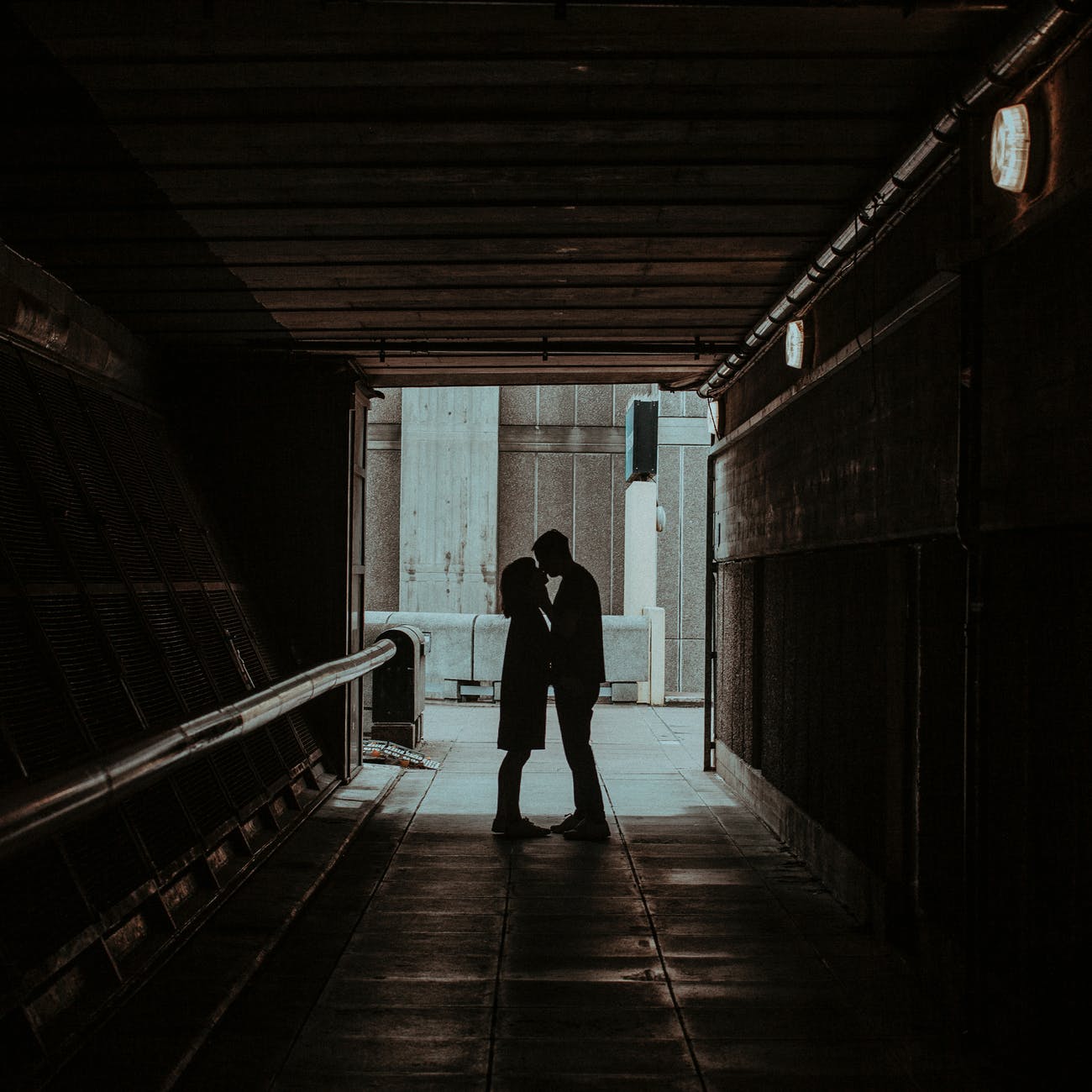
photo of couple kissing in hallway

Photo by Flora Westbrook on Pexels.com

….and it’s over before I know it. A brief instant of ecstasy that fills me up to the brim.

Creating rainbow-colored clouds beneath my feet lifting me up to momentary heaven.

I am standing below the stage looking up at you. You stand over me with a regal posture. You own the universe. Your vibrant voice rings in my ears; it slides beneath every single pore to become a part of me. To become one with my essence.

Your eyes dive into mine. I can feel you swimming in my veins. You offer me a smile. I return it. You begin to walk down the stage stairs. The lights following every single minimal move you make.

The air is balmy inside the venue. My black lace top clings to my dewy skin. I try not to pay attention to the pain that shoots up and down my legs like miniature electric bolts. Five hours of standing on eight-inch heels make me realize that I hadn’t thought about the possible torture that I was going to subject myself to when I had pulled my knee-high leather boots over my feet.

You pass by the shouting girls. They are dying for your attention. But your eyes are locked on mine. I don’t look away. I fall into your gaze. I am going down a one-way spiral, and at the end of it, there is only you. I am taken into another realm…

Our bodies compress in a sweaty haze. You cling to my lips, sucking on them. Not wanting to let me go. Brown curls fell carelessly over your eyes. My hand reaches up to move them away. I am breathless. I want to savor the moment, as it was my last.

Breath against breath, lips against lips, naked flesh against naked flesh…

“Don’t forget to keep me alive in your mind,” you sing to me as I jump out of my daydream.

Your movements are graceful, feline. I can only plead that you will come nearer.

“Remember me whenever you feel obscene.”
Your eyes are burning tiny crevices in the center of my irises. My body is all giving. As well as all receiving.

And then you touch me….

That voice…those eyes…my hand traveling down the contours of my body. It runs over my plump breasts, my thumbnail grazing over my nipples. It shifts down to my navel and passes it, lowering itself down a little further. My hand is greeted by softness. My two fingers probe at its entrance that is enveloped in musky wetness.

There’s no need for knocking, a simple push and the door is opened. The two fingers cruise down a dark and humid corridor, a thrilling chill tingles throughout my body. I smile at you.

“Remember me whenever you feel obscene.”

Suddenly I can’t control my fingers anymore. They have a life of their own as they break into a frenzied rhythm. Faster…faster…faster…

I hear a shrill in my ears and my breath gets caught in my lungs but my fingers don’t stop. Faster…faster…faster…

My body is burning. Sweat slithers down like a sensuous snake. I feel a pounding in my head as though my membrane is being nailed to my skull.

I see you. I hear you.

And my body abandons itself to the senses. The wetness around my fingers contracts, tightening its grip on them. The wetness increases. It swells up like water in a dam until the dam is broken and there’s no turning back. Shocks race up and down my body. My vision blurs. Your face becomes a tapestry of vibrant colors. And then it fades to the bleakest black. The wetness releases its iron grip on my fingers. Liberating them in a yielding manner. They slide out of the murky tunnel restless and defeated.

I bring my hand up to my lips. My tongue flickers at the opaque whiteness coated on my fingers. You smile at me. I smile back.

Your hand loosens its grasp on my shoulder. You walk away. I am breathless. My knees feel weak as though they’re going to give in. I see you walking back up towards the stage. You look down at me and smile. I smile back at you, my body pricking from the aftershocks. My breath comes back to me. I am able to breathe again. My heart slows down to a normal sequence. My fingers are coated with your glitter. My tongue flutters at the tiny red specs of luminance. You smile down at me. I smile back. The pain in my feet makes itself be heard again. I look down.

“See you next time!” you shout.

I look up in time to see you smile at me one last time. I smile back and blow you a kiss that you pay no attention to.

My senses go dormant and it’s over before I know it.

White and Pink Strikeout Cosmetics Beauty Logo

DID YOU ENJOY WHAT YOU JUST READ? IF YES, THEN SUBSCRIBE TO THE BLOG, GIVE THE POST A LIKE, OR LEAVE A COMMENT! NEW POSTS ARE UP EVERY TUESDAY & THURSDAY!

Upcoming Anthology: Running Wild Stories Volume 4

runningwild

Sometime in April, my friend and fellow Inkblotter, Erica Ruhe and I decided to pen a short story together. We figured that if we could join forces, using our strengths to collaborate then perhaps we could write a very compelling and moving story that both of us could be proud of. That’s how our short story, Fragile Fruit was born.

For some time I wanted to write a short story set in Sicily in the late 1960s. I had always been intrigued by how vastly different Sicily was to the rest of the world during that time when it came to women’s rights. 1968 was widely known as the “peak of the sexual revolution” and yet, in Sicily, it was very common for young men to kidnap girls they fancied and rape them, and then said girl was expected to marry their rapist in what was known as a “rehabilitation marriage.” The only way for a woman to regain her sense of worth and dignity from a rape would be to marry her rapist, which would make her an “honourable woman” again and thus automatically extinguish the crime for the man. Franca Viola was the first woman to stand up to her rapist and say NO. She refused to marry him and it made international news, as many women saw her as a pioneer for cultural progress and emancipation. While many men, on the other hand, saw her as a threat.

franca-viola-alcamo1

Franca Viola, the Sicilian feminist icon that inspired Fragile Fruit

Inspired by Viola’s courage, we decided to pen a story about a girl, Marietta who too, refused to marry her rapist but instead of remaining in her hometown of Maletto, fled to New York in hopes of a new life. Four years later, Marietta is forced to return to Sicily when her mother is on her death bed. She soon finds that she’s going to have to find a way to make peace with her demons and her past before both threaten to overtake her.

But when her rapist Alfio turns up dead a few days after her return, all eyes are on Marietta. But did she really do it?

fv

So, since April I’ve been sending this short story to various literary journals and magazines and of course as the norm of any writing it was rejected by a lot of them, despite each of them stating that they had enjoyed the short story very much. Flash forward to last week when I receive an email from Running Wild Press that Fragile Fruit was selected to be in the upcoming anthology Running Wild Stories Volume 4. Of course, both Erica and I are thrilled about this opportunity and that our creative child finally found a home. I don’t know yet when the anthology will be released (sometime mid-2020), so keep your eyes peeled for that info!

White and Pink Strikeout Cosmetics Beauty Logo

DID YOU ENJOY WHAT YOU JUST READ? IF YES, THEN SUBSCRIBE TO THE BLOG, GIVE THE POST A LIKE, OR LEAVE A COMMENT! NEW POSTS ARE UP EVERY TUESDAY & THURSDAY

Flash Fiction: Catching Sunshine by Erica Ruhe

hole

It had been seven days since the cave in. Two thin and bloodied hands, fingers peeled raw from days of scratching at the immovable rock, protruded through a small crack above the boulder. Autumn sunshine warmed Camille’s battered palms. Her eyes closed to enjoy the sensation and she rested her head on her arm. Inside the abandoned mine, it was black and cold but just beyond two tons of fallen mountainside there was light. There was life.

“Camille…”

She turned to the weak call.

“I’m here, Ana,” she replied and climbed down the incline of loose gravel. She stepped over the rail tracks and knelt beside her friend, breathing hard from the small exertion. Anastasia did not move, as if the flat of her back had become rooted to the floor. Camille tucked Ana’s exposed arm back under her burgundy coat blanket.

“I caught you some sunshine,” she said and placed her palms on Ana’s cold, dirt-streaked cheeks. Her friend’s chapped lips closed, her throat squeezing down nothing more than dry, dusty air. Licking morning dew from the exposed rocks day after day had not been enough to sustain them.

“Warm…” Ana croaked.

Their breath rasped loud in their suffocating confines. They spoke barely above whispers, their vocal cords strained and silenced days ago from the endless hours of screaming for help.

Ana cracked open her eyes.

“Do you think they’ll…ever find us?”

A tear trembled on the ledge of her sharpened cheekbone. Her skin had shrunk around her already slender body. Camille moved a palm to Ana’s forehead and the other to her chest, absorbing fresh chill from her skin.

“Yes,” she gave a weak nod. “One day.”

Crevices of dirt around Ana’s eyes deepened in question and the tear plummeted to the waves of her matted braid. Camille lightened the weight of concern in her expression.

“One day, we’ll be someone’s archeological find. We’ll be a treasure unearthed in a thousand years. They’ll discover our bodies, arms embraced around each other, and they will mourn for our unknown lives. They’ll make up histories for us and give us pretty new names.”

Camille stroked her thumb along the blood caked on Ana’s brow.

“They’ll lovingly preserve our bones in a life-size diorama and we will become an exhibit in their museum of ancient history. We’ll be enshrined in glass and admired by millions. We’ll live forever, Ana.”

“You’re so…dramatic.”

A smile tinted Ana’s words but it was too weak to reach her lips. Camille coughed and lowered her head to Ana’s shoulder, snuggling under the torn coat. Ana sighed.

“At least you have…a sweetheart to mourn you, Camille. I’ve never even had my first kiss yet. I never…dreamed that I would die without my first kiss.”

“A first kiss can be a horrid thing, Ana,” Camille teased. “Peter nearly drowned me.”

The girls shared a frail giggle. Ana closed her eyes again.

“Oh, the people I would have loved. The places…I would have traveled to. Perhaps our spirits will escape from this tomb. One day…”

Camille nestled closer.

“Perhaps a small sparrow will find us first,” Camille continued, adrift on Ana’s thoughts. “Perhaps she’ll leave behind dandelions on our chests and as we decompose, the seeds will catch just enough sun and dew to sprout and flower out of us.”

She twisted a loose buckhorn button.

“Perhaps the wind will carry our fragmented bodies back out to the wild. It will be spring, warm and bright. We’ll float over the mountain meadows and along the rushing rivers of melted snow. We’ll float over our town and look down upon our aging families. And we will sweep past their ears and whisper “we love you so very much but we cannot stay” and somehow they’ll know it is us and it will bring them happiness.”

She sniffled.

“We’ll live on as memories. Then the wind will take us again and we’ll be free.”

Camille lifted her head.

“Ana?”

Only stillness.

“Ana?”

She shook her friend’s shoulder but Ana’s expression did not move. There was no breath in her mouth. Her chest did not rise. Camille tried to hold down the rising emotion in her throat but her grief, unlike everything else in the darkened mine, could not be contained. Soft sobs choked her. Tears carved deep ravines through the dirt on her face revealing clean, frigid skin beneath.

Exhausted, Camille watched the last ray of the afternoon seep across the toes of Ana’s boots. She lifted her hand to the sunlight and let the dust motes waltz and twirl between her flayed fingers.

“We’ll live forever, Ana.”

sunshine

DID YOU ENJOY WHAT YOU JUST READ? IF YES, THEN SUBSCRIBE TO THE BLOG, GIVE THE POST A LIKE, OR LEAVE A COMMENT! NEW POSTS ARE UP EVERY TUESDAY & THURSDAY

Short Story: Errors of Grievance

doll3

“I warned you!”

The old priestess pounded a weathered fist on the small dining table, her dingy blouse falling off of a dark, bony shoulder. “But you know more than Miss Beaulieu, eh?”
Across the small table, Momma dried a rivulet of shame from her cheek.
“I didn’t mean no harm,” her voice quivered. “I swear.”
From her cold, moonlight-washed perch atop the old bayou house, Adelaide shifted her attention to the agitated women below. Rolling her skinny frame onto her belly, she shivered under her thread-bear dress, setting her little doll beside her. He balanced on his round torso, head draped in a dry tangle of Spanish moss. Yellow lamplight sliced across his black button eyes and together they peered through a crack near the chimney overlooking the kitchen.
“I never took it out the house.” Momma insisted. “Someone done stole it.”
Miss Beaulieu planted a hand on her hip and took a long draw on a short cigar.
“Who done the spell? That jinx, Laronde?” Syllables of dark smoke puffed out of her mouth. Momma stroked her arm and looked away.
“Stupid girl.” Beaded bracelets criticized and chided on Miss Beaulieu’s thin wrist. “His bad voodoo gon’ come back to him and everyone he cast for.”
“You’ve cast for love before.” Momma’s eyes pleaded.
Miss Beaulieu jabbed a finger. “You know this ain’t the same.”
Adelaide’s heart ached. She didn’t like seeing Momma so upset, but she also didn’t like being only one in the house when Momma fell into one of her dark moods. So when her brothers escaped to the river to hunt gators, Adelaide took refuge on the rooftop. In a cigar box, tucked under a missing brick in the chimney top, was her trove of knick-knacks. Her new doll, dressed in cotton pants and a burlap overcoat, was her most valuable addition. It was bad to spoil surprises but Adelaide knew Momma had made this Christmas doll just for her.
“‘Sides,” Miss Beaulieu paced, “he got himself a faithful wife and a good job in Baton Rouge. You think all the Magick in the world gon’ make that man wanna leave that to take up wit’ you out here? Wit’ your five kids?”
Adelaide gave the little man a kiss to ease his troubled expression, the scent of cloves and musk wafting up from the crude stitching down his chest. She would replace him in his hiding spot under the floorboard tomorrow.
“Can you make him a gris-gris bag for protection?” Momma wiped her apron across her cheeks. “In case something happen to the doll?”
Adelaide froze.
“A good Christian like him won’t be caught dead with a necklace full of chicken’s feet and dove’s blood.”
Adelaide’s eyes fell upon the little man beside her. Dried grass protruded out of his stiff arms and legs. He suddenly appeared feeble and indisposed, like a paralyzed prisoner.
“Ain’t no spell on your lover can be reversed without that doll.” Miss Beaulieu dropped a large dollop of ash onto the floor. “Only the One Most High can help him if something happens to it.”
Nausea swallowed up Adelaide like the cold, wet mouth of a whale.
Miss Beaulieu leaned in. “Who you think done stole it?”
“Adelaide?”
Below, Adelaide’s brothers eased their rowboat up to the, rotting, crooked pier. The eldest, Francois, shielded his eyes from the bow lantern to see her better.
“Why you up there?”
Flushed from hiding, Adelaide leapt to her frozen bare feet, accidentally kicking her treasures down the slanted roof. The doll bounced over the ledge. Vertigo struck her numb. Her footing slipped and she tumbled down the sharp slats.
“Adelaide!” Francois’s voice broke as her footing slipped.
A screech leapt from her throat before she plunged into the river. Frigid water hit like glass on her stomach. It rushed up her nose, burning the brain lobes behind her eyes. Sound muted, heavy and low in her ears. Her mind jolted with panic. Adelaide’s eyes popped open but there was no light. Her heart pounded. Only the flash of a brass shoe buckle glittered as it somersaulted down into the watery shadows. She grasped but only caught emptiness. Lungs aching for air, she pulled her way up through the cold void and burst to the surface.
“Sweet Jesus!”
“Grab her!”
“The doll! The do—!” A wave of river water sloshed into Adelaide’s mouth.
“Adelaide, stop! Settle down!”
“No, no, no!” she cried. Strong hands gripped under her arms and slid her into the tiny boat. Violent coughs rattled her little bones. She gagged from a bellyful of the Mississippi and tried to writhe free a final time.
“I…I…didn’t know!” Adelaide sobbed. Warm arms wrapped around her and pinned her to the seat of the small wooden rowboat. “Momma, I didn’t know!”
“Adelaide?” Momma’s voice carried from the house.
“Settle yourself, girl.” Francois held her firm. “What are you carryin’ on about?”
Adelaide’s eyes darted beyond the bucking bow, searching for the voodoo, but it had sunk all the way to the bottom of the bayou.

By: Erica Ruhe

DID YOU ENJOY WHAT YOU JUST READ? IF YES, THEN SUBSCRIBE TO THE BLOG, GIVE THE POST A LIKE, OR LEAVE A COMMENT! NEW POSTS ARE UP EVERY TUESDAY & THURSDAY

Upcoming Books: Betty Bites Back – Horror Stories for Young Feminists

bettybites

I’m thrilled to announce that my short story, GOOD SISTER, BAD SISTER is going to be included in the upcoming anthology Betty Bites Back – Horror Stories for Young Feminists (coming out October 2019). This anthology is put together by award-winning badass authors, Demitria Lunetta, Mindy McGinnis, and Kate Karyus Quinn.

Here’s a little teaser of what my story is about:

GOOD SISTER, BAD SISTER by Azzurra Nox

Puberty comes with many changes, but after being bitten by a mysterious animal in the forest, Dilay finds out that some changes may just give her a certain edge she didn’t have before.

Until then, support me and the amazing authors that are going to be included in this awesome anthology by stopping by the Kickstarter Page for it (even if you can’t contribute monetarily, forward the link on your social media so we can spread the word!).

White and Pink Strikeout Cosmetics Beauty Logo

Did you enjoy what you just read? If yes, then FOLLOW THE BLOG, give the post a like, or leave a comment! New posts are up every Tuesday & Thursday!

Let’s get social:

Instagram

Twitter

Pinterest

Book Review: Running Wild Anthology of Stories Vol. 2 – Amelia Kibbie Q & A

14563358_10104122370488439_6991094984042256591_n

Amelia Kibbie’s latest short story “Idylls of the King,” is one of the twenty short stories featured in the new Running Wild Anthology by Running Wild Press. Her short story features two young boys who have to leave their London homes due to Nazi bombings during WWII with their school teachers and classmates for the safety of the countryside. Both boys, James and Arthur are ruthlessly bullied by their peers, the first for having effeminate mannerisms and fancying boys, whilst the second for his weight. But when the two boys meet an aging Baroness, their lives will never be the same again.

What inspired you to write this short story?

Actually, it was for a totally separate anthology called “Heart of Steel.” The anthology called for happy ending LGBT love stories that contained knights of some sort. I didn’t want to do the typical fantasy thing, so my story takes place in England in WWII. I wanted to show that no matter how old you are, or what time period you live in, you can have a heart of steel — the heart of a knight that values love, friendship, honor, and protects those in need.

Your short story explores the theme of bullying—how important is it to have a story where the bullied triumph over their bullies?
Like pretty much everyone else, I’ve been bullied. I think everyone dreams of some kind of a sweet moment where you can go back in time and stand up to your bully. But in the real world, this usually doesn’t happen. So part of writing this story was wish fulfillment for me. I wish that anyone bullied for their sexuality would be able to stand up and fight back or have someone to protect them.
I’m definitely not the first person to depict this, but maybe the first person to have a suit of medieval armor involved!
What actually happens in, Idylls of the King is that James and Arthur stop being the bystanders to each other’s bullying. James sticks up for Arthur and risks a beating, only to be saved by the air raid siren. When Arthur sees this, it empowers him to stick up for James in return. In real life, empowering the bystanders is the most effective way to combat bullying. All of those other kids in the class were just standing there and watching all those years, just thankful it wasn’t them being targeted. They should have been banding together to stand up to Morgan and his friends to improve life for everyone in the class. I work with young people, and the anti-bullying research finds that empowering the bystanders is the most effective way to improve a school climate.

Why did you choose WII England as your setting?
This is going to sound super cheesy, but I was actually inspired by the ultra-crappy sequel to The Woman in Black. I liked the first movie quite a bit, and the second one was on Netflix. I was homesick, so I decided to watch it. It wasn’t a great movie, but it had some really interesting ideas to it — like the manor house being cut off by the tide at certain parts of the day. That reminded me of one of my favorite travel destinations, Mont Saint Michel. The part that obviously made it into Idylls of the King was the story of the children evacuated for Operation Pied Piper and moving into a mansion together.
Do you have any other upcoming writing projects?
I’m currently crafting Idylls of the King into a novel that picks up ten years after James and Arthur find one another. They’re still together, living in London, and find themselves on a cross-country adventure to fulfill a man’s dying wish.

You write across genres, which one is your favourite?
I would have to say horror. I just re-read The Shining, and it brought back so many memories of being in high school and reading Stephen King. He and Anne Rice were my big inspirations back in the day, and horror will forever hold my heart. I love writing in other genres and just telling a good story with characters I care about, but when I write a horror piece, I really get into it.

anthology vol 2_cover final (1)

You can purchase this book HERE or check out Amelia’s short story in MY AMERICAN NIGHTMARE – WOMEN IN HORROR ANTHOLOGY HERE.

Follow Amelia either on Facebook or her website.

By: Azzurra Nox

Short Story: Animortis Part III

zombie2Charlie turned his head and spotted the shotgun, rattling unattended in the farthest corner of the carriage floor. He still had one more shot. Gathering his strength, he twisted his shoulders, released his right hand on the girl’s throat and reached for the gun. It wobbled inches from his extended fingertips. He stretched further. The rear of the carriage lurched downward, the broken axel moments from failing. Feeling his left hold falter, Charlie abandoned his efforts and pushed back on her throat again. Desperation mounting, his eyes cut to Baumgart. The Earl remained incapacitated.

The girl wrapped her cold, palms around the back of Charlie’s neck, pulling him closer to her salivating mouth. Glassy, green eyes roved in their sockets. She screeched like a wild animal and snapped her broken, jagged teeth inches from his face. There was nothing human left in this shell of a girl. With a strike of dread in his heart, Charlie realized they were an even match of strength.

“Charles?”

Charlie looked down to his feet as Baumgart blinked back to life.
“My lord!” he strained against the girl.
Distracted, the girl whipped her head back to the Earl.

Charlie bent a leg between him and the girl and kicked her away. She fell back onto her minced knees. With all his force, Charlie brought up his right leg and delivered a smart boot to her face. Blood squirted out in all directions from under the sole of his shoe, accompanied by a chilling crack. The girl’s head recoiled and she grunted from the impact, arms spinning into wild wind-mills as she teetered backward. She fell, her spine bowed backward over carriage side, hands scratching for a hold. Charlie scooped up the shotgun just as the girl’s fingers caught the door latch release. The door flung open behind Baumgart and he tilted, wild-eyed, out of the landau.

“Charles!” Baumgart shouted. His arms sprang wide to either side of the opening, saving himself from a fatal tumble out the doorway.
“Hold fast!” Charlie doubled over and snagged Baumgart’s wrist. Bracing a foot on the side of the carriage, Charlie hauled him up and onto his feet.
“Are you hurt?” he breathed, steadying the Earl’s footing.
“I…” Baumgart’s pallid lips quivered. “I am alive.”

Beside him the maiden regained her balance. She blinked a moment in confusion, dark black blood gushing from her broken nose. Charlie maneuvered in front of the Earl and took aim a final time. The rear of the carriage shifted downward again and the bullet missed and ricocheted with a loud ‘ping’ on the iron carriage frame.

“Damn! C’mon!” he shouted, grabbing Baumgart by his vest lapels and forcing him up toward the coachman’s bench. “We haven’t much time.”

Baumgart scrambled up to the platform and swung over the guardrail. As Charlie pulled his torso up onto the railing, a final fierce shudder up the chassis signaled that the cracked axel had split completely. The back end lurched down with a heavy crash upon the road causing the rear wheels to tilt and spin free of the wood frame. Charlie’s footing slid off the railing and his body whiplashed against the front bench, cracking one of his ribs. He cried out at the sharp pain and hung from the guardrail by his underarms. Behind him, wood paneling scraped and splintered under the friction like a wooden sword put to a stone grinder.

“Take my hand, Charles!” Baumgart extended his arm. Charlie winced and clenched his teeth against the pain.

“Please,” he found a firm foothold, “Rein in the horses, if you can.”
Baumgart turned to the whip socket as Charlie struggled atop the coachman’s bench and planted his seat on the back of the guardrails.

“Oh no.” Baumgart’s mouth fell open and the last bit of color bled from his cheeks. His voice barely broke over the rumble of the pounding hooves. Charlie followed his line of sight up the road as the team cleared a bend in the forest path. His stomach dropped.

“Oh bloody hell.”

At the railway crossing in the distance ahead, a small horse-cart and its driver waited patiently behind the lowered level bar for an approaching train to pass. Charlie glanced to the whip socket. The leather straps were gone. Below, they lashed and slapped under the terrified horse hooves.

A horn blared off in the distance.

Baumgart shook his head and grabbed Charlie by the arm. “The team is lost, Charles,” he shouted over the roar. “We must jump carriage!”
The horses were inconsolable and the flesh-hungry girl was…Charlie felt a hand lock around his ankle. He looked down to see the maiden grinning back. With one hand on the guardrail and the other holding tight at his riding boot, she swayed like a drunk dancer in the disintegrating coach.

“Go, sir!” Charles unhanded himself from Baumgart.

“But—.”

Another loud crack split the air and the rear bench seat dislodged from the carriage, rolling away with a smash that left the maiden’s feet dangling above the speeding road. Charlie braced against the bench at the added weight of the girl. The horses would be dragging their tack in a few minutes more.
“Please, sir!” Charles begged. “Go now!”

His face tight with terror, Baumgart turned and steadied himself at the edge of the platform. He glanced back, “God bless you, Charles,” and threw himself out into the forest, disappearing behind the dark curtain of night before Charlie even saw him strike the ground. Charlie swiveled his head in search of another weapon but there was nothing left to defend himself. The whip was gone, the gun was lost. He had nothing.

Much louder now, the locomotive hailed its coming again. With the fire of pain searing his left rib, Charlie twisted and jerked his leg until he felt his muscles cramp but she would not let go. He never thought his life would end like this, killed on a mundane carriage ride to Coburg by a mad-girl cannibal. No one would believe the tale if he survived to tell it.

Beside him, hot oil from the swinging lanterns splashed onto the bench, setting the wood alight. Charlie’s eyes widened. His brain surged, jolting one last bit of hope into his heart.

Charlie fumbled for the oil lamp behind him.
“Burn in Hell, wretched devil!”

Charlie smashed the hot lamp down upon the girl. Glass shattered and burning oil splashed down over the maiden’s head, anointing her with bright orange fire. An unearthly shriek burst from her throat and her grip loosened. Charlie wormed free, swung his legs over the side of the platform and, with a quick prayer to the Almighty, jumped free of the carriage.

The ground hit him with a breath-stealing impact. Charlie rolled his shoulders with the bruising momentum until he slowed and flopped to a halt under a large tree, dizzy and gasping like a netted fish. He lay there a moment in disbelief until panic struck his gut. He jerked upright to see if he had truly escaped and watched, incredulous, as the disaster unfolded.

The train rounded a wide curve and barreled toward the crossing. Setting dry branches and brush alight as she passed, the maiden thrashed and screamed on the carriage, oblivious to her own fate. Hearing the commotion behind him, the old peddler scrambled down off his cart to rescue his pony. Realizing his goods could not be saved, he unhitched his mare and gave her a hearty slap on the hind quarter. The animal bolted to safety across the tracks and the poor man limped away as fast as he skinny legs would take him. The Greys were just meters from the intersection.

Up the tracks, a shout pierced through the cacophony. Sounds of metal on metal screeched through the forest as the train slammed down on its emergency brakes. The train blared the horn at its inevitable arrival.

Charlie’s beloved Greys, having seen the cart too late, squealed and skittered, their hooves gouging deep into the cold, soft earth as they struggled to veer left, away from the cart. Rigging clanged and wood creaked in protest but the impact was imminent. The wooden draft poles finally snapped under the strain, sending the carriage skidding sideways into the cart. The impact of the royal coach smashing into the back of the peddler’s cart sent it airborne, careening into a wild roll. Three of the horses broke free, galloping madly on toward Coburg. With a horrible crunching sound, the wheeler screamed and stumbled into the back of the cart creating a mass of broken slats. His neck whipped across a jagged board silencing him into instant death.

Forward momentum flung the blazing girl and landau side over side, directly into the path of the oncoming train. The locomotive engine wailed a final warning before crashing through the carriage, exploding it in mid-air with the speed and force of a giant bullet. Fiery splinters flew high into the tree canopies like a firework, the last oil lamp scattering flames up and over the sides of the railcars. The glissando of the train horn suddenly died. Metal squealed and scraped together under the protesting brakes accompanied by the solid, earthy rumble of heavy, iron wheels upon the tracks.

It was only when a small bit of wood struck Charlie’s leg that he remembered to breathe. He shook his head clear and clutched his chest, taking in large draws of air. Debris tumbled and bounced across the ground hundreds of meters in every direction. Bits of the carriage and carnage rained down all around him. Nearby, a delicate, dismembered hand flopped motionless onto the grass. Streams of dark blood oozed from the ends of the curled, claw-like fingers. From the depths of the forest, his name echoed down the road.

“Charles! Charles!”

The train continued to slow, chugging to a stop with labored effort. Surprised shouts from the crew could be heard in the distance. The peddler hobbled to meet him. Charlie tried to stand but his knees wavered like sheets in the wind. A throbbing pain swallowed his torso and seeped up his chest. Bewildered and numb, his mind faded into the cold, grey fog of shock. It was only when his knees gave out and Charlie plopped back down against the oak tree that he realized one of his legs was broken. He wheezed in disbelief at the fiery wreckage waiting for the flood of pain from his fractured femur to reach his brain. There was no movement near the horrific aftermath that lay scattered over the crossroad. Charlie was struck by the absurdity that the girl might have survived the crash. After all, she had survived everything else.

“Mein Gott, Charles!” Earl Baumgart reached his side, giving his cheek a few hearty slaps. “Keep awake now. We’ll have the doctors here, straightaway!” Charlie felt the familiar tide of nausea ebb up his stomach. It was an odd and uncomfortable reassurance that he was indeed still alive.

“God have mercy!” Earl Baumgart’s cry evaporated into the hollow shell of Charlie’s head. “God have mercy!”

THE END

READ PART I HERE

READ PART II HERE

By: Erica Ruhe