Excerpt: Magdalena by Candi Sary

Magdalena once told me she knew how to cure sadness. She read on that little phone of hers that we all need fifteen minutes of sun every day and without it, depression could set in. Those of us here on the peninsula barely get fifteen minutes a week. The fog comes in over the cliffs in the morning, creeping through town, shrouding all neighborhoods with a thick graveyard effect. We don’t have an actual graveyard, but the landslide all those years ago took enough lives and left enough ghosts behind to bring on that kind of fog. If it does lift around midmorning, a heavy cloud cover still stays most of the day, keeping things gray. I’d always thought my sadness came from the unfortunate things that happened in my life, but according to Magdalena, my gloom might simply be a lack of vitamin D.

From the day she got the phone, she stared into it constantly, seeking answers to all of her questions and even finding new questions she would have never thought of on her own. She fed on its information like meat.

“Mushrooms,” Magdalena said. “We need to eat mushrooms.” The girl was my only visitor. When she spoke, I hung onto her every word. “If we eat enough of them, we’ll get the vitamin D we’re missing from the sun.”

I didn’t question her. For weeks, I based all my meals around mushrooms. I made mushroom casseroles, salads, risotto, soups, but I’m not sure it changed me. I’m not sure it changed her. How many mushrooms would it take to replace the sun? I wish I could ask the girl, but she’s gone. Three weeks ago, I lost her for good.

I pull up my sleeves and roll up my pants. My arms and legs are so pale in this light. They look like white maps with long blue roads leading to nowhere. The lighting in my house is soft enough to disguise my pallor, but here in the rest home, the deficiency is glaring. I quickly lower my sleeves and pants again.

“Focus, Dottie.” My command is quiet.

I swallow down one of the tiny white pills and sit up straight in my chair. Pen in hand, I look around the dismal room I currently share with Mario. It is a holding cell for the dying. We aren’t dying like the old people in this nursing home. But our town is small. They had nowhere else to put my husband after the accident a decade ago. And they had nowhere else to put me after the devastating incident at my house last week. So now we live together again in room eleven with the beige walls, the brown and yellow floral comforters on our beds, and the slim, dark wood secretary desk beside the bathroom door. The old desk is where I currently sit as I tap my pen on the blank page, trying to gather my thoughts.

Now the cold distracts me. I pull a blanket from the bed and wrap it around me. The air conditioner is dreadfully high. They say it’s to keep germs down, but I sometimes wonder if they’re trying to weed out the weakest of us.

“Focus, Dottie, focus,” I say a little louder, closing my eyes.

“What do you need to focus on?” someone asks.

Startled, I tighten the blanket around me and turn toward the voice. There is a white-haired lady in a wheelchair at my door. Her face is all wrinkled up like fingertips after a long bath, and her lips seem to be growing inward around her teeth. Thick bifocals, wrapped around her head like goggles, magnify her wet and cloudy eyes. There are some really old people here, but she has to be the oldest.

“I didn’t mean to frighten you,” she says, her ancient voice slowly rattling out the words. “I heard you from the hall.”

I wasn’t trying to be heard. I place my hand over my mouth to show her I’ve no interest in a conversation. I’m hoping my hand gesture will make her leave, but it doesn’t. Instead, she wheels through the small space between the two beds and parks next to me at the desk. Her nightgown is purple and far too big on her. She smells like leftover broccoli.

“I’m curious. What do you need to focus on?” she asks again.

It’s going to take some time getting used to this place. I’m not in the habit of answering to anyone, having lived alone for so long. “A letter,” I finally say. She’s so close now, there’s no escaping her. “I’m writing a letter. A story really. The rumors are terrible and—” I catch myself before it all comes flooding back. Their ugly words. All the lies. “I need to tell my story. It’s the only way to get the truth out.”

Her face lights up. “You must be Dottie,” she whispers. I nod. “I should have known.” Her eyes travel the length of me. “I heard about you, the young woman living in the old people’s home.” It sounds strange out loud but worse things have been said about me. “How old are you, dear?”

“Forty-three.”

“So young.” She shakes her head. “It’s just awful what happened to you. How long will you be staying with us?”

“Well.” I look over at Mario in his bed. His eyes are open, but there’s no telling what he’s thinking as he stares at the ceiling tiles. “The Sisters say I can stay with my husband as long as I need. I’ve nowhere else to go.” She leans over the side of her chair to get a closer look at him.

“Does he even remember who you are?” “I haven’t let a day go by without coming to see him.” “But with what happened to him, do you think he can remember?”

“Oh, he remembers me.” I won’t let anyone convince me otherwise.

“That’s nice.” Her smile is kind. “Sometimes I think I remember too much,” she says. “Some things I wish I could forget, but the pictures are there in my mind, clear as day.” She sets her bony hands in her lap, and the veins bulge like soft worms. She smiles. Her demeanor is pleasant; it’s just the broccoli smell that’s bothersome.

I notice a pin on her nightgown. It’s gold with blue letters spelling out centenarian. I point to it. “You’re a hundred?”

“A hundred and two.”

“That’s incredible,” I say, feeling a new respect for her. She’s not just an old lady—she’s National Geographic material.

“It’s a curse, old age. The lucky ones die young. Freed from these bodies, they can move on. Or, of course, they can stick around.” She raises the few hairs left of her eyebrows, as if I know something about this. I feel her words in my stomach. I don’t respond. She whispers, “The ghosts of Sam’s Town are persistent, aren’t they, Dottie?”

“If you don’t mind, I’d like to get back to my letter.”

“But we haven’t talked about what happened to the girl yet.” She laces her fingers together under her chin. “We need to talk about what really happened to Magdalena.”

Hearing her name almost makes me lose my breath. I close my eyes and indiscriminate memories resurface—her blue nail polish, those stolen sunglasses on her head, lemon juice dripping from her fingers, her blood on the linoleum.

“Do you know what happened?” the old woman asks. “I mean what really happened to her?” She’s staring at me, waiting for an answer. I reach for my pen, gripping it like a weapon. “Until I write it all down, I’m not talking about it to anyone.”

“You can trust me, Dottie.” She wheels closer.

“I don’t even know you,” I say.

She smiles. It’s a sad smile. “Then let’s get to know one another.” She glances toward my husband before leaning forward. The smell is strong, her voice is soft. “Is it true that the man,” she asks, “who started it all was your lover?”

I close my eyes again, to escape her question, but now there he is behind my eyelids—Benjamin. His hand creeps under my dress and he’s massaging my leg. I squeeze my eyes tighter.

“Go away!” I shout. “Go away!” I am talking to Benjamin, but when I open my eyes, the old lady in the wheelchair is hunched over, wheeling away as fast as her bony arms will take her. I should explain that I was not yelling at her. But I don’t. I stay quiet.

While I feel a bit guilty, I’m relieved to see her go. The poor woman looks so frail heading for the door, like her arms might snap. That’s the other effect of vitamin D deficiency—frail bones. This town is killing all of us.

Excerpted from Magdalena by Candi Sary © 2023 by Candi Sary, used with permission from Regal House Publishing. 

DID YOU ENJOY WHAT YOU JUST READ? IF YES, THEN SUBSCRIBE TO THE BLOG, GIVE THE POST A LIKE, OR LEAVE A COMMENT! NEW POSTS ARE UP EVERY TUESDAY & THURSDAY!
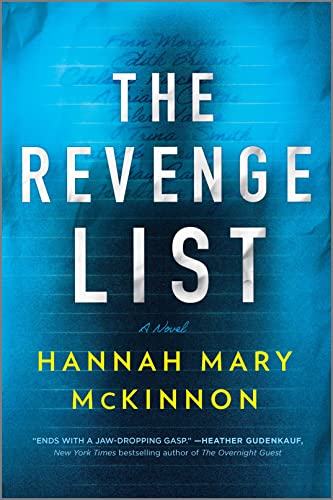
Excerpt: The Revenge List by Hannah Mary McKinnon

CHAPTER ONE

The sharp sound of a high-pitched scream filled the air. A noise so unrecognizable, at first I didn’t register it had come from deep within me, traveling up my throat in stealth mode before bursting from my mouth.

The remnants of the yell reverberated around the car, forcing their way into my ears and penetrating my skull, urging me to do something. Survival instincts kicked in, and I fumbled with the seatbelt, my other hand grasping for the door handle. The need for the relative safety that solid, stationary ground would bring was so intense it made my stomach heave. A loud click of the central locking system meant my captor had outsmarted me again, obliterating my immediate plan to throw myself from the moving vehicle.

When I looked out the windshield, I knew there was no time to find an alternate escape. The end of the road—the edge of the cliff—announced by signs and broken red-and-white-striped wooden barricades, had been far enough away seconds ago but now gleamed in the car’s headlights, a looming warning yards ahead. I couldn’t comprehend what was about to happen, couldn’t do anything as the vehicle kept going, splintering planks and racing out the other side with nothing but air below. I let out another scream, far louder than my first, the absolute terror exploding from my lungs.

For the briefest of moments, we were suspended, as if this was a magic trick or an elaborate roller coaster. Perhaps, if I were really lucky, this was all a dream. Except I already knew there were no smoke and mirrors, no swirling track leading us through loop-the-loops and to safety. It wasn’t a nightmare I’d wake from with bedsheets wrapped around my sweaty body. This was happening. It was all terrifyingly real.

As the car continued its trajectory, it tipped forward. The only thing to stop our momentum was whatever we were rushing toward, obscured by the cloudy night skies. Pushing my heels into the floor, I tried to flatten my shoulders against the seat. My hands scrambled for the ceiling to brace myself, but I flopped like a rag doll, my loosened seatbelt tearing into my shoulder.

They say your life flashes before you when you’re close to death. That didn’t happen to me. Instead, it was all my regrets. Choices I’d made. Not made. Things I’d said and done. Not said. Not done. It was far too late to make amends. There would be no opportunity to beg anyone for forgiveness. No possibility of offering some.

As the finality of the situation hit me full on, I turned my head. The features of the driver next to me were illuminated in a blueish glint from the dashboard lights. His face had set in a stony grimace; his jaw clenched so tight he had to have shattered teeth. But what frightened me the most were his eyes, filled with what could only be described as maniacal delight.

He’d said we were both going to die. As the car hurtled to the bottom of the cliff, I closed my eyes and accepted he was right.

***

Excerpted from The Revenge List by Hannah Mary McKinnon, Copyright © 2023 by Hannah McKinnon. Published by MIRA Books.

PURCHASE THE NOVEL HERE!!

DID YOU ENJOY WHAT YOU JUST READ? IF YES, THEN SUBSCRIBE TO THE BLOG, GIVE THE POST A LIKE, OR LEAVE A COMMENT! NEW POSTS ARE UP EVERY TUESDAY & THURSDAY!
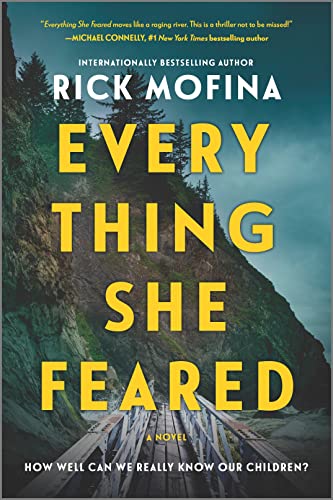
Excerpt: Everything She Feared by Rick Mofina

Near North Bend, Washington

SEVENTEEN-YEAR-OLD ANNA SHAW didn’t want to die.

Adrenaline surged through every nerve ending, her fingers digging into the tree branch jutting from the cliffside.

This was a nightmare. It couldn’t be real.

But it is real.

Anna had been atop the cliff, taking in the breathtaking panoramic view of the river, forests and mountains. Then in a heartbeat she was falling, falling some twenty feet, crashing into the big twisting branch sticking from the cliff face, catching herself, seizing it, struggling to hang on as it bent, now threatening to give way.

Gasping, she looked in horror a hundred feet straight down to the rocks at the banks of the rushing river below.

Wind gusted up, nudging her dangling legs. As she hung on for life, the branch cracked, her body jolted.

“Oh God!”

Anna glanced up at nine-year-old Katie Harmon looking down at her from the clifftop.

“Katie! Get help!”

Transfixed, Katie stared in wide-eyed silence.

Anna strained to move along the weakening branch closer to the cliff face to find a hold on the craggy rocks.

But pulling herself caused the branch to bob and shake, crackling more under her weight. Her hands landed on short branch spikes, like protruding nails piercing her palms with electrifying pain.

Suddenly the branch split and Anna jounced a few feet lower, clawing, clinging on to the fibrous remains.

“Katie!” she shrieked. “Oh God!”

Anna looked up.

Katie was gone.

The branch cracked again.

Run!

Every part of Katie’s brain screamed at her to run.

She flew along the trail, twisting, turning through the dense woods, hoping to catch up to the others who had continued moving ahead.

Anna’s fall had happened in a terrible instant.

So real and so frightening.

And no one else knows! No one was with us to see!

Katie willed herself to run fast, faster than she’d ever run in her life.

She felt like she was moving in slow motion but she blazed along the trail, coming to the clearing where her group from the Sunny Days Youth Center was setting up.

Katie glimpsed the joyful calm, nearly thirty kids and a sprinkling of adults supervising the day trip from the city, oblivious to the horror now on the cliff they’d all just passed. The boys were moving picnic tables together, others tossed a Frisbee. The girls were opening backpacks,

tearing into snacks and drinks while others took pictures. 

It all stopped when Katie screeched: “Help!”

Heads turned, smiles melted, the Frisbee crashed.

“What’s up, Katie?” said Jackson, one of the supervisors.

“Anna fell!” Katie’s chest heaved; she was gasping for air. “Taking a selfie. Fell off the cliff! Hanging on to a tree!”

It took a moment for Jackson and the others to absorb the alarm and snap to attention.

“We’ll need ropes,” he said, glancing at the other supervisors, Adam and Connie, who’d grabbed a canvas bag, unzipped it and yanked out tent ropes. They turned to Katie, who’d already fled back on the trail, her sobbing echoing in her wake.

“Everyone stay here!” Connie said, starting to run with the two men as she called to another adult with the group: “Dakota, keep everyone here!”

The supervisors struggled to keep up with Katie, all of them racing back on the trail to the area of the cliff. Two backpacks on the ground marked the point where it happened. Katie stood there horrified when she looked down.

Only spear-like remnants of the branch reached from the cliffside.

Katie stepped back while Jackson, Adam and Connie, breathing hard, looked down, their eyes ballooning in disbelief.

“Oh God!” said Connie, her voice breaking.

“No! No! No!” Adam yelled.

Anna’s body was splayed on the rocks of the riverbank.

Ribbons of blood were webbing to the water.

******

IN THE TIME that followed, events unfolded like a tragic opera.

Connie’s 911 call went to the King County Communications Center. Panting with panic, she struggled to report the emergency.

“A girl fell off a cliff! We need—please, we need—”

“Take a breath,” said the operator, calm, professional, taking control. “Tell me exactly where you are and what happened.”

Connie collected herself, answering questions and following instructions, enabling the operator to dispatch paramedics and deputies from the King County Sheriff’s Office North Precinct. The deputies then made a callout for Search and Rescue, setting the response in motion.

“I can’t look anymore.” Katie covered her face with her hands. Sobbing and trembling, she lowered her hands and asked: “Is Anna dead?”

“We don’t know.” Connie put her arm around her. “Help is coming.”

For their part, Jackson and Adam had found a safe route to hurry down from the cliff. Moving as fast as they could along the rugged riverbank, they came to Anna’s motionless body.

Her arms and legs were bent and twisted like a rag doll. She was lying faceup with her eyes open, staring skyward, blood dripping from the back of her neck. Jackson and Adam knelt next to her.

“Anna!” Adam said, knowing the worst but saying her name again.

Her stillness terrified them. They heard nothing but the river’s rush while Jackson felt her neck, warm but no pulse.

He began CPR.

Adam saw her palms, bleeding from branch fragments projecting like quills in testament to her fight to hang on. Gently holding her hand, Adam surveyed Anna, almost glowing on the rocks in her bright yellow T-shirt. He didn’t know that her mother had had it custom-made for her last birthday with the embroidered motto crowned over her heart: All We Have Is Today.

A small tattoo on her inner right wrist said Fearless, and on her inner left wrist was a small heart. Her jeans were faded, stylishly torn at the knees. One of her pink sneakers had been ripped away by the impact.

Anna’s head nodded in time with Jackson’s rhythmic pumping. But both men knew that the effort to save her was in vain.

Still Jackson refused to quit.

Adam’s phone rang—it was the emergency operator. She’d gotten his number from Connie.

“Yes… A lot of blood… No pulse… We both have CPR and First Aid… He’s doing CPR… Unconscious… Not responding… Tell them to hurry.”

Staying on the line to provide directions to the scene, Adam held Anna’s still-warm hand while watching Jackson’s unrelenting CPR. Blinking back tears. His gaze went from Anna to the rock face, his stomach lifting at the magnitude of the drop, his focus traveling up beyond the broken branch to the cliff, seeing Connie looking down at him.

Adam shook his head slowly.

Connie’s hand flew to her mouth. She turned, nearly doubling over before somehow getting enough control to pull Katie closer, comforting her. Slowly they started back to be with the others at their day camp.

Connie’s mind swirled as they returned to the clearing; twenty-four kids, aged nine to fourteen, were in the Sunny Days excursion, along with four adult supervisors and three older teen assistants—now, only two.

Moments ago they were all starting a blissful outing, only to see it turn into a day of horrible heartbreak, a day they would remember for the rest of their lives, Connie thought. Everything at their day camp came to a halt when Connie and Katie emerged.

“Is Anna okay?” asked Dakota, one of the supervisors.

Connie searched the group, meeting anxious, expectant faces, feeling Katie’s sobs against her. Holding her tight, Connie brushed at her own tears.

“Anna fell,” Connie said. “She’s hurt bad, really bad.”

“Did Anna die?” one of the girls asked.

Connie stared at her.

“I want to see!” said Dylan Frick, a boy who was also in Katie’s class at school.

“No!” Connie said loudly, then softened her voice. “We don’t know anything yet. We just have to wait.”

Some of the kids got on their phones, texting and calling their families, while a few of the girls rushed to Katie and Connie, encircling them in a group hug, their sobbing soon mingling with the tragic operatic chorus of distant sirens echoing over the treetops.

Excerpted from Everything She Feared. Copyright © 2023 by Rick Mofina. Published by MIRA Books.

PURCHASE BOOK HERE!


DID YOU ENJOY WHAT YOU JUST READ? IF YES, THEN SUBSCRIBE TO THE BLOG, GIVE THE POST A LIKE, OR LEAVE A COMMENT! NEW POSTS ARE UP EVERY TUESDAY & THURSDAY!
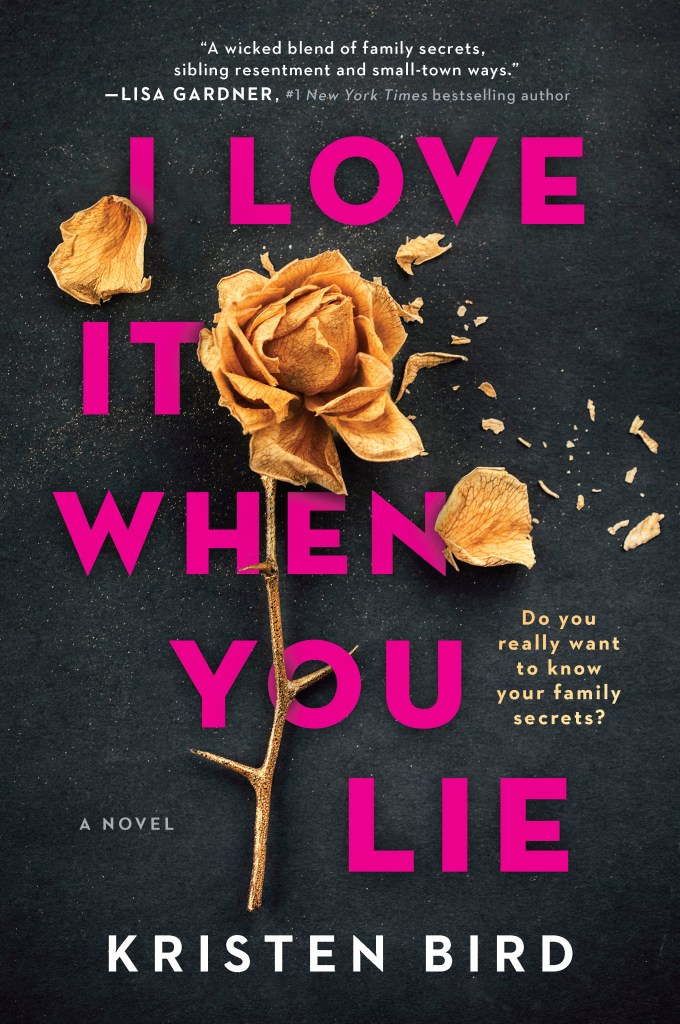
Excerpt from I Love It When You Lie by Kristen Bird

The Sheriff’s Office in Willow Gap, AlabamaOne Week After

STEPHANIE

It would’ve been a touching moment except for the reality of the grave at their feet. Gran’s grave. I shiver just thinking about the three Williams sisters standing in the family cemetery, their arms entwined, gazing up at the sunrise, all that cool Alabama clay piled beside them, their fingernails packed with the red earth, the stench of what they’d done in their nostrils. It was Decoration Sunday, the one day of the year when the entire family descended on Gran’s property to pay respect to the dead and gossip about those still living.

Tara, June, and Clementine Williams are my sisters-in-law. For so long, I’ve waited for the day that their little coven would topple some man’s ivory tower. Now that the time has come, I realize that each of us has a man that we might be better off without, but only one of us is lucky enough to have actually rid ourselves of him. 

Four men: a preacher, a doctor, a professor, and a mayor. One goes missing. It’s like our own little Willow Gap edition of Clue. How charming.

Sheriff Brady Dean, his badge shining in the interrogation lights, brings me back to the moment at hand, the moment of reckoning. The aged sheriff wants to know what I know, wants me to spill all the whys, whens, wheres, and hows of the Williams sisters over the past forty-eight hours.

“I’m sure you know why you’re here, Mrs. Williams.” The words emerge like a sigh. He’s been after this family for more than thirty years, ever since he was first elected. Poor guy. Must be exhausted.

I meet the sheriff eye to eye, tapping my recently painted nails—Los Angeles Latte, the dark bottle of polish had read—against the metal table in the claustrophobic office where he’s brought me for questioning. Not that I’m the one in trouble here.

My husband, Walker Williams, knew Sheriff Dean before Walker and I ever met and married a decade ago. Some say ours was a Yankee seduction, but I don’t care. Walker has been the mayor now for eight years, and they have to put up with me, the damn Yank in their midst.

I think of my three children—Walker Jr. and Auggie and Bella—their features too much like my husband’s. They’re fine, I remind myself. They’re with the nanny while I’m here tying up all of the loose ends. I shake my head to dislodge their faces from my mind. It’s important that I focus. I must get this right.

“Call me Ms. Chadrick. Or Stephanie. I’ll be using my maiden name soon enough,” I tell the sheriff.

Sheriff Dean clears his throat, and I follow his eyes to my hand. I’m still wearing my massive diamond, the one Walker bought for our last anniversary. To ten years, baby, and a lifetime more, he’d said as he slipped it on my finger in our Nashville hotel room. I’m not planning to part with my jewelry just because my husband can’t keep his dick in his pants.

I blink innocently at the sheriff and twist my ring around, pressing the stone into my palm until it bites. “I’m here to tell you what I saw after Gran Williams’s funeral. Isn’t that right?”

“Yes’m.” The sheriff lets out a heavy breath that reaches all the way down to the gut hanging over his belt. “I know these women are your husband’s sisters, but we’re hoping…”

“Soon to be ex-husband,” I fire back, reminding him once again.

“Fine. As I was saying, we’re hoping you’ll be willing to give us an account of the movement of your sisters-in-law these past few days. With a missing person, time is of the essence.”

He gives me one of those indulgent smiles saved only for a wronged woman. He knows about my cheating bastard of a spouse, and I breathe, reminding myself again that I’m in good company. Jackie O., Eleanor Roosevelt, Hillary—all of these fine ladies were cheated on by their infamous yet politically savvy husbands. Remembering them makes it easier for me to deal with the fact that everyone knows about Walker and his lying ways.

When I first moved here from DC, I thought my new husband and his town were adorable, quaint even. As I prepared for Walker’s bid for mayor, I even got a kick out of researching its history at the local library, trying to understand the place where generations of Walker’s family had lived for so long.

Alabama. Some historians say the word is from a Native American language and means “tribal town” or “vegetation gatherers.” My favorite definition of the word, though, was penned by one Alexander Beauford Meek, a highly unreliable 

source, but isn’t that what history is made of? Mr. Meek said that the word means “here we rest.” Alabama: here we rest. It’s deliciously spooky, isn’t it? Like something from one of those Faulkner stories I couldn’t get enough of in college.

To be fair though, my problem isn’t actually with the great state of Alabama. It’s with these people, this town, this family. They forget so easily that I’m a part of them now, for better or worse. They forget that I know where all the bodies are buried, and I’m not just talking about their kinfolk in the family cemetery a couple hundred yards down the hill from Gran’s house.

The sheriff clears his throat and tries again. “As I was sayin’, we’re hopin’ you can give us a clearer account of who all was there and what exactly went on, so we can understand what led to our missing person. He’s an important man, a good man, and the last time anyone laid eyes on him was Saturday evening a few hours after the funeral at Gran Williams’s cabin.”

Our missing person. There’s something so possessive in the phrase. I almost giggle, realizing that this man is handing me my chance on a silver platter, an opportunity to expose every inch of the Williams family drama.

“Sheriff, ask me any question, and I’ll tell you exactly what you want to hear.” I cross my legs and study my cuticles. “Although, if you want to know the whole truth, you need to go a lot further back than the past few days.”

I take a sip of the coffee he brought me earlier and stretch my arms in front of me as if preparing for a catnap. I wonder if the sheriff realizes just how far back he needs to reach, how far down he needs to dig until he hits something like the truth.

The sheriff nods at me to continue, and I notice again the plump circles hanging under his eyes. He sneezes into the crook of his arm and settles in for the real reason why people involved with the Williams family might just disappear.

I sit up straighter. “All right, then. Let’s start with the dead one.”

Excerpted from I Love It When You Lie. Copyright © 2023 by Kristen Bird. Published by MIRA Books.

PURCHASE BOOK HERE

DID YOU ENJOY WHAT YOU JUST READ? IF YES, THEN SUBSCRIBE TO THE BLOG, GIVE THE POST A LIKE, OR LEAVE A COMMENT! NEW POSTS ARE UP EVERY TUESDAY & THURSDAY!

Excerpt: Someone Had To Do It by Amber & Danielle Brown

BRANDI

I had a ton of illusions, vivid fantasies of what it would be like to score a coveted internship at Van Doren. Deluded old me thought I would be strutting around the stunning tri-story headquarters in single-soled heels, flitting from design concept meetings to on-location photo shoots, living my best fashion-girl life. Instead, I’m in the back corner of the two-thousand-square-foot ready-to-wear samples closet scrubbing fresh vomit from a slinky gown worth double my rent during my lunch hour.

Italian Vogue’s current cover girl borrowed the hand-sewn dress for a red-carpet event last night, and apparently getting it back on a rack without ruining it was too much for one of the other interns to handle. She was so hungover when she came to the office this morning that she vomited all over the dress before making it out of the elevator. But of course this dress needs to be ready for another model to wear to some big extravaganza tonight, and since I’m the designated fuckover intern, I have to clean it by hand because the satin-blend fabric is too delicate to be dry-cleaned.

This is what it takes.

I chant this to remind myself why I’m here as the lactic acid builds up in my biceps. Working for Van Doren has been on my proverbial vision board ever since I reluctantly gave up the idea, in middle school, that I could be Beyoncé. It’s a storm of hauling hundreds of pounds of runway samples around the city and sitting in on meetings with the sketch artists. A glorious, next-to-holy experience when I’m on duty at photo shoots and one of the stylists sends me to fetch another blazer, not a specific blazer, which means I get to use my own vestiary inclinations to make the selection. Which has only happened once, but still.

Just as I get the stain faded by at least seventy percent, I hear the sharp staccato of someone in stilettos approaching. I turn around and see Lexi. Lexi with her bimonthly touched-up white-blond hair and generous lip filler that she’ll never admit to having injected. When she steps closer in her head-to-toe Reformation, I am grateful that I remembered to put on a few sprays of my Gypsy Water perfume. The one that smells like rich people. But the way she’s staring at me right now, it’s clear that no matter how much I try, I am still not on her level. I do not fit in here. She does not see me as her equal, despite the fact that we are both unpaid, unknown, disposable interns. It’s become glaringly obvious that at Van Doren, it’s not actually about what you contribute, but more about how blue your blood is. Lexi doesn’t even know my name, though I’ve been here a solid nine weeks and I’m pretty sure I’ve told her at least a dozen times.

I’m already on edge because of my assignment, so I jump in before she can ask in her monotone voice. “Brandi.”

“Right,” she says, like she does every time yet still forgets. “Chloé wants the Instagram analytics report for last week. She said she asked you to put it together an hour ago.”

Which is true, but completely unfair since Jenna from marketing also asked me to run to Starbucks to buy thirty-one-ounce cups of liquid crack for her and her entire department for a 9:00 a.m. meeting, an effort that took three trips total, and technically I’m still working on the data sheets I promised Eric from product development. Not to mention the obvious: getting rid of the puke from the dress.

“I’m still working on it,” I tell her.

Lexi stares at me, her overly filled brows lifted, as if she’s waiting for the rest of my excuse. I understand her, but also I’m wondering how she still hasn’t realized this is not a case of Resting Bitch Face I have going on, that I am actually intolerant of her nagging.

Normally, I am not this terse. But nothing about today has been normal. Since this week is my period week, I’m retaining water in the most unflattering of places and the pencil dress I’m wearing has been cutting off the circulation in my thighs for the past couple of hours, and being that I’ve spent most of my break destroying the evidence of someone else’s bad decisions, it is not my fault that I’m not handling this particularly well.

“I’ll send it over as soon as I’m done,” I say to Lexi so she can leave. But she doesn’t.

“HR wants to see you,” she says with what looks like a smirk.

My mouth opens. I have no idea what HR could want, and although I’m still new to this employee thing, I know this can’t be good.

“Like, now,” Lexi barks and pivots away in her strappy, open-toe stilts.

I hang the sample next to the door, and before I leave the room I pause to briefly take in the rest of the dresses stuffed on the racks, each one in that chic, elevated aesthetic that is the cornerstone of Van Doren. This is my favorite part of the day, the chaotic nature of this room a little overwhelming but also inspiring, and I can’t wait for the day that this is my world, not just one I’m peeking my head into. A world in which I command respect.

I cross through the merchandising department, where everyone has their own private office with aerial views of Hell’s Kitchen, Soho and the Garment District, and then move through the maze of the sprawling suite in a mild sort of panic until I remind myself that I have done nothing wrong. Ever since spring semester ended, I’ve been putting in more hours than the sun. I slip in at six-thirty when the building is dark and vaguely ominous, my eyes still puffy with sleep, and when I finally drag myself into the elevator at the end of the day, it’s just as black and quiet outside. I religiously show up in current-season heels despite the blisters, albeit mass-produced renditions of the Fendi, Balenciaga and Bottega Venetas the other summer interns casually strut around in, and mostly stick to myself. I am careful about raising my voice, even if I vehemently disagree with my neurotic supervisor. I keep my tongue as puritanical as a nun’s, even when fucking incel or coddled narcissistic bitch are on the tip of it. I’m not rude or combative. I stay away from gossip. I complete all my tasks with time to spare, which is usually when I check Twitter and help out some of the other interns, even though I’d rather FaceTime Nate in the upstairs bathroom with the magical lighting. I even entertain the gang of sartorially inclined Amy Coopers in the making who insist on obnoxiously complaining to me about all of their first-world, one-percenter problems. I’ve done nothing but consistently given them reasons to think I am a capable, qualified, talented intern who would make an exceptional employee.

I have nothing to worry about.

When I knock on the door to Lauren’s office, she looks up from her desk and waves me in through the glass. I have a feeling this will not go my way when I see that my supervisor, Chloé, one of the more amiable assistants, is also here, fiddling with her six-carat engagement ring in the corner and avoiding eye contact.

“Have a seat, Brandi,” Lauren says, and I tell myself to ignore that her bright pink lipstick extends above her lip on one side.

There is no small talk. No hello or how’s it going? Under alternate circumstances, I would feel slighted, but because I’m growing more anxious by the second, I’m grateful for her smugness.

As I sit down, Chloé shifts in her chair, and I speak before she can. “I’m sorry. The Instagram report is at the top of my task list. I’ll definitely have it to you before I leave today. I just—”

“That’s not why you’re here, Brandi,” Lauren interjects.

“Oh.” I pause, and as she glances down at her notes, I try to make meaningful eye contact with my supervisor, but she is still actively dodging my eyes.

Lauren begins by throwing out a few compliments. My work ethic is admirable and I have great attention to detail, she says, and the whole time my heart is pounding so loud, I can barely make out most of her words. Chloé jumps in to effusively agree, then Lauren finally stops beating around the bush and looks me directly in the eyes.

“We just don’t feel like you’re fitting into the culture here at Van Doren.”

Every word feels like a backhanded slap across the face, the kind that twists your neck and makes the world go still and white for a few disconcerting moments, like an orgasm but not like an orgasm. It’s obvious what they mean, yet can’t quite bring themselves to say.

They just don’t like that I’m black.

They don’t like the way I wear my braids—long and unapologetic, grazing my hips like a Nubian mermaid.

They don’t like that I’m not the smile-and-nod type, willing to assimilate to their idea of what I should be, how I should act.

Culture.

That’s their code for we-can’t-handle-your-individuality-but-since-we-don’t-want-to-seem-racist-we’ll-invent-this-little-loophole.

Black plus exceptional equals threat.

“If we don’t see any improvement in the coming weeks, we’re going to have to let you go,” Lauren says with no irony, her mouth easing into a synthetic smile.

I blink. I cannot believe this is happening right now. It wasn’t supposed to go like this, my internship at Van Doren, the one fashion company whose ethics align with mine. I wasn’t just blowing smoke up Lauren’s ass when I interviewed for this job, though I was looking at her sideways, wondering why she had not a stitch of Van Doren on. I’d splurged on a single-shouldered jumpsuit from this year’s spring collection that I couldn’t really afford just to impress her, while she hadn’t even felt the need to represent the brand at all as she shot out all those futile questions interviewers love propelling at candidates, I’m convinced, just to see them squirm. Even minuscule amounts of power can be dangerous.

This is bullshit, being put on probation, and I’d give anything to have the balls to call them on it. As I sit here paralyzed, Lauren’s words reverberate in my head and I rebuke them, want to suffocate and bury them.

ORDER BOOK HERE

DID YOU ENJOY WHAT YOU JUST READ? IF YES, THEN SUBSCRIBE TO THE BLOG, GIVE THE POST A LIKE, OR LEAVE A COMMENT! NEW POSTS ARE UP EVERY TUESDAY & THURSDAY!

Excerpt: Number One Fan by Meg Elison

CHAPTER 1

 The car rolled into view, the lit decals on the dashboard letting Eli know that her driver was typical: working for all the rideshare services at once.

Gotta hustle, she thought as she quickened her pace away from the airfield. She hoped he hadn’t been waiting long.

“Elizabeth?” He seemed bored, not even bothering to turn around.

“That’s right. I go by Eli, though.”

“Sure,” he said, tapping his phone.

She settled in, her satchel beside her. “Thank you.”

The car was air conditioned against the cushion of heat that pressed against its tinted windows, and as they headed toward the freeway, she finally began to relax. She was grateful the driver didn’t seem to want to talk. She was tired of talking from the event, and her throat was dry and sore.

“There is a cold drink there in the cup holder. Down in the door.” His voice was low, a raspy baritone.

“Oh, cool, thanks.” Eli reached down and felt the blessed condensation on a plastic bottle. She pulled up a blue Gatorade and wrenched it open, suddenly very thirsty. She drank half of it in huge gulps, disliking the weird, salty taste of the electrolyte mixture but unable to stop herself. It felt good, after hours of talking and the dry air of the flight. She breathed deep and drank again, coming close to finishing it off.

Must be the heat, she thought. That and the two miniature bottles of Jack Daniel’s she’d had to calm her nerves on the plane.

Her phone vibrated in her pocket in an unfamiliar cadence and she slid it out to check.

Her notification from the rideshare app blared BRENDA HAS CANCELED THE RIDE FOR REASON: NO-SHOW. YOU HAVE BEEN CHARGED A CANCELLATION FEE OF $5.

Eli frowned at her phone. Had she summoned two cars by accident?

She unlocked it with her facial scan and checked. The app showed only one ride: a black Prius driven by Brenda, which had arrived five minutes ago and canceled four minutes after that.

It wasn’t a busy day at the airfield. It certainly wasn’t curbside pickup at SFO, but it was still possible that she had gotten in the wrong car.

But he had known her name.

She leaned forward to get the driver’s attention. “Hey, just clarifying—you’ve got my info, right? I just got a cancellation from another driver, and I’m worried that I got someone else’s ride.”

The driver tapped his phone and his eyes darted between it, the rearview mirror, and the road. “Elizabeth Grey. Headed to the Sheraton, right?”

The phone displayed a highlighted blue route along the freeway. It was a map program, rather than the rideshare’s software, but Eli had seen drivers toggle between those before. She glanced up at the rearview mirror, but his eyes were on the road and he had put on a pair of dark glasses.

“Right,” she said. “Huh. Wonder what happened.”

Eli settled back into her seat. She stared out the window and thought of home, of the deep grey fog rolling down over the hillsides and the wind coming in, salty from the Bay. She was homesick. Even in the same state, the air felt wrong on her skin. Los Angeles had been an endless parade of palm trees against a blameless sky, and the tacos were so good she could barely stop shoveling them in, but the traffic had left her feeling exhausted upon every arrival.

And then there was the way that people looked you over in Los Angeles, deciding whether you were famous or fuckable or useful in some other way before sliding on to the next thing. Her audiences had been lively and engaging but draining, and after each of her events, she’d wanted nothing but some dinner, a hot bath and sleep. Maybe a couple fingers of bourbon over ice.

Traveling always left her wrung-out and unmoored. It didn’t help that the sun was so all-encompassing outside the car it could have been anywhere, any time of day, the hot, white light blinding. She couldn’t look at a surface other than the black asphalt without squinting. Living in San Francisco gave her what she had thought was a passing acquaintance with the sun, but the glare as the 10 freeway led out of Los Angeles county and into the high desert landscape was just too much.

How are people here not dog-tired all the time? Doesn’t the heat suck all the life out of them? How do they ever leave the house? Christ, it’s March. Imagine later in the year. I gotta get some sunglasses.

She set the phone beside her on the seat to avoid pawing it in and out of her jeans. She belatedly buckled her seatbelt as they picked up speed. Out the window, the freeway was sliding past, one unfamiliar mile blending into the next.

The driver turned his radio on. It annoyed her at first that he had not asked, but then she reminded herself that he probably spent the whole day in his car. She wasn’t talking; he was probably both lonely and bored. Let him have his Oingo Boingo.

He changed lanes to get into the faster flow of traffic and the motion of it made her feel a trifle ill. This heat had produced all kinds of new feelings. She ignored it, drinking the last swallow of the Gatorade.

She looked around for a polite place to deposit the bottle. The motion of her head made her dizziness worse and she tried to blink it away. “Do you have a spot for trash?” she asked him. As the words slid out of her mouth, she realized she was slurring like she was very, very drunk. She was horrified to realize she was drooling, too.

Eli tried to get a hold of herself. She pushed with her palms and worked to sit up straight but found that she could not. Her head felt far too heavy for the wet noodle of her neck to have ever supported. Her abs were slack and her spine was a worm. She sagged against the seat; the seatbelt the only thing keeping her from sliding to the floor.

“Whass going on?” The words seemed to take a long time to reach her ears.

Oh shit, I’m having a stroke. An old classmate  of Eli’s had had a freak stroke event a week shy of her thirtieth birthday. Frantically, she tried to recall the diagnostic that the woman had posted on Facebook right after. She couldn’t speak clearly. She couldn’t lift her arms at all. Her hand flopped uselessly in the direction of her phone.

“Ooogoada tachme to ahspital,” she slurred at him in molasses-thick nightmare slowness. “Shumding wruuuuunnnnng.”

“Relax,” he said clearly, his voice less deep than before. “You are fine.”

With her last spasm of strength, Eli pulled at the door handle, intending to tumble out of the car. The child safety lock held her in place.

I’m not fine, she thought with her last clear and lucid moment. As her eyes fell closed like heavy curtains, she finally registered that they were going the wrong way. The steely spike of panic that stabbed at her heart was almost enough to counteract the soporific effect of whatever was wrong with her, but not quite. Fighting, terrified, she slipped out of consciousness.

Excerpted from Number One Fan by Meg Elison, Copyright © 2022 by Meg Elison. Published by MIRA Books.

Purchase the book on Amazon!

DID YOU ENJOY WHAT YOU JUST READ? IF YES, THEN SUBSCRIBE TO THE BLOG, GIVE THE POST A LIKE, OR LEAVE A COMMENT! NEW POSTS ARE UP EVERY TUESDAY & THURSDAY!
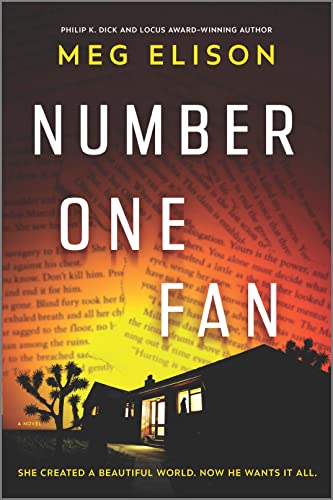
Book Excerpt: Fan Club by Erin Mayer

Chapter One

I’m outside for a cumulative ten minutes each day before work. Five to walk from my apartment building to the subway, another five to go from the subway to the anemic obelisk that houses my office. I try to breathe as deeply as I can in those minutes, because I never know how long it will be until I take fresh air into my lungs again. Not that the city air is all that fresh, tinged with the sharp stench of old garbage, pollution’s metallic swirl. But it beats the stale oxygen of the office, already filtered through distant respiratory systems. Sometimes, during slow moments at my desk, I inhale and try to imagine those other nostrils and lungs that have already processed this same air. I’m not sure how it works in reality, any knowledge I once had of the intricacies of breathing having been long ago discarded by more useful information, but the image comforts me. Usually, I picture a middle-aged man with greying temples, a fringe of visible nose hair, and a coffee stain on the collar of his baby blue button-down. He looks nothing and everything like my father. An every-father, if you will.

My office is populated by dyed-blonde or pierced brunette women in their mid-to-late twenties and early thirties. The occasional man, just a touch older than most of the women, but still young enough to give off the faint impression that he DJs at Meatpacking nightclubs for extra cash on the weekends.

We are the new corporate Americans, the offspring of the grey-templed men. We wear tastefully ripped jeans and cozy sweaters to the office instead of blazers and trousers. Display a tattoo here and there—our supervisors don’t mind; in fact, they have the most ink. We eat yogurt for breakfast, work through lunch, leave the office at six if we’re lucky, arriving home with just enough time to order dinner from an app and watch two or three hours of Netflix before collapsing into bed from exhaustion we haven’t earned. Exhaustion that lives in the brain, not the body, and cannot be relieved by a mere eight hours of sleep.

Nobody understands exactly what it is we do here, and neither do we. I push through revolving glass door, run my wallet over the card reader, which beeps as my ID scans through the stiff leather, and half-wave in the direction of the uniformed security guard behind the desk, whose face my eyes never quite reach so I can’t tell you what he looks like. He’s just one of the many set-pieces staging the scene of my days.

The elevator ride to the eleventh floor is long enough to skim one-third of a longform article on my phone. I barely register what it’s about, something loosely political, or who is standing next to me in the cramped elevator.

When the doors slide open on eleven, we both get off.

In the dim eleventh-floor lobby, a humming neon light shaping the company logo assaults my sleep-swollen eyes like the prick of a dozen tiny needles. Today, a small section has burned out, creating a skip in the letter w. Below the logo is a tufted cerulean velvet couch where guests wait to be welcomed. To the left there’s a mirrored wall reflecting the vestibule; people sometimes pause there to take photos on the way to and from the office, usually on the Friday afternoon before a long weekend. I see the photos later while scrolling through my various feeds at home in bed. They hit me one after another like shots of tequila: See ya Tuesday! *margarita emoji* Peace out for the long weekend! *palm tree emoji* Byeeeeee! *peace sign emoji.*

She steps in front of me, my elevator companion. Black Rag & Bone ankle boots gleaming, blade-tipped pixie cut grazing her ears. Her neck piercing taunts me, those winking silver balls on either side of her spine. She’s Lexi O’ Connell, the website’s senior editor. She walks ahead with her head angled down, thumb working her phone’s keyboard, and doesn’t look up as she shoves the interior door open, palm to the glass.

I trip over the back of one clunky winter boot with the other as I speed up, considering whether to call out for her attention. It’s what a good web producer, one who is eager to move on from the endless drudgery of copy-pasting and resizing and into the slightly more thrilling drudgery of writing and rewriting, would do.

By the time I regain my footing, I come face-to-face with the smear of her handprint as the door glides shut in front of me.

Monday.

I work at a website.

It’s like most other websites; we publish content, mostly articles: news stories, essays, interviews, glossed over with the polished opalescent sheen of commercialized feminism. The occasional quiz, video, or photoshoot rounds out our offerings. This is how websites work in the age of ad revenue: Each provides a slightly varied selection of mindless entertainment, news updates, and watered-down hot takes about everything from climate change to plus size fashion, hawking their wares on the digital marketplace, leaving The Reader to wander drunkenly through the bazaar, wielding her cursor like an Amex. You can find everything you’d want to read in one place online, dozens of times over. The algorithms have erased choice. Search engines and social media platforms, they know what you want before you do.

As a web producer, my job is to input article text into the website’s proprietary content management system, or CMS. I’m a digitized high school janitor; I clean up the small messes, the litter that misses the rim of the garbage can. I make sure the links are working and the images are high resolution. When anything bigger comes up, it goes to an editor or IT. I’m an expert in nothing, a master of the miniscule fixes.

There are five of us who produce for the entire website, each handling about 20 articles a day. We sit at a long grey table on display at the very center of the open office, surrounded on all sides by editors and writers.

The web producers’ bullpen, Lexi calls it.

The light fixture above the table buzzes loudly like a nest of bees is trapped inside the fluorescent tubing. I drop my bag on the floor and take a seat, shedding my coat like a layer of skin. My chair faces the beauty editor’s desk, the cruelest seat in the house. All day long, I watch Charlotte Miller receive package after package stuffed with pastel tissue paper. Inside those packages: lipstick, foundation, perfume, happiness. A thousand simulacrums of Christmas morning spread across the two-hundred and sixty-one workdays of the year. She has piled the trappings of Brooklyn hipsterdom on top of her blonde, big-toothed, prettiness. Wire-frame glasses, a tattoo of a constellation on her inner left forearm, a rose gold nose ring. She seems Texan, but she’s actually from some wholesome upper Midwestern state, I can never remember which one. Right now, she applies red lipstick from a warm golden tube in the flat gleam of the golden mirror next to her monitor. Everything about her is color-coordinated.

I open my laptop. The screen blinks twice and prompts me for my password. I type it in, and the CMS appears, open to where I left it when I signed off the previous evening. Our CMS is called LIZZIE. There’s a rumor that it was named after Lizzie Borden, christened during the pre-launch party when the tech team pounded too many shots after they finished coding. As in, “Lizzie Borden took an ax and gave her mother forty whacks.” Lizzie Borden rebranded in the 21st century as a symbol of righteous feminine anger. LIZZIE, my best friend, my closest confidant. She’s an equally comforting and infuriating presence, constant in her bland attention. She gazes at me, always emotionless, saying nothing as she watches me teeter on the edge, fighting tears or trying not to doze at my desk or simply staring, in search of answers she cannot provide.

My eyes droop in their sockets as I scan the articles that were submitted before I arrived this morning. The whites threaten to turn liquid and splash onto my keyboard, pool between the keys and jiggle like eggs minus the yolks. Thinking of this causes a tiny laugh to slip out from between my clenched lips. Charlotte slides the cap onto her lipstick, glares at me over the lip of the mirror.

“Morning.”

That’s Tom, the only male web producer, who sits across and slightly left of me, keeping my view of Charlotte’s towering wonderland of boxes and bags clear. He’s four years older than me, twenty-eight, but the plush chipmunk curve of his cheeks makes him appear much younger, like he’s about to graduate high school. He’s cute, though, in the way of a movie star who always gets cast as the geek in teen comedies. Definitely hot but dress him down in an argyle sweater and glasses and he could be a Hollywood nerd. I’ve always wanted to ask him why he works here, doing this. There isn’t really a web producer archetype. We’re all different, a true island of misfit toys.

But if there is a type, Tom doesn’t fit it. He seems smart and driven. He’s consistently the only person who attends company book club meetings having read that month’s selection from cover to cover. I’ve never asked him why he works here because we don’t talk much. No one in our office talks much. Not out loud, anyway. We communicate through a private Morse code, fingers dancing on keys, expressions scanned and evaluated from a distance.

Sometimes I think about flirting with Tom, for something to do, but he wears a wedding ring. Not that I care about his wife; it’s more the fear of rebuff and rejection, of hearing the low-voiced Sorry, I’m married, that stops me. He usually sails in a few minutes after I do, smelling like his bodega coffee and the egg sandwich he carefully unwraps and eats at his desk. He nods in my direction. Morning is the only word we’ve exchanged the entire time I’ve worked here, which is coming up on a year in January. It’s not even a greeting, merely a statement of fact. It is morning and we’re both here. Again.

Three hundred and sixty-five days lost to the hum and twitch and click. I can’t seem to remember how I got here. It all feels like a dream. The mundane kind, full of banal details, but something slightly off about it all. I don’t remember applying for the job, or interviewing. One day, an offer letter appeared in my inbox and I signed.

And here I am. Day after day, I wait for someone to need me. I open articles. I tweak the formatting, check the links, correct the occasional typo that catches my eye. It isn’t really my job to copy edit, or even to read closely, but sometimes I notice things, grammatical errors or awkward phrasing, and I then can’t not notice them; I have to put them right or else they nag like a papercut on the soft webbing connecting two fingers. The brain wants to be useful. It craves activity, even after almost three hundred and sixty-five days of operating at its lowest frequency.

I open emails. I download attachments. I insert numbers into spreadsheets. I email those spreadsheets to Lexi and my direct boss, Ashley, who manages the homepage.

None of it ever seems to add up to anything.

Excerpted from Fan Club by Erin Mayer, Copyright © 2021 by Erin Mayer. Published by MIRA Books.

PURCHASE YOUR COPY TODAY!

DID YOU ENJOY WHAT YOU JUST READ? IF YES, THEN SUBSCRIBE TO THE BLOG, GIVE THE POST A LIKE, OR LEAVE A COMMENT! NEW POSTS ARE UP EVERY TUESDAY & THURSDAY!

Excerpt: “Boys of Summer” by Azzurra Nox

The Lost Boys has been my favourite movie ever since I watched it for the very first time at 8 years old. The film has everything I love – vampires, rock music, and a combo of humour and horror. In light of my adoration for The Lost Boys and the fact that I spent most of 2020 writing so I wouldn’t have to deal with the stresses of a global pandemic – I decided to write a short story inspired by The Lost Boy, entitled, “Boys of Summer.”

My only gripe about The Lost Boys was the fact that the whole movie had only TWO female characters – so in my take – I made women the protagonists while I sidelined the boys into the background.

Here’s an excerpt of that story – it drops today and can be found in Little Demon Digest Volume II. You can pick up a copy HERE.

I was halfway into the cave when the drugs finally hit, and I regretted my decision. The scent of mildew, seawater, and copper hit me smack in the face before I had a chance to see the carnage. Before I had an inkling of what was to become of me too. Bugs pirouetted as I tripped over a bone. The candles scattered throughout the cave gave me tiny glimpses of a world that up to that point I never realized existed. The boys behind me laughed, their teasing casual as though I hadn’t just fallen on the remains of a decaying corpse. I screamed as I tried to move away from the maggot-infested body but unable to because the older boy with the bleached mullet and leather trenchcoat placed a hand on my shoulder to stop me.

“They’re only worms, Ashley. There’s nothing to be afraid of.” He laughed.

The others joined him. They were all in on the sick joke except me.

I blinked and saw that the body was gone and my hands weren’t dirty with blood as I thought. As the cave came into clearer view I realized that it was only seaweed tangled in my fingers and seasnails on a broken piece of surfboard ravaged by time.

The blond offered me his hand with a sheepish grin to remind me that they were just teasing. That I was in good company. That I was safe.

But I couldn’t stop thinking about all the vacant expressions of those girls whose photos were plastered all along the boardwalk. I was haunted by the words in bold hovering over their images, HAVE YOU SEEN ME? Only two weeks ago a crazed fan had shot and killed Rebecca Schaeffer, rising star of the popular sit-com My Sister Sam. Natalie and I would always watch the crazy adventures of Sam and Patti curled on the couch with Doritos and slurping Cherry Coke. A sudden dread overcame me as I saw myself as those boys saw me. Petite, lanky, unable to put up a good fight. My mouth felt dry as the aftertaste of chalk lingered on my tongue.

I know I shouldn’t have followed them there. Isolated from the rest of the world. And an isolated girl was always in danger. But I was aching for adventure. I yearned for a little thrill.

Standing up, I looked up at the blond’s unnaturally pale face.

“You never told me your name,” I whispered.

The other boys laughed and mocked me. “Go ahead, tell her your name.”

But he merely smiled without answering me. Instead, he handed me a jewel-encrusted bottle and said, “Drink.”

I knew that I shouldn’t have. But I was thirsty. Anything to rid myself of that awful taste. So I did as I was told.

The faint notes of Madonna’s hit song echoed in the night like a siren luring me back out into the world. Life is a mystery.

A misstep was made. I was never supposed to survive the night. Yet, I did. Life may be a mystery but there’s no greater mystery than death. Those who defy it are basically divine. Or possibly evil.

DID YOU ENJOY WHAT YOU JUST READ? IF YES, THEN SUBSCRIBE TO THE BLOG, GIVE THE POST A LIKE, OR LEAVE A COMMENT! NEW POSTS ARE UP EVERY TUESDAY & THURSDAY!

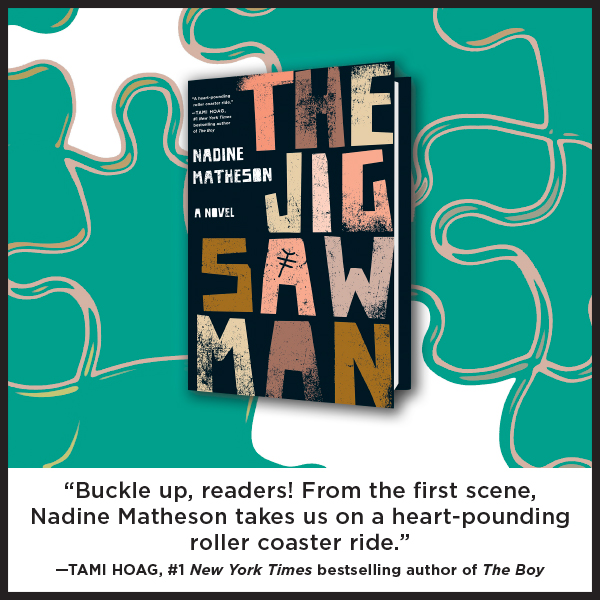
Book Excerpt: The Jigsaw Man by Nadine Matheson

Chapter Two

‘How long have we got until the tide comes in?’ Henley was facing the river watching the small waves crashing against the derelict pier. She checked her watch. Nearly two hours had passed since the first 999 call.

‘I checked online, and high tide is at 9.55 a.m.’ Ramouter replied as he stepped around a half-submerged car tire, his eyes glazed with anxiety. ‘Low tide was at 3.15. Sunrise was at 6.32. A three-hour window for someone to dump whoever this is and hope that someone would find it before the tide comes in?’

‘Maybe,’ Henley acknowledged. ‘But for all we know it could have been dumped after sunrise or was dumped earlier upstream before being washed up here.’ She inspected the glass façade of the Borthwick Wharf, empty commercial spaces and work units that opened to the terrace and lacked security cameras. Henley doubted that the local council would have extended their own CCTV cameras to this part of the street. They had been neglecting this part of Deptford for as long as she could remember.

‘Has it been touched?’ Henley asked Anthony who had appeared at her side.

‘As far as I’m aware, it’s in situ. It wasn’t touched by the woman who found it. Matei, your builder, said that he hadn’t touched the legs but unhelpfully, it’s covered in his vomit. I had a quick look at the arms that were found downstream before I came here. From the looks of things, the treasure hunters may have prodded around a bit.’

‘There’s always one.’

The wind dropped and the air softly crackled with the electricity generated from the substation nearby.

‘We’re isolating the recovery of evidence to the direct path from the alleyway to the torso,’ said Anthony. ‘I doubt very much that whoever it was sat here and had a coffee afterwards.’

‘They may not have had a coffee, but if we go with Ramouter’s theory and the body parts have been dumped then whoever it was certainly knows the river,’ Henley replied. ‘We’ll let you get on. Ramouter and I are going to take a walk.’

‘Where are we going?’ asked Ramouter.

‘To meet Eastwood.’

‘And you want to walk it?’

Henley did her best to push aside her frustration when Ramouter pulled out his phone. ‘Google maps says that Greenwich pier is almost a mile away,’ he said.

‘Your body-part dumper isn’t the only one who knows the river,’ Anthony shouted out as Henley began to walk determinedly along the riverbank.

The gold scepters on the twin domed roofs of the Old Royal Naval College pierced the cloudless sky. The bare masts of the restored Cutty Sark completed the historical panoramic view that Greenwich was known for. It was a resplendent, whitewashed version of history that contrasted with the sewage that washed ashore. Henley stopped walking when she realized that she could no longer hear the sounds of Ramouter’s leather soles slipping on wet pebbles.

‘Where are you from?’ Henley asked, waiting for Ramouter to take off his jacket and loosen his tie. She moved closer towards the moss-covered river wall as the tide began to encroach.

‘Born in West Bromwich. Moved to Bradford when I was twelve.’ Ramouter tried to brush off the bits of mud that had stuck to his trousers, but they only smeared more. ‘Lots of moors, no rivers. Surely it would have been quicker in the car.’

‘This is quicker. Unless you fancy sitting in traffic for the next half hour while they raise the Creek Road Bridge.’

‘You know this area well?’

Henley ignored the question. She didn’t see the point in telling him that she could have walked this path with her eyes closed. That this small part of South-East London was ingrained in her. ‘Whoever dumped the torso would have taken this route. It doesn’t make any sense to come down here, go back up to the street level and then drive up to Watergate Street. Out of sight, below street level. Lighting would have been minimal.’

‘Body parts are heavy though,’ Ramouter tried to quicken his step to catch up with Henley. ‘The human head weighs at least eight pounds.’

‘I know.’ Henley pulled out her mobile phone, which had started to ring. She saw who it was and ignored the call.

‘Head, torso, arms, legs. That’s at least six individual body parts.’

‘I know that also. So, tell me, what point are you making?’ Henley waited for Ramouter to reach her before maneuvering him towards the river wall as though she was chaperoning a child.

‘I’m just saying that that’s a lot of dead weight to be carrying around at three in morning.’ Ramouter paused and placed his hand against the wall, trying to catch his breath.

Henley didn’t openly express her agreement. She fished out a black hair band from her jacket pocket and pulled her thick black curls into a ponytail. She had forgotten how much energy it took to walk across the gradient slope of the riverbank. Worse, she felt mentally unprepared for the job ahead, with a trainee struggling behind her who had no idea this was her first time as senior investigator in almost a year.

‘It’s a bit grim, isn’t it?’ DC Roxanne Eastwood shouted out as Henley finally reached the first crime scene. ‘Morning, Ramouter. Not a bad gig for your first day.’

Henley had always thought that Eastwood actually looked and carried herself like a detective. Now, Eastwood was poised on the riverbank, the sleeves of her jacket rolled up with her notebook in her hand. She had come prepared for the river and was wearing a pair of jeans and trainers that had seen better days.

‘Morning, Eastie. How does it feel to be out of the office?’ Henley asked, her eyes drifting to a crime scene investigator who was putting an arm into a black bag.

‘I should be asking you that,’ said Eastwood, with a look of concern.

Henley silently appreciated the empathy and placed her hand on Eastwood’s shoulder.

‘But since you asked, it’s bloody terrible. I think I’ve got sunburn.’ Eastwood rubbed a hand over her reddening forehead. ‘Forensics are going to be wrapping up in a bit. Not that there’s much for them to do. Bag it and tag it.’

‘Where’s Mr Thomas?’

‘Ah, our illustrious treasure hunter. Last time I saw him he was heading towards the shops. Said that he needed to get some water for his dog.’ Eastwood shook her head, obviously not believing a word of it. ‘I’ve got an officer keeping an eye on him. I wouldn’t be surprised if he’d already uploaded pictures of his find onto Instagram.’

‘I want him taken back to the station. Ramouter can take another statement from him.’ Henley said it purposely so that Ramouter would sense she was in control. ‘If he’s like most mudlarkers, he would have been out here first thing this morning waiting for the tide to go out. Where exactly were the arms found?’

‘Just over there.’ Eastwood pulled down her sunglasses and pointed towards the foamed waves created by a passing river bus. The tide had already come in where X had once marked the spot. A sense of urgency filled the air as the river regained its territory.

‘Did he say anything else?’

‘Only that he found the second arm about three feet away from the first.’

‘It’s a sick trail of breadcrumbs,’ said Henley.

‘You’re telling me and before you ask about CCTV, there’re loads of cameras—’

‘But none aimed at this part of the river.’

‘Exactly.’

Henley’s mobile phone began to ring. She pulled it out and answered. After a quick chat, she ended the call.

‘That was Dr Linh Choi. You wouldn’t have met her yet but she’s our go-to forensic pathologist. She’s just arrived,’ Henley explained to Ramouter. She wiped away the sweat from the back of her neck.

‘So, we’ve got two arms, both legs and a torso,’ said Ramouter. ‘Where’s the head?’

Good question. Henley thought of the places between the two locations. A primary school, two nurseries and an adventure playground among the flats and houses. The last thing she needed was to find a head in the kids’ sandpit.

‘Can I have a quick look?’ Henley asked the assistant from Anthony’s CSI team, who had just bagged up the arm and was scribbling in her notebook.

‘Sure.’ The assistant unzipped the bag and pushed the plastic apart.

‘Fuck,’ Henley said under her breath. Her heartbeat quickened, her stomach flipped.

‘Oh,’ said Ramouter as he peered over Henley’s shoulder. One arm was covered with gravel. Slivers of seaweed criss-crossed old scars. The second arm. Slender wrist, the ring finger slightly longer than the index, broken fingernails. Black skin. Henley could hear Pellacia’s words from earlier ringing in her ears.

‘Too early to say if it belongs to the same victim or if it’s more than just one.’

‘Call DSI Pellacia,’ Henley told Ramouter. ‘Tell him that we’ve got two possible murder victims.’

Excerpted from The Jigsaw Man by Nadine Matheson, Copyright © 2021 by Nadine Matheson

Published by Hanover Square Press

PURCHASE BOOK HERE

DID YOU ENJOY WHAT YOU JUST READ? IF YES, THEN SUBSCRIBE TO THE BLOG, GIVE THE POST A LIKE, OR LEAVE A COMMENT! NEW POSTS ARE UP EVERY TUESDAY & THURSDAY!
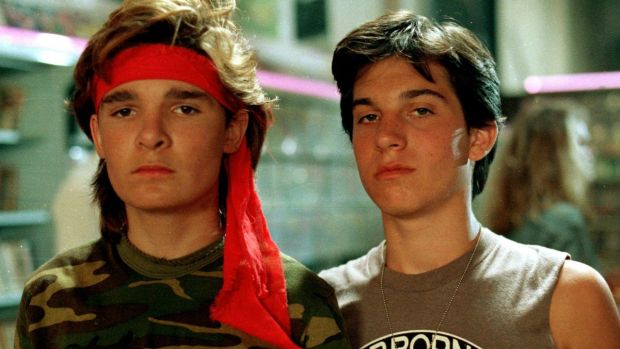
Excerpt: “Chronic Chills” by Hudson Wilding from Tainted Love: Women in Horror Anthology

Photo by RODNAE Productions on Pexels.com

Rumor had it that Oskar Abernathy rehearsed every week after choir practice, so Orchid lingered in the pews one evening after all her friends left. As Edinburgh’s meager light fell through the stained glass windows, Orchid tried to imitate the expression an older woman might take on while meditating on something holy and somber. Soon, the opening notes of “Lacrimosa” jolted her. She squeaked. The music stopped and Oskar rose to look at her from the organ bench at the front of the hall. He was wearing the same surprised expression one might have after seeing a mouse scamper up a curtain.

“Why, hello,” he said, smoothing his hands over the cufflinks on his tweed jacket. His conscientious way of dressing always gave her the impression he was waiting for a surprise visit from The Queen. Orchid could not escape the notion that he had arrived in the 1970s quite by mistake, belonging instead to an earlier time when his delicate complexion and precise mannerisms would have seemed less eccentric.

“You have the most beautiful handkerchiefs,” she told him, her high voice echoing across the large auditorium.

“They’re for my chronic chills,” Oskar replied as if her non sequitur was a completely ordinary attempt at conversation.

She walked closer to him, approximating the hip-sway of one of the older girls in the choir. “Your chronic chills?”

“Here,” he said, reaching out. “Feel my hand.”

She hesitated a moment before approaching the organ. Then she pressed two fingers gently into the skin of his outstretched palm. His fingers enveloped hers like a Venus flytrap closing around an insect at the Royal Botanic Gardens. The biting cold of his flesh shocked her. She’d heard rumors of his strange illness but had always assumed it was just town gossip.

“I’m sorry,” she said. “I didn’t mean to interrupt you.”

Only then did his grip relent. “I believe I was the one who interrupted you.”

***

Read this and other chilling tales in Tainted Love: Women in Horror Anthology! Check out the pre-order giveaway here!

DID YOU ENJOY WHAT YOU JUST READ? IF YES, THEN SUBSCRIBE TO THE BLOG, GIVE THE POST A LIKE, OR LEAVE A COMMENT! NEW POSTS ARE UP EVERY TUESDAY & THURSDAY!