
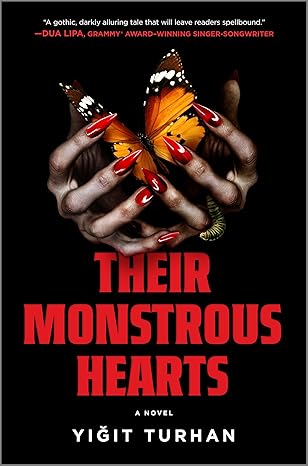
Excerpt: Their Monstrous Hearts by Yigit Turhan

Prologue

Perihan gazed at the opulent villas lined up like precious pearls on a necklace, feeling overwhelmed by their excessive beauty. The sight was almost terrifying, reminiscent of the antique pearls adorning her own necklace. As the dark clouds were illuminated by a sudden flash of lightning, she shook off her thoughts and quickened her pace along the deserted road. The gentle raindrops on her tired face felt like an omi­nous sign. The unexpected gust of wind, unusual for a mild November afternoon, added to her unease.

On her seventieth birthday, Perihan had indulged in a day of shopping at Milan’s most luxurious stores. Despite her age, she possessed a strong physique, with firm knees, agile move­ments, and enough strength to carry her shopping bags from the stores to her home. The kind store managers at Cartier and Valentino had offered to send the packages to her address with a courier, but she declined, insisting she could manage on her own. Though she lacked a family to celebrate with, her small group of friends had arranged to gather at the villa, refusing to let her spend the evening alone. They had asked her to leave the house and return around seven o’clock. Glancing at her watch, Perihan realized she was already half an hour late.

Oh my… Licia must have already set the table, she thought as she turned the corner onto Via Marco de Marchi, where she resided. Just then, another lightning bolt flashed across the sky, and a large monarch butterfly appeared seemingly out of nowhere. Despite the heavy rain, Perihan could hear the faint flapping of its wings. The butterfly had bright orange and black stripes, with one wing decorated with symmetric white dots. It seemed to hover in midair.

“What a miracle,” Perihan exclaimed, a smile stretching across her wrinkled face. “It’s been years since I last saw this one…and on my birthday!” Hastily shifting the heavy bags onto her shoulder, she wiped the raindrops from her eyes with her long red nails and followed the butterfly. It fluttered around in circles for a few moments, before darting straight ahead. Despite the downpour, the orange-and-black wings moved swiftly. Overwhelmed with excitement, Perihan dis­regarded the red light—and almost got hit by an old Ford passing by. The driver, an unattractive man with numerous moles and few teeth, leaned out of the window and cursed at her in an Italian dialect she couldn’t understand. Unfazed by his behavior, Perihan remained focused on following the butterfly, which flew rapidly and ascended into the sky.

“I wonder where it disappeared to,” she mused with a melancholic expression on her face. The rain intensified, the drainage problems in the area turning the road into a pool of water. Perihan’s bare feet were drenched as the rain seeped through the open toes of her green python slingbacks.

“You’re blocking my view.” The unexpected comment startled her. She looked at the stranger, hoping to recognize a friendly face, but it was no one she knew. She turned to notice the growing crowd of people with their faces hidden behind their phone screens. She wondered if they were filming her. Lacking an umbrella, her meticulously coiffed hair now wet, her makeup smudged, and her silk skirt ruined by the muddy street, Perihan was struck by the crowd’s indifference. They shifted slightly to the right, attempting to remove her from their line of sight, all the while continuing to record whatever had caught their attention. Curious, Perihan turned around and was terrified by what she saw. In shock, she dropped her red shopping bags, causing more muddy water to splatter onto her skirt and completely destroying her shoes.

“This can’t be happening,” she screamed to the sky at the top of her lungs. Her knees trembled uncontrollably, left her unsure about taking another five steps to cross the road. Peri­han noticed the cameras turning toward her in her peripheral vision, but she paid no mind to the desperation and terror that would eventually go viral on numerous social media networks in multiple countries. Her villa loomed in front of her, con­cealed by high walls covered with lush green bushes—now invaded by hundreds, if not thousands, of butterflies. They hovered over the garden, flapping their wings vigorously de­spite the pouring rain. The entire structure, partially visible through the bushes, seemed imprisoned within a butterfly sanctuary. When Perihan realized the creatures were all mon­archs, each one so exquisite and valuable, she paused. Beauty had a threshold, and beyond it, it became a captivating terror, holding people’s attention hostage to fulfill its own needs. She propelled herself into the flooded road, heading for the gar­den gate. With what little strength remained after the ordeal, she pushed her way through the floral Art Nouveau door.

“Licia! Where are you?” she shouted upon entering the gar­den. Before closing the door behind her, she turned to scream at the onlookers, “Leave! The show’s over! This is my prop­erty!” Yet, the crowd remained unaffected, mesmerized by the extraordinary natural phenomenon unfolding before them.

Licia, Perihan’s housekeeper and closest friend of nearly forty years, looked like a ghost. Her complexion was drained of color, her wet hair clung to her face in disheveled patches, and her shoes were ruined by dark mud. She trembled as she spoke. “Perihan… We did our best, but…” Licia glanced quickly at their small group of friends, who observed the scene from the kitchen window on the first floor of the house. Perihan brushed Licia aside with the back of her hand and made her way toward the large greenhouse on the left side of the gar­den. Orange butterflies continued to emerge rapidly through a broken pane in its ceiling, swarming through the air. Looking up at the vortex of butterflies resembling a brewing tornado, Perihan felt a wave of dizziness. Her bony hand reached for the intricately detailed metal handle of the greenhouse door, but fear gripped her body. She hesitated, afraid to enter, yet knowing she had no other choice. Slowly, she pushed the door open, entered, and closed it behind her.

Licia tried to conceal her sobbing behind her hands. Should she follow Perihan into the greenhouse or return to the house? The rain cascaded like a waterfall, obstructing not only her movements but her thoughts as well. She compelled herself to decide, but the sudden outburst from within the green­house froze her in place.

“No… No… No!” Perihan’s voice echoed, growing louder with each repetition—until the world fell silent, save for the raindrops tapping against any surface they encountered. The darkness beneath the swarm of butterflies gradually gave way to a dull light as they departed from the house. Licia collapsed onto her knees and allowed herself to sink into the saturated garden soil, her tears mingling with the raindrops. Once the first monarch butterfly Perihan had witnessed a few moments earlier found its way to her villa, it hovered briefly over the garden before heading in the same direction as the others. When the last of the butterflies vanished, no trace of the mi­raculous event remained.

Excerpted from THEIR MONSTROUS HEARTS by Yigit Turhan. Copyright © 2025 by Yigit Turhan. Published by MIRA, an imprint of HTP/HarperCollins.

DID YOU ENJOY WHAT YOU JUST READ? IF YES, THEN SUBSCRIBE TO THE BLOG, GIVE THE POST A LIKE, OR LEAVE A COMMENT! NEW POSTS ARE UP EVERY TUESDAY & THURSDAY!

Excerpt: Nothing Ever Happens Here by Seraphina Nova Glass

3

Florence

Fifteen Months Later

I read a story on the internet about how elderly people without hobbies are among the saddest sacks on earth, although I’m sure I have that wrong and they didn’t use the word “sacks.” Anyway, it went on to say how having hobbies could greatly reduce one’s chances of developing dementia. They didn’t give a percentage and I would have liked a percentage, because if it’s only a one percent chance reduction, well then, why bother? But I guess they wouldn’t have written the whole article, in that case, or used the words “greatly reduce one’s chances” for that matter either, would they? So I decided I would like a hobby. 

So, when I Googled “how to start a hobby” the first advice given was to break it into small steps so you’re not overwhelmed. For Christ’s sake, I didn’t Google how to embezzle diamonds from the Russian mafia, I was simply thinking I might take up cookie making or something. How could I get overwhelmed? Anyway…then I learned that professional cookie decorators call themselves “cookiers” and I just found the term so irritating I gave up on the whole thing. 

Then Millie told me I could knit with her and I told Millie that she’s shamefully cliché, and how does she not have carpal tunnel by now? And it’s not really a hobby, is it? She’d be sitting in front of the television watching Bonanza with or without her knitting in hand, so it’s quite mindless, and I don’t think a hobby should be mindless. Bernie has taken up winemaking, but his room smells like a boiled egg, so I don’t think he’s doing it right. It’s still at the top of my list, though. 

Gardening was a contender too. I was quite the gardener once, but the snow won’t melt until April, so that seems a long wait. I could be dead by then for all I know. But then Herb said I should make a podcast about gardening and share my wisdom with the world. This intrigued me—because I was once a news announcer on public radio, and in a way it’s a perfect idea. My love for plants and helping people learn, hmm. But how would one even begin? I just showed up and talked into a mic at the station, and that was long ago. I would need to figure out a lot of things, but learning it all would keep me busy, and maybe that’s a hobby all in itself. I was almost sold on the idea. 

But then something very serendipitous happened. I was at Murph Moyer’s funeral, which was such a sad occasion since Murph had just had a hair transplant he was very excited about, and had planned a trip to the Bahamas to swim with the pigs. I guess that’s a thing… He even bought a bottle of spray tan on Amazon, and then just like that, a fall on the ice on his way down to The Angry Trout for a pint one night and that was it. And now he looks orange in his casket, poor Murph, and he never even got to put his new hair to good use. It’s like that these days, though. When you get to be our age, you start receiving invitations to a lot more funerals. And part of you gets used to it, but the main part of you never does. 

At the reception, I was chatting with Rosie and Susan by the punch bowl. We were sitting in metal folding chairs and holding little slices of white cake on napkins when I noticed Winny pouring a long pull of scotch into a Santa Claus coffee mug and sitting by herself next to a fake ficus in need of dusting. She was hunched over her drink, and I saw her dot her eye with the corner of a napkin, so I excused myself and went to sit with her. 

I could tell it wasn’t her first scotch because she had a glassy-eyed look and loose lips, but that’s a good thing. It was easy to get her to confide in me and tell me why she’d missed our bridge game last Tuesday and what in the world was the matter. I mean, I know her husband passed only a couple of months ago, of course. But he’d been battling severe diabetes complications and was in the hospital for who knows how long. He was even left unable to speak after a diabetes-induced stroke. Lord help him. It was a mercy, really, him passing. It was very expected. So I am quite surprised at what Winny tells me—that she thinks her husband was murdered and didn’t die of natural causes. Well, I had to set my punch on the floor next to me and rest my hand on my heart a moment. 

“Sweetheart, why would you say that? Otis was so sick, bless him,” I say to her, placing my hands on her knees. I thought she lost the plot, if I’m honest, but I was still going to be sympathetic. She picks at Santa’s chipping glitter beard and talks into her lap. 

“Something wasn’t right there,” she says with a haunted look on her face. 

“What do you mean, love?” I ask, trying to look in her eyes so she’s forced to look back at me, but she continues to mumble. And I suppose I would speak quietly too if I were saying the crazy thing she was about to say. 

“Someone there killed him,” she whispers. 

“At the hospital?” 

“Yes, Florence. I… Yes. I’m not just—I’m not crazy. I’m not making shit up.” 

“Of course you’re not, dear,” I say, but I don’t really mean it. “Well, did you tell the police?” I ask, because what else does one ask in this sort of situation? “Of course, but they don’t believe me. I can tell. They say they’ll ‘have a look,’ whatever that means, but I know when I’m being condescended to. They will not have a look. Plus that old detective Riley has a head full of chipped beef. Has he ever helped anyone solve anything in this town?” she asks, becoming louder and more agitated as she goes. She puts her mug down and takes a deep breath. 

To be fair, the only crime I can remember happening in the last few years in this town, besides petty bike theft or drunk fistfights, is the tragedy that happened to Mack and Shelby that terrible night last year, but I can’t blame Riley for that. It absolutely baffled everyone. He does have a head full of chipped beef though, I’ll give her that. 

“Why would you think something like that, love? You know all of the hospital workers,” I say, which is a given. She pretty much knows everyone around here. “You think one of them hurt Otis? That’s…” I stop, because I don’t know what to say. It’s absurd and makes me worry for Winny. I wonder if she’s gone around telling other people this sort of thing. 

“He told me,” she says, and since I know he was unable to speak, now I really zip my lip and just look over at the bottle of scotch on the refreshments table with a longing gaze, wondering how to kindly extract myself from the conversation. 

“Something’s goin’ on around here, Flor. Something is happening. First Shel and Mack, and poor Leo wherever the hell he really is. Now this.” It’s strange to hear someone say “poor Leo,” because the general, mostly unspoken consensus is that he’s a rat bastard who ghosted his wife. I hope I’m using that term correctly. Ghosted. Anyway, I wonder if it would be rude to lean over and pick a few cucumber sandwiches off of the table while she’s talking. I do hate to be rude, but I really am famished, and I know Liddy Wingfield made them, and she uses the pimento cream cheese on them, which is a dream. 

Before I can decide, Winny leans in conspiratorially. 

“Can I show you something?” she asks. 

“Of course,” I agree, giving up on my chance for a cucumber sandwich as she motions for me to follow her. The reception is at Dusty Waltman’s house because he and Murph were very good friends. I suppose he’s a nice enough man, I just can’t get past the urge to take a bottle of Pledge and a washrag after him each time I hear the name Dusty. Not his fault, I suppose, and his house is quite tidy, although too drafty for my taste. 

Even so, I follow Winny down his front hall with the brown plaid wallpaper and creaky wood floors, and we pull our coats from a pile of other sad-looking black and navy down coats draped over an old steamer trunk near the door and walk out into the frozen air. It’s so cold the snow is having trouble trying to fall, and it swirls around the lampposts in light, icy specks. Before I can complain about freezing to death, I hear “My Heart Will Go On” start to play inside, and now I’m happy to be out here, so I give her a minute as I shift from foot to foot and blow on my hands while she pulls something from her pocket. Why do they play songs like that at funerals? Everyone is already sad, and now I can hear sobs from inside. I hope they play “Another One Bites the Dust” at my funeral. And have it at a Dave & Buster’s, where everyone will get free mojitos and play free SkeeBall, and not in a drafty house with peely wallpaper and stale sheet cake. 

Winny finally fishes out whatever it is she’s been digging for, then shoves the pieces of a ripped-up sheet of paper at me. I take it, examining it and have no idea what the hell she’s playing at. 

“What is it?” I ask. She takes the papers back, swipes a layer of snow off of Dusty’s porch swing, and sits. I sit next to her, and she lays them out on her knees. 

“Look,” she says, and I do. I see a scrap with the words “Help me” scrawled across it, and another that reads “Trying to kill me.” But the words before it are torn away. She stares at me, waiting for a response. “Well, what is this?” I ask. “Otis wrote it. Look! This is the clearest one.” She puts a scrap on top of the others. It says, “You have to tell someone what’s happening here.” The last part says, “Warn Mack and Shel…” but the end of her name is torn away. 

“See,” she says, “and then it stops, like he couldn’t finish.” 

“I don’t… Why is this in scraps? Why would he write this?” I’m shivering from the cold, and my words come out in white puffs. 

“All I can think is that he was trying to get this note to me. Maybe something happened when I went home that last night, because he was gone by morning and he never had a chance to give it to me. And then I think back to all the people who were in the room when I was there, and maybe he couldn’t risk giving it to me then, but I was there so much it’s all a blur. I can’t keep it all straight. I found it just a few days ago in the wooly sweater he always wore over his hospital gown. It was sitting in a bag for weeks and then I went through it all and… God. He was begging for help. I’ll never forgive myself. Maybe he didn’t want someone to find he’d written it—someone he was afraid of. I don’t know,” she says, tears welling in her eyes as she pushes the paper shreds back into her pocket. 

“Why else would it be torn up?” she asks before I even have a chance to respond to all this shocking information. “I mean, that’s all that makes sense, right? For why it’s torn up? It’s like he was afraid of someone finding it, I mean why else? He was trying to warn me—to get help, and he was afraid the person who was after him would find it. I know how that sounds, but I have gone over this a million times in my head, and what other reason could there be?” 

“Shit” is all I manage to say. 

“My poor Otis, I couldn’t help him and he was all alone there with someone trying to hurt him. But who would want to hurt Otis? I mean, who in the world?” she says, and that’s exactly what I was going to ask. 

“And you told all of this to Detective Riley?” I ask. 

“Yeah right. What do you think he’d say—that Otis had a stroke and we didn’t know the extent of the damage, so this was probably some delusion or paranoia?” she says, and he would have a point, of course. “But I know my Otis, and he seemed different those last days. I know, of course, a stroke makes people different, but I still know him, Florence. I know him, and I saw his eyes change. Now I think it was fear, not just being sick, but…this…” She half motions to the papers in her pocket. 

“I can’t let it go. I can’t have his cries for help literally in my hand and blow it off as paranoia. I need to find out the truth. And fine, people can think whatever they want about me, but what about Mack…and poor Shelby Dawson. It was a warning to them too.” 

“You think he meant they’re in danger?” I ask. She closes her eyes and blows a cone of white mist into the frozen air, shaking her head. “I don’t know,” she says. “Yeah. Maybe.” 

“This could all be connected,” I sort of mumble to myself, thinking about any reason why, even if he was suffering from some delusion, he would bring Mack and Shelby into it. That’s pretty specific for a delusional man’s imaginings. Winny holds her head in her hands and I put my arm around her shoulder. We shiver together for a few moments. 

“I believe you,” I say. 

“You do?” she asks, straightening up and looking at me with wet, desperate eyes. 

“If there’s some motherfucker out there responsible for this, we’re gonna find him,” I say. She puts her arms around me and cries while I hold her and tell her it’s going to be okay. 

And that’s the moment everything was set in motion. I didn’t know it then, but hunting a killer would become my new hobby, not gardening, as it turns out.


Excerpted from NOTHING EVER HAPPENS HERE by Seraphina Nova Glass. Copyright © 2025 by Seraphina Nova Glass. Published by Graydon House, an imprint of HarperCollins.

DID YOU ENJOY WHAT YOU JUST READ? IF YES, THEN SUBSCRIBE TO THE BLOG, GIVE THE POST A LIKE, OR LEAVE A COMMENT! NEW POSTS ARE UP EVERY TUESDAY & THURSDAY!

Book Excerpt: Last Twilight in Paris by Pam Jenoff

Prologue

Helaine

Paris, 1943 

Darkness. 

Helaine stumbled forward, unable to see through the black void that surrounded her. She could feel the shoulders of the others jostling on either side. The smell of unwashed bodies rose, mingling with Helaine’s own. Her hand brushed against a rough wall, scraping her knuckles. Someone ahead tripped and yelped. 

Hours earlier, when Helaine had been brought from her underground cell at the police station into the adjacent holding area, she was surprised to see other women waiting. She had not encountered anyone since her arrest. She had studied the women, who looked to be from all walks of life, trying to discern some commonality among their varied ages and classes that had caused them to be here. There was only one: they were Jews. The yellow star they wore, whether soiled and crudely sewn onto a worn, secondhand dress or pressed crisply against the latest Parisian finery, was identical—and it made them all the same. 

They had stood in the bare holding area, not daring to speak. Helaine was certain that her arrest had been some sort of mis take. She had done nothing wrong. They had to free her. But even as she thought this, she knew that the old world of being a French citizen with rights was long gone. 

An hour passed, then two. There was nowhere to sit, and a few people dropped to the floor. An elderly woman dozed against the wall, mouth agape. But for the slight rise and fall of her chest, she might have been dead. Hunger gnawed at Helaine and she wished that she still had the baked goods she purchased at the market just before she was taken. The meager breads, which had seemed so pathetic days earlier, now would have been a feast. But her belongings had been confiscated at arrest. 

Helaine looked upward through the thin slit of window near the ceiling. They were still in Paris. The sour smell from the city street and the sounds of cars and footsteps despite the curfew were familiar, if not comforting. How long they would stay here, she did not know. Helaine was torn. She did not want to remain in this empty room forever. Yet she also dreaded leaving, for wherever they were going would surely be worse. 

Finally, the door had opened. “Sortir!” a voice ordered them out in native French, reminding Helaine that the policemen, who had brought them here and who were keeping them captive, were not Germans, but their own people. 

Helaine had filed into the dimly lit corridor with the others. They exited the police station and stepped outside onto the pavement. At the sight of the familiar buildings and the street leading away from the station, Helaine momentarily considered fleeing. She had no idea, though, where she would go. She imagined running to her childhood home, debated whether her estranged mother would take her in or turn her away. But the women were heavily guarded and there was no real possibility of escape. Instead, Helaine breathed the fresh air in great gulps, sensing that she might not be in the open again for quite some time. 

The women were herded up a ramp toward an awaiting truck. Helaine recoiled. They were being placed in the back part of the vehicle where goods should have been carried, not people. Helaine wanted to protest but did not dare. Smells of stale grain and rotting meat, the truck’s previous cargo, assaulted her nose, mixing with her own stench in the warm air. It had been three days since she had bathed or changed and her dress was wrinkled and filthy, her once-luminous black curls dull and matted against her head. 

When the women were all inside the truck, the back hatch shut with an ominous click. “Where are they taking us?” someone whispered. Silence. No one knew and they were all too afraid to venture a guess. They had heard the stories of the trains headed east to awful places from which no one ever returned. Helaine wondered how long the journey would be. 

As they bumped along the Paris streets, Helaine’s bones, already sore from sleeping on the hard prison cell floor, cried out in pain. Her mouth was dry and her stomach empty. She wanted water and a meal, a hot bath. She wanted home. 

If home was a place that even existed anymore. Helaine’s husband, Gabriel, was missing in Germany, his fate unknown. She had scarcely spoken with her parents since before the war. And Helaine herself had been taken without notice. Nobody knew that she had been arrested or had any idea where she had gone. It was as if she simply no longer existed. 

To distract herself, Helaine tried to picture the route they were taking outside the windowless truck, down the boulevards she had just days earlier walked freely, past the cafés and shops. The familiar locations should have been some small comfort. But this might well be the last time she ever came this way, Helaine realized, and the thought only worsened her despair. 

Several minutes later, the truck stopped with a screech. They were at a train station, Helaine guessed. The back hatch to the truck opened and the women peered out into pitch blackness. “Raus!” a voice commanded. That they were under the watch of Germans now seemed to confirm Helaine’s worst fears about where they were headed. “Schnell!” Someone let out a cry, a mix of the anguish and uncertainty they all felt. 

The women clambered from the truck and Helaine stumbled, banging her knee and yelping. “Quiet,” a woman’s voice beside her cautioned fearfully. A hand reached out and helped her down the ramp with an unexpectedly gentle touch. 

Outside the truck it was the tiniest bit lighter, and Helaine was just able to make out some sort of loading dock. The group moved forward into a large building. 

Now Helaine found herself in complete darkness once more. This was how she had come to be in an unfamiliar building, shuffling forward blindly with a group of women she did not know, uncertain of where they were going or the fate that might befall them. She could see nothing, only feel the fear and confusion in the air around her. They seemed to be in some sort of corridor, pressed even more closely together than they had been. Helaine put her hand on the shoulder of the woman in front of her, trying hard not to fall again. 

They were herded roughly through a doorway, into a room that was also unlit. No one moved or spoke. Helaine had heard rumors of mass executions, groups of people gassed or simply shot. The Germans might do that to them now. Her skin prickled. She thought of those she loved most, Gabriel and, despite everything that had happened, her parents. Helaine wanted their faces, not fear, to be her final thought. 

Bright lights turned on suddenly, illuminating the space around them. “Mon Dieu!” someone behind her exclaimed softly. Helaine blinked her eyes, scarcely daring to believe what she saw. They were not in a camp or a prison at all. Instead, they were standing in the main showroom of what had once been one of the grandest department stores in Paris.

Excerpted from LAST TWILIGHT IN PARIS by Pam Jenoff. Copyright © 2025 by Pam Jenoff. Published by Park Row Books, an imprint of HTP/HarperCollins.

DID YOU ENJOY WHAT YOU JUST READ? IF YES, THEN SUBSCRIBE TO THE BLOG, GIVE THE POST A LIKE, OR LEAVE A COMMENT! NEW POSTS ARE UP EVERY TUESDAY & THURSDAY!

Book Excerpt: The Queen of Fives by Alex Hay

A confidence scheme, when properly executed, will follow five movements in close and inviolable order:

I. The Mark.

Wherein a fresh quarry is perceived and made the object of the closest possible study.

II. The Intrusion.

Wherein the quarry’s outer layers must be pierced, his world peeled open…

III. The Ballyhoo.

Where a golden opportunity shall greatly tempt and dazzle the quarry…

IV. The Knot.

Wherein the quarry is encircled by his new friends, and naysayers are sent gently on their way…

V. All In.

Where all commitments are secured, and the business is happily—and irrevocably—concluded.

A coda: there may be many counterstrikes along the way, for such is the nature of the game; it contains so many sides, so many endless possibilities…

Rulebook—1799. 

Day One

The Mark

1

Quinn

Five days earlier

Here was how it began. Four miles east of Berkeley Square, a few turns from Fashion Street and several doors down from the synagogue, stood a humble old house in Spitalfields. Four floors high, four bays across. Rose-colored shutters, a green trim to the door. A basement kitchen hidden from the street, and a colony of house sparrows nesting in the eaves, feasting on bread crusts and milk pudding scrapings.

On the first floor, behind peeling sash windows, stood Quinn Le Blanc.

She changed her gloves. She had a fine selection at her disposal, per her exalted rank in this neighborhood—chevrette kid, mousquetaire, pleated gloves for daytime, ridged ones for riding, silk-lined, fur-edged. All shades, too—dark, tan, brandy, black, mauve. No suede, of course. And no lace: nothing that could snag. The purpose of the glove was the preservation of the skin. Not from the sun, not from the cold.

From people.

She pulled on the French kid—cream-colored with green buttons—flexed her fingers, tested the grip. For she was the reigning Queen of Fives, the present mistress of this house; the details were everything.

“Mr. Silk?” she called from the gaming room. “Have you bolted the rear doors?”

His voice came back, querulous, from the stairs. “Naturally I have.” Then the echo of his boots as he clumped away.

The gaming room breathed around her. It was hot, for they kept a good strong fire burning year-round, braving incineration. But now she threw cold water on the grate, making the embers hiss and smoke. She closed the drapes, which smelled as they always did: a tinge of tobacco and the sour tint of mildew. Something else, too: a touch of cognac, or absinthe—one of the prior queens had enjoyed her spirits.

Quinn examined the room, wondering if she should lock away any valuables for the week. Of course, she had no fears of not returning on schedule, in triumph, per her plan—but still, she was venturing into new and dangerous waters. Some prudence could serve her well. The shelves were crammed with objects: hatboxes, shoeboxes, vinegars, perfume bottles, merino cloths, linen wrappings. But then she decided against it; she despised wasting time. The most incriminating, valuable things were all stored downstairs, in the bureau.

The bureau contained every idea the household ever had, the schemes designed and played by generations of queens. It stood behind doors reinforced with iron bolts, windows that were bricked up and impassable. It was safe enough, for now.

“Quinn?” Silk’s voice floated up the stairs. “We must be punctual.”

“We will be,” she called back with confidence.

Confidence was all they had going for them at the Château these days.

The Château. It was a pompous name for a humble old house. But that was the point, wasn’t it? It gave the place a sense of importance in a neighborhood that great folk merely despised. There were tailors and boot finishers living on one side, cigar makers and scholars on the other, and a very notorious doss-house at the end of the road. Quinn had lived in it nearly all her life, alongside Mr. Silk.

Quinn descended the creaking staircase, flicking dust from the framed portraits lined along the wall. They depicted the Château’s prior queens, first in oils, later in daguerreotype, with Quinn’s own picture placed at the foot of the stairs. Hers was a carte de visite mounted in a gilt frame, adorned with red velvet curtains. In it, Quinn wore a thick veil, just like her predecessors. She carried a single game card in one hand, and she was dressed in her inaugural disguise—playing the very splendid “Mrs. Valentine,” decked in emerald green velvet, ready to defraud the corrupt owners of the nearby Fairfield Works. She was just eighteen, and had already secured the confidence of the Château’s other players—and she was ready to rule.

That was eight years ago.

Quinn rubbed the smeared glass with her cuff. The house needed a good spring clean. She’d given up the housekeeper months ago; even a scullery maid was too great an expense now. Glancing through the rear window, she caught her usual view of the neighborhood—rags flapping on distant lines, air hazed with smoke. The houses opposite winked back at her, all nets and blinds, their disjointed gardens tangled and wild. She fastened the shutters, checking the bolts.

Silk was waiting by the front door. “Ready?” He was wearing a bulky waistcoat, his cravat ruffled right up to his chin. His bald head shone in the weak light.

Quinn studied him, amused. “What have you stuffed yourself with?”

“Strips of steel, if you must know.”

“In your jacket?”

“Yes.”

“For what reason?”

“My own protection. What else?”

Quinn raised a brow. “You’re developing a complex.”

“We’re living in a violent age, Le Blanc. A terribly violent age.”

Silk was forever clipping newspaper articles about foreign agitators, bombs being left in fruit baskets on station platforms.

“Stay close to me, then,” Quinn said, hauling open the front door, squinting in the light.

Net curtains twitched across the road. This was a quiet anonymous street, and the location of the Château was a closely guarded secret, even among their kind. But the neighbors kept their eyes on the Château. Nobody questioned its true ownership: the deeds had been adulterated too many times, sliced out of all official registers. In the 1790s, it was inhabited by an elusive Mrs. B—(real name unknown). Some said she’d been a disgraced bluestocking, or an actress, or perhaps a Frenchwoman on the run—a noble comtesse in disguise! She caught the neighborhood’s imagination; they refashioned her in their minds. B—became “Blank,” which in time became “Le Blanc.” Her house was nicknamed le Château. Smoke rose from the chimneys; queer characters came and went; the lights burned at all hours. Some said Madame Le Blanc had started a school. Others claimed it was a brothel.

In fact, it was neither.

It was something much cleverer.

The Queen of Fives. They breathed the title with reverence on the docks, down the coastline. A lady with a hundred faces, a thousand voices, a million lives. She might spin into yours if you didn’t watch out… She played a glittering game: lifting a man’s fortune with five moves, in five days, before disappearing without a trace.

The sun was inching higher, turning the sky a hard mazarine blue. “Nice day for it,” Quinn said, squeezing Silk’s arm.

Silk peered upward. “I think not.” He’d checked his barometer before breakfast. “There’s a storm coming.”

Quinn could feel it, the rippling pleasure down her spine. “Better and better,” she replied. “Now, come along.”

They made an unassuming pair when they were out in public. An older gentleman in a dark and bulky overcoat, with a very sleek top hat. A youngish woman in dyed green furs, with a high collar and a sharp-tilted toque. He with his eyes down, minding his step. She with her face veiled, gloves gripped round an elegant cane. Always listening, watching, rolling dice in their minds.

Silk and Quinn had a single clear objective for the day. Audacious, impossible, outrageous—but clear. He showed her his appointment book: Three p.m.—Arrive in ballroom, Buckingham Palace, en déguisé.

“In disguise? Doesn’t that go without saying?”

“You tell me. Has your costume been delivered?”

“Not yet. But we have a more serious impediment.”

“Oh?” he asked her.

“I’ve still not received my invitation card to the palace.”

They turned into Fournier Street. Silk tutted. “I’ve dealt with that. Our old friend at the Athenaeum Club will oblige you.”

“You’re quite sure? We’ve never cut it so fine before.”

“Well, you might need to prod him a little.”

“Just a little?”

“The very littlest bit, Quinn.”

Unnecessary violence was not part of their method. But persuasion—well, that was essential. Let’s call a spade a spade: the Château was a fraud house, a cunning firm, a swindler’s palace ruled by a queen. It made its business by cheating great men out of their fortunes. In the bureau stood the Rulebook, its marbled endpapers inscribed with each queen’s initials, setting the conditions of their games.

And this week the Queen of Fives would execute the most dangerous game of her reign.

Quinn paused outside the Ten Bells. “Very well. We can’t afford any slips. I’ll go to the Athenaeum now. Anything else?”

Silk shook his head. “Rien ne va plus.” No more bets.

They gripped hands. He gave her his usual look: a fond gaze, then a frown. “Play on, Le Blanc.”

She grinned at him in return. “Same to you, old friend.”

They parted ways.

And the game began.

Excerpted from THE QUEEN OF FIVES by Alex Hay. Copyright © 2025 by Alex Hay. Published by Graydon House, an imprint of HarperCollins. 

DID YOU ENJOY WHAT YOU JUST READ? IF YES, THEN SUBSCRIBE TO THE BLOG, GIVE THE POST A LIKE, OR LEAVE A COMMENT! NEW POSTS ARE UP EVERY TUESDAY & THURSDAY!

Excerpt: The Lotus Shoes by Jane Yang

One

Little Flower

I sat shivering on a low stool in our farmhouse kitchen. The frosty air stung my cheeks and chilled my hands and feet until they hurt. To warm up, I rubbed my arms and legs. Though it never snowed in southern China, this winter in the sixth year of Emperor Guangxu’s reign felt brutally cold. Normally, I would still be curled beneath our patched quilt, but my aa noeng had woken me at first light. 

“We are going on an adventure today,” she announced, turning to me with a basin of boiling water. For the first time in months, her thin, pale face broke into a smile. But it wasn’t a proper sparkling smile, like the ones she used to shower on me before my aa de died. This smile looked stiff, and her eyes remained dull. 

“I’m taking you to Canton City,” she continued. “Farmer Tang will give us a ride on his cart.” She poured cold water into the basin. I squealed, clapping with delight. I had never been to Canton City, but I had heard all about it from traveling storytellers. Peddlers prowled the streets, selling sugared plums, sweet buns and roasted chestnuts. My belly grumbled at the thought of them, reminding me that I had not eaten since yesterday’s bowl of watery congee. The storytellers also boasted of traveling acrobats, men who swallowed live snakes, and puppet shows. 

“Is Little Brother coming too?” I asked. 

“He is too young,” she said. “I’ve sent him to our neighbor for the day. This is a mother-and-daughter trip.” 

“Why are we going?” “Little girls should not ask questions,” she chided. “Good girls keep quiet, follow rules and obey grown-ups.” Her tone was mild, but her face sagged with misery, frightening me into silence. 

She knelt in front of me, cradling my golden lilies in her palms. “Do you remember why I started binding your feet when you were only four?” she asked. 

“Because…because…” I shook my head. With a heavy sigh she explained, “Other six-year-old girls in our village wouldn’t start foot-binding until now. Some farming families might even wait until their daughter is seven or eight, if they’re desperate for an extra worker around the house. But that is risky. Do you know why?” 

I shook my head again. “The bones might already be too stiff to be shaped. I love you so much that I bound your feet two years ago, as though you’re a little lady, to make sure you get perfect golden lilies so you can be like Consort Yao Niang. Do you remember her story?” 

“I do!” Eager to impress her, I merrily recited the bedtime tale she had often told me. “Once upon a time, before the Manchu invaded and when China was cut up into lots of little kingdoms, like a patchwork quilt, there lived an emperor called Li Yu. He loved to see new things. One day he asked his many, many wives to surprise him with a new dance. Everyone tried but no one was good enough except Yao Niang. She wrapped her feet into crescents and danced on her toes!” 

“What else?” she quizzed. 

I frowned. 

She prompted, “The emperor was so impressed that he promoted her to Royal Imperial Consort—” 

Oh!” With a bounce I finished her sentence, “So no other wife could boss Yao Niang around except the empress. All the ladies of the court copied her and soon rich girls across the country started to do the same. Now all re-respectable girls have bound feet. And the most loving mothers make sure their daughters have perfect four-inch golden lilies.” 

I expected the rest of my speedy answer would earn praise, especially since I had only stumbled on two characters, but Aa Noeng’s lips trembled. I reached out to hug her, but she shook her head as she straightened her back and smoothed her faded tunic-blouse, ou

“Even the poorest boy might hope to pass the imperial exams and become a mandarin if he is clever and studious,” she said, “but a girl’s only chance for a better life is through her golden lilies. This is my priceless gift to you. No matter what happens, I want you always to remember how much I love you. You’re my precious pearl. Do you understand?” 

“I love you this much too!” I swung my arms behind my back until my palms touched. But she didn’t return my smile. 

“Why is it important to have perfect four-inch golden lilies?” she asked. 

“To get a good marriage,” I chirped. “Matchmakers and mothers-in-law like tiny feet. Golden lilies are proof of a girl’s goodness.” 

“Yes,” she agreed. “Only girls with immense endurance and discipline can get perfect golden lilies. This is what mothersin-law from nice families want for their sons.” She squeezed my hands and asked, “Do you want to marry into a nice family when you grow up?” 

“Yes.” 

“How do you get four-inch golden lilies?” she asked. 

“I must sit very still when you clean my feet and change my bandages.” 

“What else?” 

“I mustn’t complain when you tighten the bindings.” 

“That’s true,” she replied slowly. “But…” After a long pause she said, “You are a big girl now. It’s time you learned to take care of your golden lilies yourself.” 

“I’m still little!” I protested, alarmed by her grave tone. 

“Watch carefully,” she instructed. She unraveled the binding and eased my left foot into the basin of warm water. She massaged away the dead skin on the sole and between my toes. Next she trimmed my toenails and wrapped my foot in a towel before sprinkling alum onto it. 

“Be sure to use a generous amount of alum,” she said. “It wards off sweat and itch.” 

She wound a length of clean, dark blue cotton around and around my foot. The pressure increased with each layer until my foot throbbed and my eyes ached with unshed tears. I had to use all my willpower not to groan. She continued to wrap the bindings, much more tightly than usual. I tried to pull my foot away. She gripped it harder. “Stay still,” she ordered. 

“Aa Noeng,” I cried. “It hurts too much.” 

“Hush,” she said. “One day these golden lilies will bring you a good marriage. You will wear silk and live in a house with tiled floors. Best of all, you will never go hungry again.” 

My whimpering faded as she continued to talk about the tasty food that would fill my belly when I become a bride in a wellto-do family. Finally, she eased my foot into my best pair of indigo cotton shoes. She pushed the basin toward me. 

“Now you must do the same for your right foot,” she said. 

Excerpt from The Lotus Shoes by Jane Yang. Copyright © 2025 by Jane Yang. Published by Park Row Books.

DID YOU ENJOY WHAT YOU JUST READ? IF YES, THEN SUBSCRIBE TO THE BLOG, GIVE THE POST A LIKE, OR LEAVE A COMMENT! NEW POSTS ARE UP EVERY TUESDAY & THURSDAY!

Book Excerpt: You Can’t Hurt Me by Emma Cook

7 December 2022, 7:30 p.m. 

I am a ghost in the room tonight. A shadow no one will notice, exactly as it should be. Guests arrive, flowing toward the heat and hum of the glass atrium at the back of the bookshop. Turning my back to them, I retreat farther into the deserted aisles of Anthropology, reach for a slim volume, inhale the flutter of air as my thumb zips through the pages. I wait for that aroma, dry and sweet, biscuits and sawdust to work its usual magic, a sensory hit that never fails to reassure me. Until now. Books used to be an escape. A window to another world that for a short time might alter me in some unfathomable way. But I’ve been too close to them, seen how they can taint and twist the truth. 

I slip into the atrium packed with a hundred or so more guests. It is easy enough to lose myself here, hovering at the back behind a pillar. I’ve been paid to melt away into the ether, but I doubt they’ll be looking out for me. 

So why risk coming along at all, what will it solve? His book is displayed on a table next to me in a tower of carefully spiraled spines, a DNA strand to show every angle. On top a hardback copy is perched upright, his name embossed across the front in glossy black. I imagine teasing out the bottom copy, watching them topple to the floor. The cover is luxuriant, creamy, a lily in one corner. It could be a bereavement card. 

In a way, it is. Loss in fifty shades of vanilla. In those pages resides a version of his wife, Eva, much-loved, much-missed, much-constructed, packaged up for public consumption. The other ghost in the room tonight. 

It is his back I see first as he walks through the crowd. Briefly he turns around and from my vantage point I watch him, this stranger who only three months ago I thought I knew so well. He pauses to chat to someone, draws his fingers through the back of his hair, letting his hand rest at the nape of his neck, something I know he does when he’s tired or anxious. He looks a little older this evening, a little grayer, a scattering of salt at his temples, a silvery haze of stubble at his jawbone. I see now, or is it wishful thinking, how the past few months have punished him too. He is leaner perhaps, his face more angular. His brow bones protrude a little, lending him an almost hawkish glare. 

From my vantage point, I spy an attentive young woman as she approaches him, offering up an open copy of the memoir, the shadow of a smile as they connect. Even from here I can see she is transfixed, caught up in whatever he is telling her, that way he has diverted the conversation and channeling it elsewhere. 

He pauses, bites his lip, and I see something new in his expression, a tentativeness perhaps as he excuses himself from the guest, disappears into his public persona. Slowly he climbs the spiral staircase to a gallery that circles the room and by the time he’s at the top, he has become Dr. Nate Reid, any shade of hesitation vanished. 

Priya, his editor, is already there, smiling down at the crowd. Everything about her is sharp and precise, the cut of her pale silk dress cinched at the waist, the razored line of her dark glossy bob tucked neatly behind each ear. She taps her ring against a champagne flute and the clamor subsides. 

“Hello, everyone. Thanks so much for coming tonight. I’d like to start by saying what a privilege and an honour it has been working on this book.” She turns and raises her glass to him, her hand touching his arm. 

“Nate’s instinct for storytelling is rare and inspiring. Many of us are used to hearing about Dr. Reid as a distinguished neuroscientist and TV personality, so it has been even more impressive to discover his gift for personal writing, his unflinching honesty and extraordinary ability to let the reader in.” 

As she hands it over to him, there’s a peal of applause. Unflinching honesty? Here’s to fantasy fiction. 

He clears his throat and steps toward the balcony edge. “I’d like to return Priya’s compliment and say how deeply satisfying it has been collaborating with her.” He touches her hand. “One silver lining in my journey is that it has brought me here tonight. To be here with so many friends who have given me their unstinting support. In a strange sort of way, it’s like Eva’s last gift to me. I feel very loved.” 

He falters, falls silent for a moment. 

Priya passes him a glass of water and there is a tingling anticipation as the silence stretches. 

“When I started this book, I was overwhelmed. My first thought was, why would anyone do this? Then I realized here is a golden opportunity. My chance to help others in a similar situation. There are more of us around than you’d think.” He looks down at us, as if seeking out other grief-stricken souls in the crowd. “No one can really bear the truth that every minute of our life hangs by a thread. However much we think we can script our own existence and try to ensure nothing bad can ever happen to us, it does and it will.”

His index finger silently strikes the iron balcony rail, in sync with the rhythm of his words. “To each and every one of us. Tonight, tomorrow, at some point. Of course, that’s why memoirs about grief are so popular. They’re a window to a world that one day we’ll all inhabit, if we haven’t already. It’s only a matter of time.” He grips a copy of the book, raising it up. 

“Eva was an extraordinary person, someone who radiated optimism, a hunger for life. As many of you are aware, she was best known as a sculptor, her work was widely regarded. She also made headlines around the world when I first diagnosed her with a rare medical condition, congenital analgesia, the inability to experience pain. But pain is nature’s alarm system helping to protect us, or as C.S. Lewis once put it, ‘God’s megaphone to rouse a deaf world.’ The value of pain is only evident when you see its absence. Which was why Eva was the most fearless person I ever knew, but the most vulnerable too.” 

Guests lean in, heads tilt and crane. One woman tucks loose hair behind her ear in the hope of catching more. That voice. Gentle, well-spoken. Articulate and low. Gravel and smoke. He’s lectured around the world, been interviewed by the New York Times and doorstepped by the Sun. As his reputation grows, his words became quieter, loaded with a particular power. 

A waitress passes with a tray of champagne and reluctantly I shake my head. It’s been five months since I touched a drink. Five months since that night at Algos House. Now I can’t help wondering if everything would have turned out quite as it did if I’d kept a clear head the whole time. I sip on a flute of orange juice, watch as he effortlessly ramps up his performance. 

“I wanted to examine how you carry on after something like this, how to accept the horror of it. To come back home one evening and discover, in an instant, that my wife had died. How do you begin to make sense of it?” 

How indeed. 

“Death is the great leveler, even for those who appear to be invincible.” He pauses, eyes shining. “Because it shows us who we really are, and reveals how much we truly love the person we have lost. Here’s to Eva. Tonight is for you.” 

He raises his glass as a tide of rapturous applause swells. It takes a moment or two, as the clapping subsides, to identify another noise in the crowd. A shriek. Like a contagion it spreads through the room, palpable and urgent. 

“Murderer! We know what you did!” 

I swallow hard. There are ripples of movement close to the door, security staff swarm, a scuffle ensues. “Justice for my sister!” she shouts, saying something else inaudible before she is bundled outside and removed from the event, leaving the crowd murmuring in her wake. I know I should leave but I’m frozen to the spot. 

Back up at the gallery, Priya steps steadily in front of him. “Well, I guess grief affects us all in different ways,” she says. “And hopefully Nate’s book will offer comfort and understanding to anyone who’s suffered great loss. As a publisher, I couldn’t ask for more. Nate’s on his way down now to sign copies so do buy one and see what all the fuss is about.” 

He appears, unphased, unflustered, his enigmatic reserve intact. There is nothing like the fury of a scorned woman to add intrigue, allure even. Priya knows this, so does he. Scandal swirls around him, somehow raising his stock rather than dimming it. I watch as he works the room. 

“Well, that was all highly entertaining, wasn’t it?” says a woman next to me, her breath ripe with wine and crisps. “Who was she?” 

“I’m not sure,” I lie. “Eva’s sister, I guess?” 

“Ah, the disgruntled sibling desperate for the true story to be told. Delicious.” She regards me for a moment and there’s a flicker of recognition in her eyes. 

She seems familiar, but I can’t quite place her. “Maybe a bit misery memoir for my liking,” she says, her tone conspiratorial. “But a great idea. Whoever got him to do it was completely on the money. Even more so if the sister doesn’t like it. I’m Jane. Jane Burton by the way. Mail On Sunday. And you?” 

I should have known; the over-highlighted hair and green quilt jacket are a giveaway. She swooshes the bubbles around her mouth and studies me as if I’m a puzzle to be solved. There’s that familiar glint in her eyes that I have grown to recognize down the years, a precise and very familiar brand of curiosity, watching from the sidelines, prying, insinuating, picking away. It’s part of the job, until it becomes part of you. 

“So you’re covering the book,” I ask. 

“Yes, we ran first serial last Sunday. Triumph over tragedy, the usual.” She shrugs lightly. “Still, if you cry, you buy, they say.” She smiles briefly, moves in a little closer so I can see a smear of fuchsia lipstick on her front tooth. I’m repelled by something in her that feels too close to home. I shudder slightly, step away from her, but she inches closer, as if we’re both coconspirators. 

“Good-looking, isn’t he? In that rather obvious way.” She crooks her head to one side, her eyes slide over him. 

“I guess, I hadn’t really noticed.” 

“What a horrible thing to happen. I don’t think you ever get over something like that, do you?” 

“I hear he’s doing pretty well.” 

“I wonder if he wrote it all himself?” Her steady look unnerves me. “A lot of them get help these days, don’t they?” 

“I wouldn’t know. If they choose to have a ghostwriter, it’s usually kept a secret.” A flush prickles my neck and spreads upward. 

I make my excuses and head for the exit, via Memoir & Autobiography for old time’s sake. The siren-call of those glittering lives on display spilling all—fame, grief, misery and addiction. “Read all about me, me, me,” they seem to echo, screaming for attention. I walk to the end of the aisle and stop in my tracks. There he is with Priya, standing just yards away. 

Something in me deflates, and I know that it’s all over. He talks quietly, rapidly, and Priya nods in affirmation, her head dipped. 

They carry on, deep in conversation. As I walk briskly past them toward the door, he looks up and our eyes lock. Priya reaches for his arm, but he pushes her away, starts toward me as I turn to the exit. 

“Wait,” he shouts after me. But I don’t turn back. I have spent too long under his skin and now it’s time to burrow out. I won’t be another acolyte like Priya. I don’t deserve Eva’s fate. 

I take off my heels, stuff them into my bag and start to run. Away from him. Still, I hear his voice, urgent and cracked, calling my name. I turn a corner and break into a sprint, my bare soles slap the cold wet pavement. Keep going, I tell myself, my breath ragged, my lungs burning. Only two questions keep circling. 

What did you do to Eva? 

What could you do to me?

Excerpted from YOU CAN’T HURT ME by Emma Cook, Copyright © 2024 by Emma Cook. Published by Hanover Square Press, an imprint of HarperCollins.

DID YOU ENJOY WHAT YOU JUST READ? IF YES, THEN SUBSCRIBE TO THE BLOG, GIVE THE POST A LIKE, OR LEAVE A COMMENT! NEW POSTS ARE UP EVERY TUESDAY & THURSDAY!

Book Excerpt: The Greatest Lie of All by Jillian Cantor

Prologue

Amelia

Sometimes the end of everything sneaks up on you when you least expect it. 

I read that once, in a Gloria Diamond novel. Only she was referring to an asteroid. For me, the end came as a 32 DD red lace bra. 

It happened on a rare rainy day in LA, two months after my thirty-third birthday. Two days after my mother had died. 

She had collapsed quite suddenly in her garden, my mother. And forty-eight hours later, I found myself numb and standing in the open doorway of my walk-in closet in my underwear. I knew I needed something to wear to the funeral home to discuss arrangements, but I couldn’t figure out how to step inside the closet and choose what that should be. Young woman with newly dead mother. It was a role I didn’t yet understand and didn’t want. I stared at all my clothes blindly, as if I’d never seen any of them before. 

“How about this?” Jase stepped around me, walked into the closet and pulled out a hanger with a simple black shift dress. Was it mine? I had no memory of buying it. The tags were still on. 

“She hated black,” I reminded him. My mother had been in love with color, from the pink azaleas in her garden to the color-splattered abstract art she made in her studio to the bright orange plates she’d serve us brunch on each Sunday. 

Jase raised his eyebrows, and I took the dress from him, ripped off the tags and quickly slipped into it. I glanced at myself in the floor-length mirror. The dress was shapeless, and I looked pale and powerless. 

Jase walked up behind me and hugged me, whispering one more apology over not being able to accompany me this morning. His shooting schedule was intense. The director would get mad if he called out last minute. 

“It’s fine,” I told him, again. Work was work. And he had fought so hard to get this far. It wasn’t like I could be mad he hadn’t planned ahead. No one could’ve expected my healthy fifty-eight-year-old mother to collapse in her azaleas when shooting schedules had been made. I’d just wrapped shooting on a supporting role in an indie film, so luckily my schedule this week was clear. My mother always had impeccable timing. 

“Are you sure?” Jase released the words slowly, tickling my ear with his breath. When I nodded, he spun me around, planted a gentle kiss on my forehead. He took a step back, nodded approvingly as he glanced over the blah black dress, then flashed what I knew by then was his TV-doctor sexy grin. The smile was an apology, or a promise, or maybe by then it was more like a tic. Since he’d taken on the role of heart surgeon/ heartthrob on the überpopular Seattle Med last year, my boyfriend’s face had become familiar to every woman in America. But it had come to feel strangely unfamiliar to me. 

“I’ll be okay,” I heard myself saying. And in spite of everything, I was still a good actress. I sold it. 

“I know,” he said easily. Then he shouted after me as I walked out: “Call me if you need anything, though.” 

“I won’t,” I yelled back. 

But it turned out, I did need something. 

Halfway to Pasadena on the 10, I realized I hadn’t grabbed my wallet, and I called Jase to see if he had time before the shoot to drop it off, or if he could at least text me a picture of my credit card so I had the number to pay. But Jase didn’t pick up, and if he’d already left for his shoot, he’d be no help. 

I sighed and got off the next exit on the freeway to circle back. I knew I would be late for the appointment now; my mother had abhorred lateness and, more, she had never understood what she termed my spaciness—a lifetime of forgotten wallets and missing socks. But then it hit me, she would never know about this. A dead woman couldn’t get angry. And suddenly I had to pull off to the side of the on-ramp because I couldn’t see the road through my tears. 

By the time I made it back to our apartment again, my face was puffy from crying, and I clutched a crumpled tissue in my hand as I unlocked the door. I was blowing my nose as I walked inside, so I almost didn’t notice that random red bra strewn across the floor until my foot caught on it in my path to the bedroom. 

And even then, I disentangled it from my foot, picked it up and tossed it aside. I couldn’t process what it was, why it was there. I kept on walking like an idiot to my bedroom; all I knew in that moment was that my wallet was still sitting on my dresser. I opened my bedroom door and suddenly everything—and nothing—made sense. Jase was lying on our bed completely naked, a blonde woman with too-bronze skin, also completely naked, straddling on top of him. 

“Jase?” I ran toward the bed and said his name like I was in some stupid movie of the week, and I was too naive to understand what was happening. What had been happening, right in front of me. 

The naked woman turned at the sound of my voice and then I recognized her: Celeste Templeton, Jase’s gorgeous twenty-two-year-old Seattle Med costar. 

I had this weird moment after she turned where I was nearly eye level with her breasts, and I found myself wondering if they were real. They couldn’t be. No one had authentic breasts that large and that perfectly symmetrical. Did they? 

“Shit, Melly. It’s not what you think,” Jase said. But he didn’t move right away, and neither did she. Until she finally shifted off him to grab a blanket and I noticed her breasts barely moved. Definitely fake. I was trapped inside some awful cliché, and all I wanted to do was run. I had to get out. 

“I forgot my wallet,” I finally heard myself saying, my voice coming from somewhere far away, above me, apart from me, the way it did when I auditioned for a role. I grabbed my wallet from the dresser and tore out of the room, then out of our apartment. 

Just as I stepped outside, it started to rain. It had been raining on and off all week, and rain had been forecasted for today too. But I stood there, letting the water wash over me because, of course, I’d forgotten my umbrella too. And there was no way I was going back inside for it now. 

Water flattened my curls and ran down my face, pelted my arms and soaked my ugly dress. My skin felt both numb and raw at once. But I stood there, in the rain, as the understanding hit me, that everything I was and everything I thought I knew, suddenly it was gone, just like that.

Excerpted from THE GREATESE LIE OF ALL by Jillian Cantor, Copyright © 2024 by Jillian Cantor. Published by Park Row Books, an imprint of HarperCollins.

DID YOU ENJOY WHAT YOU JUST READ? IF YES, THEN SUBSCRIBE TO THE BLOG, GIVE THE POST A LIKE, OR LEAVE A COMMENT! NEW POSTS ARE UP EVERY TUESDAY & THURSDAY!

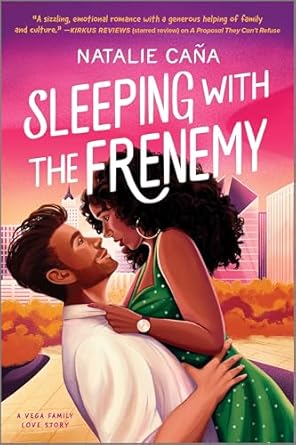
Book Excerpt: Sleeping with the Frenemy by Natalie Cana

PROLOGUE

THE NIGHT OF KAMILAH VEGA AND LIAM KANE’S FIRST ENGAGEMENT PARTY

LEO VEGA ALREADY KNEW WHAT WAS IN STORE FOR HIM WHEN HE knocked on the door in front of him, but he did it anyway. The situation was too important for him to ignore. 

“What?” the grumpy voice said from the other side. 

“It’s me,” he said. 

“I know who it is. I have a camera doorbell.” Leo could practically hear the eye roll. “What do you want?” 

“We need to talk.” 

“I’m not really in the mood to talk.” 

Leo knew that he had two options if he wanted to be let in: be annoying or be cajoling. There was a fifty-fifty chance with either option. It all depended on whether the person on the other side of the door was more pissed or more hurt. His best guess was pissed because of the hurt. He went for cajoling, praying it worked. “Come on. Open the door. I just want to check on you.” 

There was noticeably less anger when the voice responded, “I’m fine.” 

“I need to see you with my own eyes.” 

A snort slash growl. He moved close and put his forehead against the door. “Please, bombón,” he said in a deep murmur. “Let me see you.” 

A hiss of annoyed breath filtered through the door, but it had obviously worked. 

He heard the locks being disengaged and he stepped back when the door swung open. There she stood, still in the body-hugging dress she’d worn to his sister’s disastrous engagement party. She looked almost as perfect as she had when she’d first walked in and nearly caused him to stroke out on the floor, except for one thing. All the immaculate makeup on her face was gone and her eyes were swollen and red rimmed. 

He knew there was a good chance she’d push him away, but he couldn’t stop his response. He stepped into the apartment and palmed her damp cheek. “Come here.” He pulled her into a hug and was mildly surprised when she let him. “Ay, mi Sofi.” 

Sofi didn’t respond, she just buried her face in his neck and squeezed him. 

He tightened his hold on her and firmly told himself to ignore the way her body felt against his, but it was impossible. It always was. It had been since they were teens. Sofia Santana just did something to him on every single level. To attempt to ignore her was like trying to ignore being tased. Even if he managed to shut his thoughts down, his body wasn’t going to let him not react to the inundation of sensation. 

“What happened?” he asked after a few minutes of silence. “All I could understand from a blubbering Kamilah is that you left because you’re mad at her.”

Sofi pulled back. A scowl appeared on her face. “Of course it’s all because of me, right?”

Leo frowned. “I didn’t say that. I’m just trying to understand what happened.” It was hard for him to believe that she hadn’t known about this whole fake engagement stunt either. He’d figured that she had to be in on it too. Kamilah and Sofi did everything together from the moment they met. It was often annoying to him just how close they were. 

“She lied to me,” Sofi said. 

“She lied to all of us,” he pointed out. He was angry about that too, but Sofi wasn’t the type to get so upset about something like this. At the end of the day Kamilah and Liam faking an engagement to keep their grandpas from selling the family businesses they wanted to run didn’t really affect Sofi that much. It wasn’t like she had a stake in either business, not like Leo did. 

Sofi pushed away from him. “Not about that,” she scoffed. “I knew about that stupid shit with Liam. I warned her about that blowing up in her face, but she did it anyway.” Leo suddenly remembered something else that had come up. Something that had affected Sofi. “You didn’t know she’d turned down the scholarship in Paris,” he concluded. Kamilah and Sofi had planned to move to Paris together after high school, but when their abuela got sick, Kamilah lied to everyone and told them she hadn’t gotten the scholarship that would have made the move possible. 

Sofi actually growled in anger. “Can you believe that bullshit?” She stalked down the short hallway into her living room. “Not only did we say we were going to do that since middle school, but we had plans. Firm plans. I had a school lined up! We were looking at apartments!” 

Leo could understand how that would be frustrating at the very least, more likely heartbreaking. “Why didn’t you just go anyway?” 

Sofi let out a bark of unamused laughter. “Have you met my mother? You think she was going to be okay with me going to Europe by myself? She didn’t want me to go even with Kamilah, but once Kamilah wasn’t an option…” 

Leo knew Sofi’s mother pretty well and Alicia Santana was not someone you ignored when she put her foot down. However, she wasn’t an unreasonable person and she trusted her daughter. “I don’t know, bombón. I think she would’ve come around eventually.” 

“You don’t get it, Leo. Once Kamilah said she wasn’t accepted, everything changed for me. I had to—” She cut herself off. “Forget it. That’s not the point. The point is that not only did she lie to me, she kept this a secret for twelve years.” 

Leo wasn’t exactly as upset about the situation as he could be. The truth was that he’d been keeping a secret from his sister for longer than that. So had Sofi. “I understand how learning all this would upset you, but Sofi, come on.” 

She spun on her heel and gave him a look that said, You’d better not be saying what I think you’re saying, while her mouth said, “Come on, what?” 

He gestured between the two of them. 

Sofi arched a brow. 

“Are you really going to make me say it?” 

She crossed her arms and looked him up and down. “I guess you’d better because I don’t know what you’re talking about.” He gave her a look. She couldn’t be serious. 

“Sofi…” She pursed her lips. Leo sucked his teeth. “Sofi, we’ve been together on and off for how long now? Since you were like fifteen?” 

“First of all, we kissed once when I was fifteen and then nothing happened again until much later. Second of all, we have never been together, we have sex when we are both single, bored, and horny, which is not the same thing.” 

Leo didn’t let the hurt that statement caused distract him. “Yet, never once did you mention it to Kamilah and you forbid me from telling anyone about it, because you don’t want it to get back to her.” 

“I don’t want you telling everyone and their momma about it, because who I sleep with is nobody’s fucking business but mine.” 

Leo had to roll his eyes at that. She was so weird about people “knowing her business.” She tended to think that her life was so interesting that it was some sort of gossip fodder. It was ridiculous. She worked at her father’s company, went grocery shopping with her mom every week, and liked to go dancing with her friends on the weekend. Her life was not that different from plenty of women he knew. Shit, their secret relationship (because it was a fucking relationship) was probably the most interesting thing about her life. “You never want her to find out, because you know she’ll be upset about you lying to her. Sort of how you’re mad now.” 

“Are you really throwing this in my face right now?” 

“All I’m saying is that it’s not easy to tell people stuff you know will hurt them, so maybe you should give her a break.” 

Her eyes widened. “Give her a break,” she murmured to herself. When she looked at him, there was anger and shock in her expression. “You really are standing in front of me not only defending her, but trying to guilt me out of feeling my own emotions right now.” 

“I just think given the circumstances we both owe her—” “I. Don’t. Owe. Her. Shit.” She accentuated each word with a clap of her hands then paused, screwed up her face, and shook her head as if disgusted. “I don’t owe you shit either. Why am I even having this conversation with you?” 

“Sof—” “I should’ve known that at the end of the day you were going to pick her side over mine.” 

“How do you figure?” 

“Because, Leo, that’s how your family operates. Y’all are all open and friendly and welcoming until something happens. Then you close rank like a bunch of elephants circling around the weakest members of the herd. It happens every time Big Sam and your tía Iris break up. It happened when Chase left Kamilah. Y’all still barely talk to your tía Alba’s husband after he said Puerto Rico should become a state.” 

“Not true,” Leo argued. “He said that Puerto Ricans on the island wouldn’t be able to run a country without the US, so they needed to be a state which is different than just saying that Puerto Rico should be a state. And we hardly liked his conceited and low-key racist ass before that. Plus, you were just as mad about that as the rest of us were!” 

“That’s not the point, Leo!” she yelled at him. “Then what is your point,” he yelled back. “Because you aren’t making any fucking sense.” 

“My point is that I’m done. I have no interest in doing this with you, your sister, or anyone else in your family.” 

Leo froze. His body going cold. “What does that mean?” 

“That means that I’m not making up with Kamilah. I’m not coming around El Coquí anymore.” She paused and looked him right in the eyes. “I don’t want you coming here anymore either.” 

Leo scoffed. “You always say that and then you text to ask me what I’m doing and tell me to come over.” 

She passed by him to open her door. “Yeah well, why don’t you go home and wait for that message?” 

“Sofi,” he began. 

“Bye, Leo. Have a nice life.” Leo growled. He hated when she pulled that dismissive shit with him and she knew it. “You have to be the most stubborn person I’ve ever met,” he called.

“Didn’t I already tell you goodbye?” 

“One of these days, you’re going to push me too far and I’m not going to come back.” 

“Maybe I’ll be lucky and today will be the day.” 

Annoyed that she was being so stubborn and unreasonable, Leo stormed out the door. It closed with a snick behind him and Leo fought the urge to flip it off. Instead he stomped down the stairs to the front door of the building. He hated that Sofi did this to him. She’d push him away just to prove that she could. But she didn’t actually want him to go anywhere, which was why she always called him back. She’d do it again this time too. He knew she would, because—no matter how much they fought—they couldn’t live without each other. 

This was not an ending. It was only an intermission.

Excerpted from SLEEPING WITH THE FRENEMY by Natalie Caña, Copyright © 2024 by Natalie Caña. Published by Mira, an imprint of HarperCollins.

DID YOU ENJOY WHAT YOU JUST READ? IF YES, THEN SUBSCRIBE TO THE BLOG, GIVE THE POST A LIKE, OR LEAVE A COMMENT! NEW POSTS ARE UP EVERY TUESDAY & THURSDAY!
Book Excerpt: The Changing of Keys by Carolyn Jack

Only one light was on in the house when I arrived home, although it was by then fully dark

outside.

It was the light over the piano.

At first, I thought Mother wasn’t there and I was briefly confounded, trying to imagine where she

could be—she who no longer went anywhere in the evening except to the monthly church

supper. And it wasn’t church-supper week. But then I saw her rise from her chair on the night-

filled screened porch and place her Bible, which she could not have been reading, on the table

next to her.

I waited, hoping she would speak. She didn’t. She stayed in the shadows, looking down at the

book.

“Mother.”

Nothing. I didn’t believe she couldn’t hear me.

“Mother!”

She turned around briskly then and entered the living room. “You don’t have to shout,” she said.

“Where have you been?” “I went for a walk.”

The tortures of Hades could not have wrung from me that I had sought Brownlea’s advice.

“Well, it’s long past teatime. I’ll fix something to eat. Cold beef all right?”

“I’m not hungry, Mother, I want…”

“You may not think you are now, but if you go to bed with-out a bite, you won’t sleep well. Now,

what would you like? There are sardines and some…”

“Mother, I don’t want food! I want to talk to you!”

She stopped as if I had switched her off, gazing away from me at some distant point in the dim

room, gathering herself. After a moment, she turned her head a little toward me and said quite

calmly, “Then we had best sit down.”

Neither of us took the chair that had been my father’s.

I turned on another lamp and sat next to it at one end of the sofa. She did not choose to sit next to

me, perching instead on the piano bench. The light behind her made it hard to see her face.

She waited. She was not going to help me start.

“Mother, why?” My voice cracked, angering me. I spoke more loudly. “Why?”

“Do you mean, why am I sending you to Chicago? I should think it would be obvious—you’ll

need a teacher of the first rank if you’re to have a career.”

“But you’ve never asked me if I wanted a career. And why Chicago? Why not New York or

London? Why should I study with this Hellman geezer? Who is he, anyway?”

“No slang, please. And I’ll thank you not to inundate me with questions.”

Her mouth tightened and she folded her arms over her prim, blue-cotton blouse. She shook her

head as if a gnat were besieging her.

“My dear,” she said tentatively, trying out a foreign expression, “Gunter Hellman was at

university with your father and, unlike him, went on to a distinguished international career. He

plays with all the major European and American orchestras and is on the Chicago Conservatory

faculty. The fact that you have not heard of him signifies only that you are fourteen, not that he is

inconsequential.”

“But…”

“I beg your pardon. I was about to say that I had written to him two years ago to ask if he would

take you as a pupil, and he said that when you were old enough to go to an American high school

and if you were truly devoted to piano, then he would.

“I have prayed every night for the last year, hoping that God would grant you the passion and

ambition to match your talent, so that you would not let it go to waste. It is a sin to waste great

talent or to thwart it in any way. A sin.”

She wasn’t looking at me.

Her fingers gripped the edge of the bench, turning her knuckles livid and making the pale blue

veins strain against the skin of her hands.

“Gunter last wrote me a month ago to say that, if I thought the time was right, you could come to

him this summer. After I heard you play today, I knew you must go.”

“But why didn’t you tell me? You never tell me anything! Why does everything have to be a

secret?”

“You are told as much as you need to know. I can’t have you distracted from your music by

details and half-formed plans that do not require your worry.”

“There’s nothing half-formed about this! You’ve been plot-ting the whole thing since I was

twelve, you just said so! Why won’t you let me decide what my own future will be?”

Mother looked straight at me. Her eyes were as hard as jet beads.

“Your future is entirely up to you. I can’t earn your success for you or prevent your ruin. You

must decide which it is to be.” She stood, as if ready to quit the house and me with it, to stride

off with her sword and take up the cause of some worthier supplicant. I was angry and strangely

terrified that she would leave altogether, who had never really come close. I held out my hand to

stop her. She didn’t take it—she hadn’t taken my hand in years.

“But why aren’t you coming, too?” I said, suddenly pleading. “Why do I have to go by myself?”

She looked away. Was she crying? I had never seen her cry. She turned back to me, dry-eyed.

“You will learn faster on your own,” she said quietly.

“What? About playing?”

“About everything.”

She coughed and stood up, pushing the piano bench in and turning off the lamp.

“You’ll be able to come home for the Christmas holidays,” she continued, already halfway to the

door of her own room. “If you wish.”

She called goodnight without looking back.

I sat for a while, gazing around the room where I suddenly did not belong. I was to go; I was

already gone. The knowledge of my impermanence had, in an hour, made me a ghost in my own

home. Another member of the family who would leave nothing behind but his habitual imprint

on a cushion.

Oddly enough, I now wanted my tea. I went to the kitchen, unearthed some bread and cheese,

and finished them off, along with the rest of the lemonade. A kind of excitement was grow-ing in

me, conjoined to the lump of dread. I was going to study with the best, be the best. Everybody

would know my name. I would never again be locked away alone in silence. I would be

surrounded by cheering audiences, blazingly visible in stage light far friendlier than the sun. I

would succeed.

I rinsed my glass and knife, switched off the lamp in the liv-ing room, and brushed my teeth. The

dark of my room seemed to drown all my hope. I lay in bed and listened to the waves in the

cove, breaking against the beach.

Excerpted from THE CHANGING OF KEYS by Carolyn Jack © 2024 by Carolyn Jack, used

with permission from Regal House Publishing.

DID YOU ENJOY WHAT YOU JUST READ? IF YES, THEN SUBSCRIBE TO THE BLOG, GIVE THE POST A LIKE, OR LEAVE A COMMENT! NEW POSTS ARE UP EVERY TUESDAY & THURSDAY!

Book Excerpt: The Banned Books Club by Brenda Novak

“Wait…you’re not still running that book club you started in high school, are you?”

Gia Rossi had been shopping at her local grocer when her sister called. “I’ve never really stopped. Not

completely.” She switched her phone to her other ear, so she could use her more dexterous left hand to

steer her empty shopping cart across the parking lot to the reclamation point.

“Most of the members weren’t your friends. They were just people who blindly followed you no matter

what you did,” her sister pointed out drily.

Was there a hint of jealousy in that response? Margaret, who’d been known as Maggie when they were

kids but now called herself a more distinguished Margot, was only thirteen months younger than Gia, so

just one year behind her in school. Margot hadn’t been nearly as popular—but it was because she’d

never done anything exciting. She’d been part of the academic group, too busy excelling to be going out

having fun.

“A few of them were close friends,” Gia insisted. “Ruth, Sammie and a handful of others are still in the

book club with me, and we rotate picking a read.”

“Seriously? It’s been seventeen years since you graduated. I thought you left them and everything else

behind when you dropped out of college and took off for Alaska.”

Her sister never would’ve done something that reckless, that impulsive—or that ill-advised. Gia had

walked away from a volleyball scholarship at the University of Iowa, which was part of the reason her

family had freaked out. But she was glad she’d made that decision. She treasured the memories of

freewheeling her way through life in her twenties, learning everything she could while working on

crabbing and fishing boats and for various sightseeing companies. She wouldn’t have the business she

owned now, with a partner, if not for that experience. “No. We fell off for a bit, then we went back to it,

then we fell off again, and now we meet on Zoom to discuss the book we’re reading on the fourth

Thursday of every month.” She lowered her voice for emphasis. “And, of course, we make sure it’s the

most scandalous book we can find.”

Margot had never approved of the book group or anything else Gia did—and that hadn’t changed over

the years, which was why Gia couldn’t resist needling her.

“I’m sure you do,” Margot said, but she didn’t react beyond a slightly sour tone. She’d grown adept at

avoiding the kind of arguments that used to flare up between them, despite Gia sometimes baiting her.

“So seven or eight out of what…about sixty are active again?”

“For one month out of the year, the ratio’s quite a bit better than that,” she said as the shopping cart

clanged home, making her feel secure enough to walk away from it. “The rest of the group gets together

for an online Christmas party in December.”

“How many people come to that?”

Margot sounded as if she felt left out, but she’d never shown any interest in the book group. “Probably

fifteen or twenty, but it’s not always the same fifteen or twenty.” She opened the door to her red Tesla

Model 3, which signaled the computer to start the heater—something she was grateful for since she

hadn’t worn a heavy enough coat for the brisk October morning. Coeur d’Alene, Idaho, didn’t usually

turn this cold until November or December.

The car’s Bluetooth picked up the call as Margot asked, “Why haven’t you ever mentioned it?”

Now that they lived thirteen hundred miles apart, there were a lot of things she didn’t tell her sister. It

wasn’t until she’d left her hometown behind that she’d felt she could live a truly authentic life—one

without the constant unfavorable comparisons to her “perfect” sibling.

But that wasn’t why she hadn’t mentioned the book group. She’d assumed her sister wouldn’t want to

hear about it. Margot had been mortified when Gia challenged the gaggle of well-meaning but

misguided women from the PTA who’d descended on Room 23 on Back-to-School Night, insisting Mr.

Hart, head of the English department, drop The Catcher in the Rye, The Outsiders and The Handmaid’s

Tale from the Honors English reading list. Gia had expected her favorite teacher to stand up for the

books she loved by explaining why they were so important. She’d known how much he’d loved those

books, too. Instead, just to avoid a fight, he’d caved in immediately, which was what had incited her to

start a club that championed the books they’d targeted—as well as others.

That was the first time Mr. Hart had let her down, but it wouldn’t be the last. “If you’d ever joined the

club, you’d be on the email list,” she said as she backed out of the parking space.

“I would’ve, but you know me. I don’t really read.”

Her sister would not have joined. The Banned Books Club was far too controversial for Margot. It

would’ve required a bit of rebellion—something she seemed incapable of. And maybe she didn’t read

much fiction, but Gia knew her to consume the occasional self-help tome. That was probably how she

reassured herself she was still the best person she knew, because if there was anyone who didn’t need a

self-help book, it was Margot. Their parents’ expectations were more than enough to create her

boundaries.

“You should try reading along with us now and then. It might broaden your horizons.” As good as

Margot was, she had a mind like a steel trap—one that was always closed, especially when faced with

any information that challenged what she already believed. She lived inside a bubble of confirmation

bias; the only facts and ideas that could permeate it were those that supported her world view.

“I’m happy with my horizons being right where they are, thank you.”

“You don’t see the limitations?”

“Are you trying to offend me?” she asked.

Gia bit back a sigh. That was the difference between them. Margot would sacrifice anything to maintain

her position as their parents’ favorite child, to gain the approval of others, especially her husband, and

be admired by the community at large. Growing up, she’d kept her room tidy, gotten straight As and

played the piano in church. And these days, she was a stay-at-home mom with two children, someone

who made a “hot dish”—what most people outside the Midwest would call a casserole—for any

neighbor, friend or acquaintance who might be having surgery or suffering some kind of setback.

Her conventionalism was—in certain ways—something to be admired. As the black sheep of the family,

Gia knew better than to try to compete with Margot. That wasn’t possible for someone who couldn’t

take anything at face value. She had to question rules, challenge authority and play devil’s advocate at

almost every opportunity, which was why she was surprised that her sister had been trying, for the past

two weeks, to convince her to come home for the winter. Their mother’s health had been declining

since she’d been diagnosed with breast cancer. It was at stage four before they discovered it, and the

doctors had done what they could, but Ida hadn’t responded to treatment. Margot claimed their mother

wasn’t going to last much longer, that Gia should spend a few months with her before it was too late.

But Gia was surprised Margot would risk the peace and contentment they all seemed to enjoy without

her.

Gia wasn’t sure she could go back to the same family dynamic she found so damaging, regardless. She

and her business partner ran a helicopter sightseeing company for tourists and flew hunters and

fishermen in and out of the remote wilderness—but Backcountry Adventures was closed during the

coldest months, from November to February. She would soon have the time off, so getting away from

work wouldn’t be a problem. It was more that when she was in Wakefield, the walls seemed to close in

around her. It simply got too damn hard to breathe. “Fine,” she grumbled. “Don’t answer that question.

But speaking of limitations, how’s Sheldon?”

“Seriously, Gia? I’m going to assume you didn’t mean to ask about him in that way,” her sister stated

flatly.

There was no love lost between Gia and her brother-in-law. She hated the way he controlled Margot,

how he could spend money on hunting or fishing or buying a new camper, but her sister had to scrape

and bow for a new pair of jeans. Margot explained it was because he earned all the money, that he was

trying to be a good “manager” by giving her such a tight budget so the business would be successful and

they’d have money to retire in old age, but to Gia, it seemed that Margot was making all the sacrifices.

Stingy was stingy, and yet he was the one who wanted Margot at home, waiting for him with a hot meal

at the end of the day. Their boys, Matthew and Greydon, were eight and six, both in school. Margot

could work part-time, at least, establish something of her own, if Sheldon wasn’t calling all the shots.

“It was a joke.” Gia really didn’t want to cause problems in her sister’s marriage. Margot insisted she

was happy, although if that were her life, Gia probably would’ve grabbed her kids and stormed out of

the house—for good—long ago.

“He’s doing great. He’s been busy.”

“It’s deer hunting season. I assume he’s going.”

“Next week.”

And what will you do—stay home and take care of the kids and the house while he’s gone? Gia wanted

to ask, but this time she managed to bite her tongue. “He’s going to Utah again?”

“Yeah. They go there every year. One of his buddies grew up in Moab.”

“Last winter, Sheldon’s business slowed down a bit, so I’m surprised to hear you say he’s been busy.”

“That was the economy in general. All trucking companies took a hit. I don’t think the same thing’s going

to happen this year, though. He just bought two new semis and is hiring more drivers.”

“He’s quite the businessman.” Gia rolled her eyes at her own words. He hadn’t built the trucking

business; he’d inherited it from his parents, who remained heavily involved, which was probably what

saved it from ruin. But thankfully, Margot seemed to take her words at face value.

“I’m proud of him.”

He was proud of himself, could never stop talking about his company, his toys, his prowess at hunting or

four-wheeling or any other “manly” pursuit. Gia was willing to bet she could out-hunt him if she really

wanted to, but the only kind of shots she was willing to take were with her camera.

Still, she was glad, in a way, that her sister could buy into the delusion that Sheldon was a prize catch.

“That’s what matters,” she said as she pulled into the drive of her two-bedroom condo overlooking Mill

River. The conversation was winding down. She’d already asked about the boys while she was in the

grocery store—they were healthy and happy. She was going to have to ask about Ida before the

conversation ended, so she figured she might as well get it over with. “And how are Mom and Dad?”

Her sister’s voice dropped an octave, at least. “That’s actually why I called…”

Gia couldn’t help but tense; it felt like acid was eating a hole in her stomach. “Mom’s taken a turn for

the worse?”

“She’s getting weaker every day, G. I—I really think you should come home.”

Closing her eyes, Gia allowed her head to fall back against the seat. Margot couldn’t understand why Gia

would resist. But she’d never been able to see anything from Gia’s perspective.

“G?” her sister prompted.

Gia drew a deep breath. She could leave Idaho a few weeks before they closed the business. Eric would

cover for her. She’d worked two entire months for him when his daughter was born. She had the

money, too. There was no good excuse not to return and support her family as much as possible—and if

this was the end, say goodbye to her mother. But Gia knew that would mean dealing with everything

she’d left behind.

“You still there?”

Gathering her resolve, Gia climbed out of the car. “Sorry. My Bluetooth cut out.”

“Did you hear me? Is there any chance you’d consider coming home, if only for a few weeks?”

Gia didn’t see that she had any choice. She’d never forgive herself if her mother died and she hadn’t

done all she could to put things right between them. She wished she could continue procrastinating her

visit. But the cancer made it impossible. “Of course. Just…just as soon as I finish up a few things around

here.”

“How long will that take you?”

“Only a day or two.”

“Thank God,” her sister said with enough relief that Gia knew she couldn’t back out now.

What was going on? Why would having her in Wakefield matter so much to Margot?

“I’ll pick you up from the airport,” her sister continued. “Just tell me when you get in.”

“I’ll get back to you as soon as I’ve made the arrangements.”

Excerpted from THE BANNED BOOKS CLUB by Brenda Novak. Copyright © 2024 by Brenda Novak. Published by MIRA Books, an imprint of HarperCollins.

DID YOU ENJOY WHAT YOU JUST READ? IF YES, THEN SUBSCRIBE TO THE BLOG, GIVE THE POST A LIKE, OR LEAVE A COMMENT! NEW POSTS ARE UP EVERY TUESDAY & THURSDAY!