
Book Excerpt: Last Twilight in Paris by Pam Jenoff

Prologue

Helaine

Paris, 1943 

Darkness. 

Helaine stumbled forward, unable to see through the black void that surrounded her. She could feel the shoulders of the others jostling on either side. The smell of unwashed bodies rose, mingling with Helaine’s own. Her hand brushed against a rough wall, scraping her knuckles. Someone ahead tripped and yelped. 

Hours earlier, when Helaine had been brought from her underground cell at the police station into the adjacent holding area, she was surprised to see other women waiting. She had not encountered anyone since her arrest. She had studied the women, who looked to be from all walks of life, trying to discern some commonality among their varied ages and classes that had caused them to be here. There was only one: they were Jews. The yellow star they wore, whether soiled and crudely sewn onto a worn, secondhand dress or pressed crisply against the latest Parisian finery, was identical—and it made them all the same. 

They had stood in the bare holding area, not daring to speak. Helaine was certain that her arrest had been some sort of mis take. She had done nothing wrong. They had to free her. But even as she thought this, she knew that the old world of being a French citizen with rights was long gone. 

An hour passed, then two. There was nowhere to sit, and a few people dropped to the floor. An elderly woman dozed against the wall, mouth agape. But for the slight rise and fall of her chest, she might have been dead. Hunger gnawed at Helaine and she wished that she still had the baked goods she purchased at the market just before she was taken. The meager breads, which had seemed so pathetic days earlier, now would have been a feast. But her belongings had been confiscated at arrest. 

Helaine looked upward through the thin slit of window near the ceiling. They were still in Paris. The sour smell from the city street and the sounds of cars and footsteps despite the curfew were familiar, if not comforting. How long they would stay here, she did not know. Helaine was torn. She did not want to remain in this empty room forever. Yet she also dreaded leaving, for wherever they were going would surely be worse. 

Finally, the door had opened. “Sortir!” a voice ordered them out in native French, reminding Helaine that the policemen, who had brought them here and who were keeping them captive, were not Germans, but their own people. 

Helaine had filed into the dimly lit corridor with the others. They exited the police station and stepped outside onto the pavement. At the sight of the familiar buildings and the street leading away from the station, Helaine momentarily considered fleeing. She had no idea, though, where she would go. She imagined running to her childhood home, debated whether her estranged mother would take her in or turn her away. But the women were heavily guarded and there was no real possibility of escape. Instead, Helaine breathed the fresh air in great gulps, sensing that she might not be in the open again for quite some time. 

The women were herded up a ramp toward an awaiting truck. Helaine recoiled. They were being placed in the back part of the vehicle where goods should have been carried, not people. Helaine wanted to protest but did not dare. Smells of stale grain and rotting meat, the truck’s previous cargo, assaulted her nose, mixing with her own stench in the warm air. It had been three days since she had bathed or changed and her dress was wrinkled and filthy, her once-luminous black curls dull and matted against her head. 

When the women were all inside the truck, the back hatch shut with an ominous click. “Where are they taking us?” someone whispered. Silence. No one knew and they were all too afraid to venture a guess. They had heard the stories of the trains headed east to awful places from which no one ever returned. Helaine wondered how long the journey would be. 

As they bumped along the Paris streets, Helaine’s bones, already sore from sleeping on the hard prison cell floor, cried out in pain. Her mouth was dry and her stomach empty. She wanted water and a meal, a hot bath. She wanted home. 

If home was a place that even existed anymore. Helaine’s husband, Gabriel, was missing in Germany, his fate unknown. She had scarcely spoken with her parents since before the war. And Helaine herself had been taken without notice. Nobody knew that she had been arrested or had any idea where she had gone. It was as if she simply no longer existed. 

To distract herself, Helaine tried to picture the route they were taking outside the windowless truck, down the boulevards she had just days earlier walked freely, past the cafés and shops. The familiar locations should have been some small comfort. But this might well be the last time she ever came this way, Helaine realized, and the thought only worsened her despair. 

Several minutes later, the truck stopped with a screech. They were at a train station, Helaine guessed. The back hatch to the truck opened and the women peered out into pitch blackness. “Raus!” a voice commanded. That they were under the watch of Germans now seemed to confirm Helaine’s worst fears about where they were headed. “Schnell!” Someone let out a cry, a mix of the anguish and uncertainty they all felt. 

The women clambered from the truck and Helaine stumbled, banging her knee and yelping. “Quiet,” a woman’s voice beside her cautioned fearfully. A hand reached out and helped her down the ramp with an unexpectedly gentle touch. 

Outside the truck it was the tiniest bit lighter, and Helaine was just able to make out some sort of loading dock. The group moved forward into a large building. 

Now Helaine found herself in complete darkness once more. This was how she had come to be in an unfamiliar building, shuffling forward blindly with a group of women she did not know, uncertain of where they were going or the fate that might befall them. She could see nothing, only feel the fear and confusion in the air around her. They seemed to be in some sort of corridor, pressed even more closely together than they had been. Helaine put her hand on the shoulder of the woman in front of her, trying hard not to fall again. 

They were herded roughly through a doorway, into a room that was also unlit. No one moved or spoke. Helaine had heard rumors of mass executions, groups of people gassed or simply shot. The Germans might do that to them now. Her skin prickled. She thought of those she loved most, Gabriel and, despite everything that had happened, her parents. Helaine wanted their faces, not fear, to be her final thought. 

Bright lights turned on suddenly, illuminating the space around them. “Mon Dieu!” someone behind her exclaimed softly. Helaine blinked her eyes, scarcely daring to believe what she saw. They were not in a camp or a prison at all. Instead, they were standing in the main showroom of what had once been one of the grandest department stores in Paris.

Excerpted from LAST TWILIGHT IN PARIS by Pam Jenoff. Copyright © 2025 by Pam Jenoff. Published by Park Row Books, an imprint of HTP/HarperCollins.

DID YOU ENJOY WHAT YOU JUST READ? IF YES, THEN SUBSCRIBE TO THE BLOG, GIVE THE POST A LIKE, OR LEAVE A COMMENT! NEW POSTS ARE UP EVERY TUESDAY & THURSDAY!
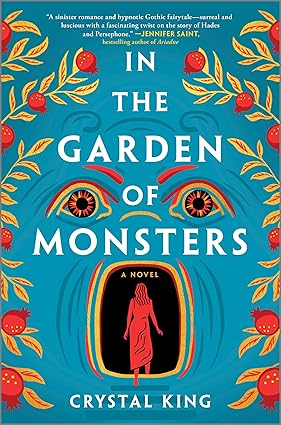
Book Excerpt: In the Garden of Monsters by Crystal King

Bomarzo, Italy, 1547–1560

It took me years to find Giulia Farnese, but no time at all to win her confidence. I did so with an

unassuming cherry rose tart. It had been nearly a hundred years since I last looked upon her

face, but from the moment she pulled the golden tines of her fork away from her lips and she

looked to me, not her husband, I knew my influence had taken hold.

“You truly are a maestro, Aidoneus,” she said, closing her eyes to savor the sweet, floral flavors.

“And a welcome addition to our kitchen.”

“Madonna Farnese, you flatter me.” I gave the couple a polite bow, my gesture more fluid than

human custom, and turned back to my earthly duties.

“It seems you will eat well when I am gone,” Vicino joked behind my back. “But don’t eat too

well, my beauty, or you won’t fit into those lovely dresses.”

Giulia laughed, and my heart warmed. Oh, she would eat well, I vowed. Very well.

* * *

The next day, as Vicino Orsini gave his wife a peck on the cheek and vaulted onto his horse, I

watched from the rooftop terrace, my gaze lingering on the horizon where earth met sky—a

threshold I knew all too well. Then, with a flick of the reins, he led his men down the road into

the valley. They were headed to Venezia to escort the Holy Roman Cardinal, Pietro Bembo, to

Rome. Afterward, Vicino would depart for Napoli and Sicilia on business for Papa Pio IV.

Jupiter had blessed the region of Lazio with a warm spring, and a week after Vicino left, Giulia

asked me if I wanted to take a walk. I suggested we explore the wood in the valley below the

palazzo. She readily agreed, which did not surprise me. It was impossible for her to ignore the

aphrodisiac qualities of my food, let alone the timbre of my voice, and the brush of my hand

against hers. The first time she startled at my warmth— no human runs as hot as I—but she did

not ask me to explain. In all the centuries past, she never has. This alone stoked the fire of hope

within me.

She led me on a thin path through the verdant tapestry of the forest, where sunlight, diffusing

through the emerald canopy, dappled the woodland floor with patches of gold. Beneath our feet,

a carpet of fallen leaves, still rich with the scent of earth, crunched softly. We moved through

clusters of ancient evergreen oaks, their gnarled limbs reaching out like weathered hands, and

past groves of squat pomegranate trees with their ruby-hued fruits catching the sunlight and

casting a warm, inviting glow.

Upon reaching a clearing surrounded by several large tufa stones jutting up through the grass

and weeds, I was immediately drawn to one of the stones embedded in the hillside. The

exposed side was round and flat, and it hummed, a song of the earth, a low vibration that

warmed the deepest depths of me.

Giulia could not hear the humming, but she was surely aware of it in some hidden part of her, for

she turned to me then.

“I love this wood,” she said, her arms outstretched toward the

stone. The early morning light brightened her features, making

her blue eyes shine.

“I can see why.”

She twined her hand in mine. “I come here often to bask in the feeling. The moment I arrived in

Bomarzo, I felt like I had been called home, to my true home. And this wood, this is why. It re-

minds me of a fairy tale, or a place from the ancient, heroic myths.” It was then that I had the

idea. The stone—it hummed be-cause the veil to the Underworld was thin there.

Perhaps…yes… if the wood was enhanced, and energy from the darkness was better able to

pierce the surface into this realm I would no longer have to spend years attuning to Giulia when

she reappeared in the world. Instead, she would be drawn closer, and I would

find her faster. It would work. I was sure of it.

“Vicino doesn’t like me walking here alone. Too many wolves and bears, he says.”

I could sense a wild boar in the far distance, but no wolves or bears. “I think we’re safe here.” I

gestured toward one of the big misshapen rocks. “Sometimes I like to imagine rocks as mythical

creatures. Like that one. It could be a dragon poised to fight off danger.”

“Ooo, I can see it. The big open mouth, ready to take on any wolf, or even a lion.” Her

enthusiasm was exactly what I had hoped for.

I waved my arm toward the large, round, smooth rock be-hind it. “And that should be a great big

orco, with a mouth wide open. And it eats up and spits out secrets.”

“An ogre that spits out secrets?” Giulia laughed.

“Oh yes. This orco would tell all. Ogni pensiero volo.” I made my hands look like a fluttering bird.

She wore a wide grin. “All thoughts fly! How perfect. But if he eats up secrets, there should be a

table inside this orco. It could be his tongue.”

As we wandered through the wood, dreaming up new lives for the monstrous rocks left eons

ago by a force of nature, I was delighted to see how invested she was in the game.

“There are so many stones,” she said, clapping her hands together. “We could make a whole

park of statues. I will write Vicino tonight.”

I did not expect it would be quite so easy. Usually it took a long while to convince Giulia of the

merit of my ideas. But the pull of the Underworld was strong here and my influence was far

greater than it would have been in Paris, or some backwater hill town in the wilds of Bavaria or

Transylvania.

On the walk back, she paused by another enormous stone that jutted out of the ground, the size

of a giant. She leaned against it. “Can you keep a secret?” she asked coyly.

“Of course.”

“This secret is only for you.” She leaned forward and grasped the edge of my cloak, pulling me

toward her. Our lips met and she melted into me.

In the years following, as Vicino began work on the garden, a change was palpable in the air.

Each evening, as the twilight deepened, a subtle energy began to emanate from the heart of the

valley. I found contentment not just in the evolving grove, but also in my closeness to Giulia. Our

time together, so abundant and intimate, felt different. I had never waited so long to make my

attempt, but I nurtured this earthly bond, knowing it was essential for the garden’s growth.

The day finally arrived when Vicino ushered Giulia into the heart of the Sacro Bosco—the

Sacred Wood—the name he had fondly bestowed upon the garden. As she crossed the

threshold, I sensed it—a strengthening of our connection, more profound than ever before. It

was time.

That night, the chicken with pomegranate sauce I prepared was met with Giulia’s usual lavish

praise, although I knew she took in the single pomegranate seed garnishing the dish as a

courtesy, not a desire for the fruit. As she savored each bite, I felt a loosening in the ethereal

shackles binding her heart. A vivid, red-hued hope blossomed within me.

Post dinner, I retreated to the palazzo’s highest balcony, my gaze drawn to a nascent light in the

wood below. The light, though barely perceptible, was imbued with a power that seemed to

bridge the realms of mortal and divine. A faint green luminescence that whispered of unwanted

things to come. It pulsed like a languid heartbeat, beckoning to something—or someone.

I was immediately compelled to find Giulia. Amidst the soft murmur of the salon where she

played with her children, I enveloped her in my senses and the flower of hope within me

withered. Her heartbeat, steady and unsuspecting, echoed the rhythm of the garden’s glow.

Excerpted from In the Garden of Monsters by Crystal King © 2024 by Crystal King. Used with

permission from MIRA/HarperCollins.

DID YOU ENJOY WHAT YOU JUST READ? IF YES, THEN SUBSCRIBE TO THE BLOG, GIVE THE POST A LIKE, OR LEAVE A COMMENT! NEW POSTS ARE UP EVERY TUESDAY & THURSDAY!

Book Excerpt: The Changing of Keys by Carolyn Jack

Only one light was on in the house when I arrived home, although it was by then fully dark

outside.

It was the light over the piano.

At first, I thought Mother wasn’t there and I was briefly confounded, trying to imagine where she

could be—she who no longer went anywhere in the evening except to the monthly church

supper. And it wasn’t church-supper week. But then I saw her rise from her chair on the night-

filled screened porch and place her Bible, which she could not have been reading, on the table

next to her.

I waited, hoping she would speak. She didn’t. She stayed in the shadows, looking down at the

book.

“Mother.”

Nothing. I didn’t believe she couldn’t hear me.

“Mother!”

She turned around briskly then and entered the living room. “You don’t have to shout,” she said.

“Where have you been?” “I went for a walk.”

The tortures of Hades could not have wrung from me that I had sought Brownlea’s advice.

“Well, it’s long past teatime. I’ll fix something to eat. Cold beef all right?”

“I’m not hungry, Mother, I want…”

“You may not think you are now, but if you go to bed with-out a bite, you won’t sleep well. Now,

what would you like? There are sardines and some…”

“Mother, I don’t want food! I want to talk to you!”

She stopped as if I had switched her off, gazing away from me at some distant point in the dim

room, gathering herself. After a moment, she turned her head a little toward me and said quite

calmly, “Then we had best sit down.”

Neither of us took the chair that had been my father’s.

I turned on another lamp and sat next to it at one end of the sofa. She did not choose to sit next to

me, perching instead on the piano bench. The light behind her made it hard to see her face.

She waited. She was not going to help me start.

“Mother, why?” My voice cracked, angering me. I spoke more loudly. “Why?”

“Do you mean, why am I sending you to Chicago? I should think it would be obvious—you’ll

need a teacher of the first rank if you’re to have a career.”

“But you’ve never asked me if I wanted a career. And why Chicago? Why not New York or

London? Why should I study with this Hellman geezer? Who is he, anyway?”

“No slang, please. And I’ll thank you not to inundate me with questions.”

Her mouth tightened and she folded her arms over her prim, blue-cotton blouse. She shook her

head as if a gnat were besieging her.

“My dear,” she said tentatively, trying out a foreign expression, “Gunter Hellman was at

university with your father and, unlike him, went on to a distinguished international career. He

plays with all the major European and American orchestras and is on the Chicago Conservatory

faculty. The fact that you have not heard of him signifies only that you are fourteen, not that he is

inconsequential.”

“But…”

“I beg your pardon. I was about to say that I had written to him two years ago to ask if he would

take you as a pupil, and he said that when you were old enough to go to an American high school

and if you were truly devoted to piano, then he would.

“I have prayed every night for the last year, hoping that God would grant you the passion and

ambition to match your talent, so that you would not let it go to waste. It is a sin to waste great

talent or to thwart it in any way. A sin.”

She wasn’t looking at me.

Her fingers gripped the edge of the bench, turning her knuckles livid and making the pale blue

veins strain against the skin of her hands.

“Gunter last wrote me a month ago to say that, if I thought the time was right, you could come to

him this summer. After I heard you play today, I knew you must go.”

“But why didn’t you tell me? You never tell me anything! Why does everything have to be a

secret?”

“You are told as much as you need to know. I can’t have you distracted from your music by

details and half-formed plans that do not require your worry.”

“There’s nothing half-formed about this! You’ve been plot-ting the whole thing since I was

twelve, you just said so! Why won’t you let me decide what my own future will be?”

Mother looked straight at me. Her eyes were as hard as jet beads.

“Your future is entirely up to you. I can’t earn your success for you or prevent your ruin. You

must decide which it is to be.” She stood, as if ready to quit the house and me with it, to stride

off with her sword and take up the cause of some worthier supplicant. I was angry and strangely

terrified that she would leave altogether, who had never really come close. I held out my hand to

stop her. She didn’t take it—she hadn’t taken my hand in years.

“But why aren’t you coming, too?” I said, suddenly pleading. “Why do I have to go by myself?”

She looked away. Was she crying? I had never seen her cry. She turned back to me, dry-eyed.

“You will learn faster on your own,” she said quietly.

“What? About playing?”

“About everything.”

She coughed and stood up, pushing the piano bench in and turning off the lamp.

“You’ll be able to come home for the Christmas holidays,” she continued, already halfway to the

door of her own room. “If you wish.”

She called goodnight without looking back.

I sat for a while, gazing around the room where I suddenly did not belong. I was to go; I was

already gone. The knowledge of my impermanence had, in an hour, made me a ghost in my own

home. Another member of the family who would leave nothing behind but his habitual imprint

on a cushion.

Oddly enough, I now wanted my tea. I went to the kitchen, unearthed some bread and cheese,

and finished them off, along with the rest of the lemonade. A kind of excitement was grow-ing in

me, conjoined to the lump of dread. I was going to study with the best, be the best. Everybody

would know my name. I would never again be locked away alone in silence. I would be

surrounded by cheering audiences, blazingly visible in stage light far friendlier than the sun. I

would succeed.

I rinsed my glass and knife, switched off the lamp in the liv-ing room, and brushed my teeth. The

dark of my room seemed to drown all my hope. I lay in bed and listened to the waves in the

cove, breaking against the beach.

Excerpted from THE CHANGING OF KEYS by Carolyn Jack © 2024 by Carolyn Jack, used

with permission from Regal House Publishing.

DID YOU ENJOY WHAT YOU JUST READ? IF YES, THEN SUBSCRIBE TO THE BLOG, GIVE THE POST A LIKE, OR LEAVE A COMMENT! NEW POSTS ARE UP EVERY TUESDAY & THURSDAY!

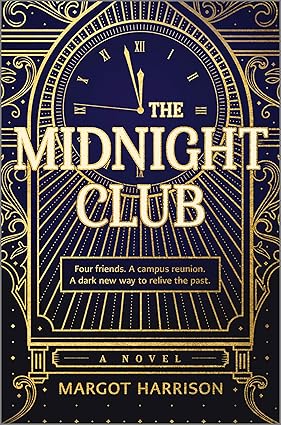
Book Spotlight: The Midnight Club by Margot Harrison

Four friends. A campus reunion. A dark new way to relive the past.

It’s been twenty-five years since The Midnight Club last convened. A tight-knit group of college

friends bonded by late nights at the campus literary magazine, they’re also bonded by

something darker: the death of their brilliant friend Jennet junior year. But now, decades later, a

mysterious invitation has pulled them back to the pine-shrouded Vermont town where it all

began.

As the estranged friends gather for a weeklong campus reunion, they soon learn that their host

has an ulterior motive: she wants them to uncover the truth about the night Jennet died, and

she’s provided them with an extraordinary method—a secret substance that helps them not only

remember but relive the past.

But each one of the friends has something to hide. And the more they question each other, the

deeper they dive into their own memories, the more they understand that nothing they thought

they knew about their college years, and that fateful night, is true.

Twisty, nostalgic, and emotionally thrilling, The Midnight Club explores that innate desire to

revisit our first loves, our biggest mistakes, and the gulf between who we are and who we hoped

we’d be.

About the Author: MARGOT HARRISON is the author of four young adult novels, including

an Indies Introduce Pick, Junior Library Guild Selections, and Vermont Book Award Finalists.

She grew up in New York and now lives in Vermont. The Midnight Club is her debut adult novel.

DID YOU ENJOY WHAT YOU JUST READ? IF YES, THEN SUBSCRIBE TO THE BLOG, GIVE THE POST A LIKE, OR LEAVE A COMMENT! NEW POSTS ARE UP EVERY TUESDAY & THURSDAY!
Book Excerpt: The Banned Books Club by Brenda Novak

“Wait…you’re not still running that book club you started in high school, are you?”

Gia Rossi had been shopping at her local grocer when her sister called. “I’ve never really stopped. Not

completely.” She switched her phone to her other ear, so she could use her more dexterous left hand to

steer her empty shopping cart across the parking lot to the reclamation point.

“Most of the members weren’t your friends. They were just people who blindly followed you no matter

what you did,” her sister pointed out drily.

Was there a hint of jealousy in that response? Margaret, who’d been known as Maggie when they were

kids but now called herself a more distinguished Margot, was only thirteen months younger than Gia, so

just one year behind her in school. Margot hadn’t been nearly as popular—but it was because she’d

never done anything exciting. She’d been part of the academic group, too busy excelling to be going out

having fun.

“A few of them were close friends,” Gia insisted. “Ruth, Sammie and a handful of others are still in the

book club with me, and we rotate picking a read.”

“Seriously? It’s been seventeen years since you graduated. I thought you left them and everything else

behind when you dropped out of college and took off for Alaska.”

Her sister never would’ve done something that reckless, that impulsive—or that ill-advised. Gia had

walked away from a volleyball scholarship at the University of Iowa, which was part of the reason her

family had freaked out. But she was glad she’d made that decision. She treasured the memories of

freewheeling her way through life in her twenties, learning everything she could while working on

crabbing and fishing boats and for various sightseeing companies. She wouldn’t have the business she

owned now, with a partner, if not for that experience. “No. We fell off for a bit, then we went back to it,

then we fell off again, and now we meet on Zoom to discuss the book we’re reading on the fourth

Thursday of every month.” She lowered her voice for emphasis. “And, of course, we make sure it’s the

most scandalous book we can find.”

Margot had never approved of the book group or anything else Gia did—and that hadn’t changed over

the years, which was why Gia couldn’t resist needling her.

“I’m sure you do,” Margot said, but she didn’t react beyond a slightly sour tone. She’d grown adept at

avoiding the kind of arguments that used to flare up between them, despite Gia sometimes baiting her.

“So seven or eight out of what…about sixty are active again?”

“For one month out of the year, the ratio’s quite a bit better than that,” she said as the shopping cart

clanged home, making her feel secure enough to walk away from it. “The rest of the group gets together

for an online Christmas party in December.”

“How many people come to that?”

Margot sounded as if she felt left out, but she’d never shown any interest in the book group. “Probably

fifteen or twenty, but it’s not always the same fifteen or twenty.” She opened the door to her red Tesla

Model 3, which signaled the computer to start the heater—something she was grateful for since she

hadn’t worn a heavy enough coat for the brisk October morning. Coeur d’Alene, Idaho, didn’t usually

turn this cold until November or December.

The car’s Bluetooth picked up the call as Margot asked, “Why haven’t you ever mentioned it?”

Now that they lived thirteen hundred miles apart, there were a lot of things she didn’t tell her sister. It

wasn’t until she’d left her hometown behind that she’d felt she could live a truly authentic life—one

without the constant unfavorable comparisons to her “perfect” sibling.

But that wasn’t why she hadn’t mentioned the book group. She’d assumed her sister wouldn’t want to

hear about it. Margot had been mortified when Gia challenged the gaggle of well-meaning but

misguided women from the PTA who’d descended on Room 23 on Back-to-School Night, insisting Mr.

Hart, head of the English department, drop The Catcher in the Rye, The Outsiders and The Handmaid’s

Tale from the Honors English reading list. Gia had expected her favorite teacher to stand up for the

books she loved by explaining why they were so important. She’d known how much he’d loved those

books, too. Instead, just to avoid a fight, he’d caved in immediately, which was what had incited her to

start a club that championed the books they’d targeted—as well as others.

That was the first time Mr. Hart had let her down, but it wouldn’t be the last. “If you’d ever joined the

club, you’d be on the email list,” she said as she backed out of the parking space.

“I would’ve, but you know me. I don’t really read.”

Her sister would not have joined. The Banned Books Club was far too controversial for Margot. It

would’ve required a bit of rebellion—something she seemed incapable of. And maybe she didn’t read

much fiction, but Gia knew her to consume the occasional self-help tome. That was probably how she

reassured herself she was still the best person she knew, because if there was anyone who didn’t need a

self-help book, it was Margot. Their parents’ expectations were more than enough to create her

boundaries.

“You should try reading along with us now and then. It might broaden your horizons.” As good as

Margot was, she had a mind like a steel trap—one that was always closed, especially when faced with

any information that challenged what she already believed. She lived inside a bubble of confirmation

bias; the only facts and ideas that could permeate it were those that supported her world view.

“I’m happy with my horizons being right where they are, thank you.”

“You don’t see the limitations?”

“Are you trying to offend me?” she asked.

Gia bit back a sigh. That was the difference between them. Margot would sacrifice anything to maintain

her position as their parents’ favorite child, to gain the approval of others, especially her husband, and

be admired by the community at large. Growing up, she’d kept her room tidy, gotten straight As and

played the piano in church. And these days, she was a stay-at-home mom with two children, someone

who made a “hot dish”—what most people outside the Midwest would call a casserole—for any

neighbor, friend or acquaintance who might be having surgery or suffering some kind of setback.

Her conventionalism was—in certain ways—something to be admired. As the black sheep of the family,

Gia knew better than to try to compete with Margot. That wasn’t possible for someone who couldn’t

take anything at face value. She had to question rules, challenge authority and play devil’s advocate at

almost every opportunity, which was why she was surprised that her sister had been trying, for the past

two weeks, to convince her to come home for the winter. Their mother’s health had been declining

since she’d been diagnosed with breast cancer. It was at stage four before they discovered it, and the

doctors had done what they could, but Ida hadn’t responded to treatment. Margot claimed their mother

wasn’t going to last much longer, that Gia should spend a few months with her before it was too late.

But Gia was surprised Margot would risk the peace and contentment they all seemed to enjoy without

her.

Gia wasn’t sure she could go back to the same family dynamic she found so damaging, regardless. She

and her business partner ran a helicopter sightseeing company for tourists and flew hunters and

fishermen in and out of the remote wilderness—but Backcountry Adventures was closed during the

coldest months, from November to February. She would soon have the time off, so getting away from

work wouldn’t be a problem. It was more that when she was in Wakefield, the walls seemed to close in

around her. It simply got too damn hard to breathe. “Fine,” she grumbled. “Don’t answer that question.

But speaking of limitations, how’s Sheldon?”

“Seriously, Gia? I’m going to assume you didn’t mean to ask about him in that way,” her sister stated

flatly.

There was no love lost between Gia and her brother-in-law. She hated the way he controlled Margot,

how he could spend money on hunting or fishing or buying a new camper, but her sister had to scrape

and bow for a new pair of jeans. Margot explained it was because he earned all the money, that he was

trying to be a good “manager” by giving her such a tight budget so the business would be successful and

they’d have money to retire in old age, but to Gia, it seemed that Margot was making all the sacrifices.

Stingy was stingy, and yet he was the one who wanted Margot at home, waiting for him with a hot meal

at the end of the day. Their boys, Matthew and Greydon, were eight and six, both in school. Margot

could work part-time, at least, establish something of her own, if Sheldon wasn’t calling all the shots.

“It was a joke.” Gia really didn’t want to cause problems in her sister’s marriage. Margot insisted she

was happy, although if that were her life, Gia probably would’ve grabbed her kids and stormed out of

the house—for good—long ago.

“He’s doing great. He’s been busy.”

“It’s deer hunting season. I assume he’s going.”

“Next week.”

And what will you do—stay home and take care of the kids and the house while he’s gone? Gia wanted

to ask, but this time she managed to bite her tongue. “He’s going to Utah again?”

“Yeah. They go there every year. One of his buddies grew up in Moab.”

“Last winter, Sheldon’s business slowed down a bit, so I’m surprised to hear you say he’s been busy.”

“That was the economy in general. All trucking companies took a hit. I don’t think the same thing’s going

to happen this year, though. He just bought two new semis and is hiring more drivers.”

“He’s quite the businessman.” Gia rolled her eyes at her own words. He hadn’t built the trucking

business; he’d inherited it from his parents, who remained heavily involved, which was probably what

saved it from ruin. But thankfully, Margot seemed to take her words at face value.

“I’m proud of him.”

He was proud of himself, could never stop talking about his company, his toys, his prowess at hunting or

four-wheeling or any other “manly” pursuit. Gia was willing to bet she could out-hunt him if she really

wanted to, but the only kind of shots she was willing to take were with her camera.

Still, she was glad, in a way, that her sister could buy into the delusion that Sheldon was a prize catch.

“That’s what matters,” she said as she pulled into the drive of her two-bedroom condo overlooking Mill

River. The conversation was winding down. She’d already asked about the boys while she was in the

grocery store—they were healthy and happy. She was going to have to ask about Ida before the

conversation ended, so she figured she might as well get it over with. “And how are Mom and Dad?”

Her sister’s voice dropped an octave, at least. “That’s actually why I called…”

Gia couldn’t help but tense; it felt like acid was eating a hole in her stomach. “Mom’s taken a turn for

the worse?”

“She’s getting weaker every day, G. I—I really think you should come home.”

Closing her eyes, Gia allowed her head to fall back against the seat. Margot couldn’t understand why Gia

would resist. But she’d never been able to see anything from Gia’s perspective.

“G?” her sister prompted.

Gia drew a deep breath. She could leave Idaho a few weeks before they closed the business. Eric would

cover for her. She’d worked two entire months for him when his daughter was born. She had the

money, too. There was no good excuse not to return and support her family as much as possible—and if

this was the end, say goodbye to her mother. But Gia knew that would mean dealing with everything

she’d left behind.

“You still there?”

Gathering her resolve, Gia climbed out of the car. “Sorry. My Bluetooth cut out.”

“Did you hear me? Is there any chance you’d consider coming home, if only for a few weeks?”

Gia didn’t see that she had any choice. She’d never forgive herself if her mother died and she hadn’t

done all she could to put things right between them. She wished she could continue procrastinating her

visit. But the cancer made it impossible. “Of course. Just…just as soon as I finish up a few things around

here.”

“How long will that take you?”

“Only a day or two.”

“Thank God,” her sister said with enough relief that Gia knew she couldn’t back out now.

What was going on? Why would having her in Wakefield matter so much to Margot?

“I’ll pick you up from the airport,” her sister continued. “Just tell me when you get in.”

“I’ll get back to you as soon as I’ve made the arrangements.”

Excerpted from THE BANNED BOOKS CLUB by Brenda Novak. Copyright © 2024 by Brenda Novak. Published by MIRA Books, an imprint of HarperCollins.

DID YOU ENJOY WHAT YOU JUST READ? IF YES, THEN SUBSCRIBE TO THE BLOG, GIVE THE POST A LIKE, OR LEAVE A COMMENT! NEW POSTS ARE UP EVERY TUESDAY & THURSDAY!

Spotlight: The Berlin Apartment by Bryn Turnbull

Berlin 1961: When Uli Neumann proposes to Lise Bauer, she has every reason to accept. He offers her love, respect, and a life beyond the strict bounds of the East German society in which she was raised — which she longs to leave more than anything. But only two short days after their engagement, Lise and Uli are torn violently apart when barbed wire is rolled across Berlin, splitting the city into two hostile halves: capitalist West Berlin, an island of western influence isolated far beyond the iron curtain; and the socialist East, a country determined to control its citizens by any means necessary. 

Soon, Uli and his friends in West Berlin hatch a plan to get Lise and her unborn child out of East Germany, but as distance and suspicion bleed into their lives and as weeks turn to months, how long can true love survive in the divided city?

DID YOU ENJOY WHAT YOU JUST READ? IF YES, THEN SUBSCRIBE TO THE BLOG, GIVE THE POST A LIKE, OR LEAVE A COMMENT! NEW POSTS ARE UP EVERY TUESDAY & THURSDAY!

Book Excerpt: The Ghost Cat by Alex Howard

FIRST HAUNTING, 

APRIL 1909 

On the morning of his first haunting, Grimalkin felt supple and alive; more alive, in fact, than he’d ever felt as a sentient breathing Victorian cat. 

He had landed in 1909 with a thump. Rather than having to acclimatize his senses to the eerie, misty environment of Cat-sìth’s waterfall, the transition through time felt immediate, as if he had been dropped from a huge height. Suddenly, he was just there…sitting back on a fine oak table in the bay window of 7/7 Marchmont Crescent. With one turn of the head, he could see the whole street: there were the communal gardens opposite, tucked behind filigreed iron railings and sweeping off to the right as the street disappeared into a tree smudged infinity. It was clearly springtime as the trees opposite were bursting with taut little pods of pink blossom. Glimpsed at intervals along the street, the odd horse and carriage loitered while awaiting the emergence of passengers from tenement doors, their oil-painting-like stillness disturbed only when the horses tugged against the reins or stamped on the cobbles with an irritated clop. Above, purple clouds huddled tightly, their edges yellow where the sun tried its best to pierce through. The cobbles were dark with the wetness of a recent shower. Grimalkin knew these showers well, having often bolted in from the garden when they struck, only to stare longingly out of this very window as the Edinburgh sun burst out again, making steam rise off the carriage tops below. It was a familiar and heart-warming scene; one Grimalkin could happily gaze at for hours in Victorian times, particularly if it was mating season and the pigeons were out on the sandstone sill, cooing and clucking tantalizingly close, almost within swiping distance.

Well, nothing has changed! thought Grimalkin suddenly, with a pang of disappointment. That Cat-sìth charlatan has merely returned me to Victoria’s reign! Why, I have been duped! Ah…ah, ah steady on, wait… 

He turned his gaze back into the belly of the room. His eyes widened and his back fur prickled upward in shock. Here, everything was different. In place of the somber damask wallpaper of his Victorian youth, the walls had been painted a pure, apple-green. Rather than great mirrors and huge paintings, little artworks studded the walls in clusters. Most of them appeared to feature the same fairy-like woman in billowing white robes. French? Dutch? Grimalkin wasn’t sure. There was a soft hiss emanating from the room…somewhere on the wall? Somewhere above? Grimalkin’s ears twitched furiously. Yes, there! In the center of the ceiling, the chandelier had been removed. In its place there hung a little brass sconce that breathed out an orangey flame behind a smoked-glass lampshade. Above it, the formerly pristine ceiling rose had turned black with tarry soot and Grimalkin could feel the dryness of the gas-heated air rasp at his throat.

They think they’re being clever, he thought, eyeing the ceiling rose. They will struggle to beat a good coal fire for efficiency and comfort! 

Fancy bow-fronted armchairs, settees and cabinets squatted about the floor, upon which books and papers were piled up into dubious little towers. On a side table, a looking glass and moustache comb rested beside an open snuff box. Apart from the flicker of the blue flame, everything was perfectly still as if frozen by some kind of spell. 

Humph, apologies Cat-sìth… I see there HAS been a change… 

How can so much change in just seven years? Was Eilidh still tending the fires? It made Grimalkin feel eerie looking at it all: this room where he drew his final breaths had become a lens into the future. He was suddenly struck with the sense that this whole business of time travel might turn out to be rather more taxing on his brain than he’d initially thought. 

But something else was different—Grimalkin himself. As he stood on the table, his paws perfectly centered, he became suddenly aware of a complete absence of pain. The arthritic throb in his back and legs had vanished. His left rear leg and flank, always a focus of curiosity to Marchmont Crescent’s visitors owing to its bright marmalade hue, had lost its oily aged texture and become velveteen again, like a fox cub’s tail. Down at the point where his paw hinged from the base of his leg, the little bald patch that had so long been the recreation ground for a particularly stubborn army of fleas, was now smooth and itch-free. 

Could it be that my ghosting role has rid me of the pestilence? If so, praise be! 

Grimalkin rewarded the discovery with a wash. Gazing at the windowpane, he was shocked to discover he couldn’t see his reflection. However, as he rose and arched his back with ease, and felt the springiness of his ears as they pinged up each time he sent a damp paw across them, and glimpsed his perfectly pink toe pads, he could tell he had become young again. He couldn’t see his eyes, but were he able to, he would have guessed that they were no longer rheumy and grayish and that his whiskers were sharp and unjagged again. And he would have been right. 

My word, I’m veritably juvenile! he thought, stretching up his tail like a broom handle. A potent, virile pride washed across him: he was a looker again, an Adonis of cats…a youthful, muscular mouser whose iron claw had once commanded the envy and respect of all the cats in the neighborhood. He rose to his paws and turned a large vainglorious circle on the table, his ears pricked up into sharp triangles. He leaped onto the back of an armchair, his supernatural paws making no noise whatsoever as they landed on the polished oak. He felt positively ageless, neither kitten nor adult…with all the vim and energy of the former but with the latter’s acuity of mind. 

I feel in the most capital of moods! May I be a spirit-puss FOREVER MORE! 

Suddenly a noise. From over his shoulder there came the familiar creak of the living room door lock turning. Grimalkin spun around. A short, narrow-shouldered man entered the room in a silver-swirled Jacquard waistcoat. The man strode over to the bay window as if about to pull open the sashes, before turning back and making a sudden stop in the middle of the room, as if he’d been halted by a police constable. He then proceeded to bounce on the balls of his feet, his hands clenching and unclenching, and his eyes darting around the room frantically. At one point, he appeared to look directly in Grimalkin’s direction, though could see nothing of him of course. What caught Grimalkin’s feline attention most of all, however, was the perfect little mustache that crossed the man’s top lip, its ends waxed up into points, like a mouse’s tail. It seemed to jiggle in perfect time with the man’s nervous energy as he bounced up and down on the spot. Stiffly, the man flopped down on the settee, placing one leg over the other with a dandy-like flourish, the fingers on his right hand patting a little ditty on the settee cushion, in an ongoing attempt to calm himself. 

The man of the house? mused Grimalkin, for the man moved with the ease of a gentleman who knows he is unobserved in his own space; a rich man; an entitled man who has the wealth and means to live, by and large, as he pleases… 

The man closed his eyes and let out a big sigh through lips circled into an O-shape. 

There was a jumpiness to the way he moved around, which, along with his scruffy waistcoat, misaligned collar and limp bow tie, made up the sort of human that would put any cat ill at ease. His fingers were continually tap-tap-tapping, and Grimalkin was convinced he was the type who went about their business far too quickly as if there was a fire around every corner, or a bear careening up the stairwell, or a marauding army of Jacobites about to scale the tenement walls. This behavior was at odds with Grimalkin’s, who, like all Victorian cats, knew a thing or two about taking his time and tending to his appearance properly. It was like being around a jack-in-the-box… an awful spring-loaded human who could leap and surprise at any moment and positively ruin a good slumber. 

I wish he’d bally-well SLOW DOWN. Such unrestful behavior! 

It didn’t help matters that there appeared to be something on the man’s mind. Something important. 

A thought occurred to Grimalkin. He cannot see me, but I wonder if he can hear me? With that, he opened his mouth and let out a gentle, but concerted purr-mew. 

Prrrrrp? Prrrrrrrrrrrrrr—woaw? 

But the man did not respond. 

Silence briefly filled the space between cat and man as the gentleman took a pipe from his breast pocket. Drumming his fingers, he plucked a tin from a little adjacent table from which he extracted a healthy amount of stringy tobacco and a box of matches. Striking one of the matches, he guided the flame to the two gas lamps that curled out from the mantelpiece like the necks of swans. Blue-yellow flames leaped out from the sconces as the lit match approached, spurting like fiery dragon breath, and reflecting for a moment on the man’s forehead. 

“Heavens Archie, man, pull yourself together!” blurted the gentleman to himself, tossing his tobacco box back on the side table. “You’re a publisher, for God’s sake. He should fear you if anything. Just be civil. J. M. Barrie. Humph! So, he’s started doing well for himself. Well, who hasn’t in this day and age? The whole world’s on the make what with motorcars and electric lights and God knows what else! J. M. Barrie? Why, he’s just like everybody else! And I need not fear him; you hear that Archie, ol’ bean? You need not fear him.” The man fell silent for a moment. Grimalkin scrutinized his brow to see if any secrets of his character lurked there.

Prrrrrpppppppp…” said Grimalkin, this time a little louder. No, he cannot hear me. For three he stays, for three he strays, for three he plays. I am only meant to observe in this age…with no poltergeist capabilities, and perhaps no power to roam beyond this flat either. This gentleman and I shall have to get better acquainted. 

Unseen observation felt exciting to Grimalkin: the thrill of the gaze, unthreatened, with the only prospect of pain being that which is emotional, rather than physical…the chance to witness the unvarnished truth of the ages! He wanted to find out what happened and who this J. M. Barrie character was. Evidently, he was a writer of some sort, though not one Grimalkin had ever heard of during Queen Victoria’s reign. There had been piles of books he’d slept on and, occasionally, perused, back in the 19th century; but they had all been written by a certain Robert Louis Stevenson who was preoccupied with lighthouses, or Elizabeth Gaskell, who was obsessed with wizened old clerks and long descriptions of dirty mills that, frankly, made Grimalkin’s whiskers droop. 

With a moody burst of energy, the man procured a walking cane from underneath the settee which he used to jab a wooden button, mounted just to the right of the fireplace. On pushing this, a bell chimed down the hall. There followed a padding of feet. And from those feet alone, Grimalkin could tell who was approaching…the mere dance of that noise into his ears made him slowblink in fondness. Eilidh. 

The doorknob turned, and in came Eilidh herself, the same boar-bristle brush in her hand, and the same flushed face, like a little rosy moon, under the same white headdress. Unchanged. She smiled and turned to the master. 

“Yes, sir? Can I help ye?” 

A delicious scent came with her into the room: one of her famous pies was in the oven, known throughout Edinburgh for its exquisite taste. She breathed heavily. It was then Grimalkin noticed the first signs of age: she was a little wider about the shoulders and her eyes, though still sparkling, had lost their youthful, girlish twinkle. The pompadour hairstyle had gone; instead, her hair was pulled back in a matronly style that Grimalkin suspected offered maximum practicality for her work and nothing else. Her skin had become thicker, too, and those once perfectly pink cheeks had lost some of their porcelain tautness. But Eilidh’s hands were perhaps the biggest change—the skin was cracking about the knuckles, which had clearly become arthritic, and the undersides were so red that Grimalkin suspected they must bleed often. Despite this, her fingernails remained scrupulously clean, the progress of years clearly doing nothing to her habit of scrubbing them free of coal dust after each shift. Oh, Eilidh! The same sweet maid who found Grimalkin in Thirlestane Lane stables, and tended to him throughout his young life, right up to his dying day in 1902! 

Excerpted from The Ghost Cat by Alex Howard, Copyright © 2024 by Alex Howard. Published by Hanover Press.

DID YOU ENJOY WHAT YOU JUST READ? IF YES, THEN SUBSCRIBE TO THE BLOG, GIVE THE POST A LIKE, OR LEAVE A COMMENT! NEW POSTS ARE UP EVERY TUESDAY & THURSDAY!

Spotlight: One Deadly Eye by Randy Wayne White

From New York Times bestselling author Randy Wayne White, after the deadliest hurricane to hit Florida’s Gulf Coast in a century, Doc Ford must stop a gang of thieves—and worse—during the twelve hours of chaos that follow the passing of a storm’s eye.

A Russian diplomat disappears while Doc is tagging great white sharks in South Africa, and members of a criminal brotherhood, Bratva, don’t think it’s a coincidence. They track the biologist to Dinkin’s Bay Marina on the west coast of Florida, where Brotherhood mercenaries have already deployed, prepared to pillage and kill in the wake of an approaching hurricane.

No one, however, is prepared for a cataclysmic event that will forever change the island and leaves Doc to deal with escapees from Russia’s most dangerous prison, including a serial killer—the Vulture Monk—who has a taste for blood. His only ally is an enigmatic British inventor whose decision to ride out the storm might have more to do with revenge than protecting a priceless art collection.

Doc has a lot at stake—the lives of his fiancée, Hannah Smith, and their son, plus the fate of his hipster pal, Tomlinson, whose sailboat has disappeared in the Gulf of Mexico. The greatest threat of all, though, is a force that cannot be escaped—a Category Five hurricane that, minute by minute, melds sins of the past with Florida’s precarious future.

DID YOU ENJOY WHAT YOU JUST READ? IF YES, THEN SUBSCRIBE TO THE BLOG, GIVE THE POST A LIKE, OR LEAVE A COMMENT! NEW POSTS ARE UP EVERY TUESDAY & THURSDAY!

Spotlight: The Summer Swap by Sarah Morgan

A recent widow’s plan to spend the summer in Cape Cod hiding from her interfering family is upended when she discovers her beach house has an unexpected guest, and the secret she’s been keeping about her marriage threatens to be exposed. Perfect beach reading for fans of Taylor Jenkins Reid and Emily Henry.

70 year old widow Cecilia Lapthorne can’t bear the prospect of a family party to celebrate her birthday and the memory of her husband, famous artist Cameron Lapthorne. They had a toxic marriage but stayed together for the children, and bound by a big secret. She runs away to the Cape Cod seashore cottage she owned with Cameron–it’s where they first fell in love–but she hasn’t returned since she discovered him cheating on her there (for the first time). No one in her family knows about it, so she will be perfectly, delightfully alone for the summer.

Except struggling artist Lily has been secretly crashing on the sofa of the seashore cottage for the last couple of weeks. Unable to make rent after dropping out of medical school to pursue her dreams of becoming an artist and working as a housekeeper in Cecilia’s Cape Cod enclave, she’s been illicitly camping at the cottage. Which isn’t a problem as it’s been unoccupied for years…until Cecilia unexpectedly shows up.

After the drama of discovering she has an unexpected house-guest has faded, Cecilia decides she’ll get along just fine with Lily for the summer. They form a tentative and powerful bond, based on shared love of art, but also the vulnerabilities they both share with each other. And when Todd, Cecilia’s beloved grandson (and the man who broke Lily’s heart in college) tracks her to the cottage, the three of them settle in for a summer of self-discovery, self-belief and second chances.

PURCHASE BOOK HERE

DID YOU ENJOY WHAT YOU JUST READ? IF YES, THEN SUBSCRIBE TO THE BLOG, GIVE THE POST A LIKE, OR LEAVE A COMMENT! NEW POSTS ARE UP EVERY TUESDAY & THURSDAY!

Book Excerpt: The Day Tripper by James Goodhand

SEPTEMBER 6, 1995 | AGE 20

It’s three-deep at the bar, and I get my order in seconds before they ring for time. I double up: a JD and Coke each and two beers to take with us. The lights are up and the music’s gone quiet as I weave the tray through the punters. Standing in the doorway out to the terrace, I am disorientated. There must be fifty tables outside between here and the river and it’s still packed out, darker and smokier than ever. I search the crowd but can’t see Holly.

I negotiate my way down to the water’s edge. She’s maybe ten tables away, oblivious, a ciggie poised skyward in her fingers like she’s posing for Vettriano. I smirk, enjoy my good fortune again.

“Excuse me, good gentlemen,” I say to a group of four in my path, voice cocky with booze and lust. They shuffle over, not breaking from their conversation. The resulting gap between their circle and the edge of the path isn’t wide enough—a careless elbow would send the tray of drinks into the river, possibly me with them.

“If you don’t mind, guys?” I lay a palm on the forearm of the bloke with his back to me. Their circle opens out and he turns side-on, ushering me past. “Nice one,” I say, glancing at him as I pass.

I look back at the ground. There’s a delay in my brain processing who it is I’m walking past. There’s a moment in which it seems that we’ll just carry on, pretend like we don’t know each other.

The air thickens. Time slows. I stop, a step past him. Look again. Razor-sharp short back and sides, hooded eyes, lopsided mouth. Preppy. It’s a face I catch myself imagining sometimes, never for long. A waking nightmare. Not that my imagination does it justice. Not even close, I now realize.

His recognition of me unfolds in slow motion. Perhaps like me, alcohol has dulled his synapses, delayed the inevitable shift of mode.

Blake Benfield. There have been times in the past when just hearing that name in my head has stopped me dead, left me incapable.

How long since we last ran into each other? I was sixteen—best part of four years, then. Feels so recent. Our paths crossing has always been inevitable; we grew up barely a mile apart. He spat at me that last time, called me faggot cunt. The many times before that I’d just legged it, hidden from his fury and his hatred. But you get too old to do that.

This crowded place seems so quiet now. Like there’s cotton wool stuffed in my ears. The two bottles tip over on my trembling tray, foam splattering to the ground. One rolls over the edge and shatters on the concrete. People turn.

How long have we stood here, him glaring at me, me unable to hold his stare? Saying nothing. A few seconds? Feels longer.

There’s the smell of burned-out house in my nose. The sound of his whisper in my ears that I try to drown out.

Don’t think about it. Do not think about that day. 

Why do I shake? I’m a fucking grown man. Why am I shaking?

He takes a half step closer to me.

I once told him I was sorry. It was years ago—when I was still a kid. I was sorry. Does he remember?

I spin around. Where’s Holly? She must be watching this.

There’s no more delay. There is, of course, nothing for me and this bloke to say to each other. We have ventured into each other’s space, and that brings with it a remembering. And, as we always have, we must deal with that in our own way.

His knuckles graze my chin. I stumble backward and the tray falls to the ground. His swing is off, though; there is no pain. Not even surprise. We definitely have an audience now.

My response is pure instinct: palms raised, lean away. Easy now.

I don’t want to fight this man. I want to go back thirty seconds, walk a different route, have this night back for myself.

Blake closes the gap, my weakness an invitation. His second punch crashes into my ear like a swinging girder. My brain slaps side to side in my skull. Vision sways. My head boils, a cool trickle from my eardrum.

Where is Holly? Panic grips. I can’t just stand here and take this.

My eyes flit to our audience. He swings again, this time with his left. But I see it coming, dodge. He stumbles.

I drive my weight, shoulder first, into his ribs. He goes over, sprawled among the spilled drinks and shattered glass.

On all fours, he stares up at me. I’m perfectly positioned. I could kick him square in the face. End this right now. Why don’t I do it? Why can’t I bring myself to do it? I’d rather turn my back and cry than kick his head in.

He glares up at me. Why do I pity him? Why am I so uncomfortable towering over him like this? It’s like the positions we’ve always held have been reversed. The power is mine.

I let him find his feet.

He’s up and level with me again. He glares like a bloodthirsty dog, wipes his nose on the sleeve of his polo shirt. If we were alone, maybe I’d run. But with people watching, with Holly watching, that’s no option.

My punch lands perfectly. His jaws scissor against each other. For a second his head floats, eyes rolling.

I realize my error too late. I should’ve followed up when I had the chance. One punch is only enough in the movies, everyone knows that. His hands are on the collar of my shirt, cloth tearing as he holds firm. His forehead slams into the bridge of my nose like a sledgehammer. My face is suddenly and totally numb. I drop to the ground. A ruby-red stain spreads fast through the jewels of broken glass around me.

He shouts above me. Every filthy word I’ve long come to expect. Something soft disperses against my head. Spit.

The neck of the Stella bottle I dropped lies on the ground. Inches away. Blood gurgles in my mouth as I take a deep breath. I launch like a sprinter. Leading with the dagger of green glass, I’m aiming straight at his face and closing fast.

Blake backs into a table, stumbles, hands slow to cover his face. His eyes widen, abject fear. But this is no time to be derailed.

I see it too late. No time to react. One of Blake’s friends windmilling a table ashtray. The side of my skull cracks like thunder.

The ground feels like a cushion, drawing me in and bouncing me back. My vision finds enough order in time to see the sole of boot accelerating toward me, like a cartoon piano from the sky.

There is no pain. Just a sense of floating in space.

Time passes. More blows land.

The surface of the Thames billows like a black satin sheet as it rises toward me. There’s no fear. Is that Holly I can hear calling my name? It’s so distant, so hard to tell.

The river gathers me in like it’s here to take care of me.

Cool water spears my lungs like sharpened icicles. I sink forever.

A low hum builds in my ears. Lights fades to nothing.

And I sleep.

NOVEMBER 30, 2010 | AGE 35

My head throbs. It doesn’t matter if I open or close my eyes, the pain worsens either way. My mouth is like dust. Joints and muscles lie seized.

Last night is a blank. I hate that. I look above me. Focusing is excruciating. The ceiling is browny cream, textured in spikes like a Christmas cake. An unshaded bulb swings in the draft, the filament shivering. It’s really cold in here.

Where the fucking hell am I?

Excerpted from THE DAY TRIPPER by James Goodhand. Copyright © 2024 by James Goodhand. Published by MIRA Books, an imprint of HarperCollins.

DID YOU ENJOY WHAT YOU JUST READ? IF YES, THEN SUBSCRIBE TO THE BLOG, GIVE THE POST A LIKE, OR LEAVE A COMMENT! NEW POSTS ARE UP EVERY TUESDAY & THURSDAY!