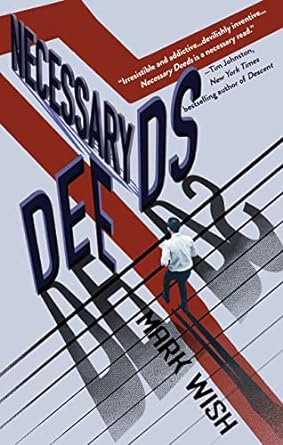
ABOUT NECESSARY DEEDS: Matt Connell, a formerly successful literary agent who’ s been in prison for four years for a crime of passion— homicide by strangulation after learning his wife slept with a friend— receives an early release from Sing Sing to join an FBI undercover investigation of multiple murders in Manhattan. Killings continue to mount as Matt does his best to calm his “ Ferrari brain” — a condition in which his mind accelerates wildly into negative thoughts and worst-case scenarios— even as he falls in love with a suspect, then discovers disturbing truths about his past and hers. When he finds his own life in danger, can he stand up for the Bureau’ s heralded principles of Fidelity, Bravery, and Integrity? Not to mention genuine love?
ABOUT MARK WISH: Mark Wish’s previous novels have been praised by Daniel Woodrell, Delia Ephron, Salman Rushdie, Rebecca Makkai, Ben Fountain, Anne Serling, the Chicago Tribune, and the Los Angeles Times. His short fiction has won a Pushcart Prize and appeared in more than 125 print venues including BEST AMERICAN SHORT STORIES. A renowned book doctor for thirty years, he now edits and publishes COOLEST AMERICAN STORIES, whose inaugural volume went to a third printing.
“What makes Necessary Deeds so irresistible and addictive is that it’s a devilishly inventive murder mystery presented in the finest of sentences and filtered through a mind wonderfully beset at every turn by the dark truths of human desire, ambition, envy, and jealousy—but most of all by love itself. If Mark Wish’s life imitates his art, his gift for storytelling might just get him
murdered. But not before his next book deal, please. In any case, Necessary Deeds is a necessary read.”
—TIM JOHNSTON, New York Times bestselling author of Descent
“By turns tense and tender, Mark Wish’s Necessary Deeds delivers a high-stakes noir and a taut tale of jealousy, murder, and redemption.”
—LAURA MCHUGH, internationally bestselling author of The Weight of Blood
“Necessary Deeds is a tight, tense thriller that explores some of the darkest, twistiest workings of the human mind. Mark Wish asks the question: Who can you trust if you can’t trust yourself?”
— LOU BERNEY, winner of Edgar, Hammet, Anthony, Dagger, and ALA Awards, author of November Road
“Mark Wish’s Necessary Deeds hits the sweet spot: sly, sharp, and satirical. Highly entertaining!”
—ALAN ORLOFF, Anthony, Agatha, Derringer, and two-time Thriller Award Winning author
“Smart and gripping, nuanced and wryly observed, Necessary Deeds is unputdownable, and Wish is clearly a writer at the top of his game. A phenomenal thriller that will leave you breathless.”
—TISH COHEN, author of The Summer We Lost Her
“Bursting at the seams with voice and tension, Mark Wish’s Necessary Deeds reads like the literary lovechild of Bellow, Chandler and Robert Bolaño. This is a literary page-turner, full of life and poetry. A novel to be devoured, then savored.”
—DANIEL TORDAY, two-time winner of the National Jewish Book Award, author of The Last Flight of Poxl West
“In Necessary Deeds’ Matt Connell, Mark Wish has created a diabolically compelling anti-hero—a literary agent with both romance and murder in his heart. As soon as I read the first few lines of this novel, I was all the way in—Wish portrays the high-stakes New York City literary world and the conflicted soul of Connell with humor, pathos, and supreme suspense.”
—Grace Paley Prize Winner CHRISTINE SNEED, author of Little Known Facts
“Smart, exceptionally told, and a pleasure to read, this mystery by Mark Wish is complemented by dialogue brimming with emotional insights, whether about the foreboding passion between a man and a woman, or the rage of a wounded husband. Necessary Deeds is the kind of book you read in a rush but remember long after.’
—E. A. AYMAR, bestselling author of No Home for Killers
“I was hooked by the first sentence—one of the best I’ve read—and followed Mark Wish’s tale on and on. Wish knows how to tell a story, and in Necessary Deeds, he has given us a varied, surprising, and irresistibly engaging one.”
—Pulitzer Prize winner TIM PAGE, author of Parallel Play
“Necessary Deeds is a captivating, spiraling story that doesn’t let up off the throttle. When it was over, I found myself wanting—no, needing—that speed again. Wish has created a stunning narrative with so much drive and power. Any reader would love this.”
—PEN Award winner MORGAN TALTY, national bestselling author of Night of the Living Rez
“Necessary Deeds is a rarity: A murder mystery that keeps you guessing until the very end, and most important, is a lot of fun. Mark Wish has written a witty page-turner that’s necessary reading.”
—LELAND CHEUK, author of No Good Very Bad Asian
“Mark Wish’s Necessary Deeds is a deliciously gleeful send-up of the New York literary world, a wildly satirical removal of the veil over High Art. Most notably, it’s a genuine whodunnit: Who is murdering the Talented Writers in the city (with their outsized advances)? Intertwined throughout is a noir love story and humor, but also a clear-eyed gaze at what has happened to notions of Integrity, Literature…and Fame. The twist at the end took me by surprise while making perfect wicked sense.”
—Drue Heinz Literature Prize winner KATHERINE VAZ, author of Fado and Other Stories
DID YOU ENJOY WHAT YOU JUST READ? IF YES, THEN SUBSCRIBE TO THE BLOG, GIVE THE POST A LIKE, OR LEAVE A COMMENT! NEW POSTS ARE UP EVERY TUESDAY & THURSDAY!
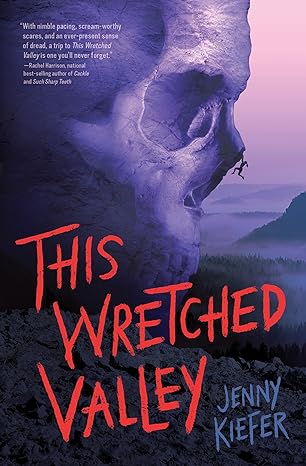
This trip is going to be Dylan’s big break. Her geologist friend Clay has discovered an untouched cliff face in the Kentucky wilderness, and she is going to be the first person to climb it. Together with Clay, his research assistant Sylvia, and Dylan’s boyfriend Luke, Dylan is going to document her achievement on Instagram and finally cement her place as the next rising star in rock climbing.
Seven months later, three bodies are discovered in the trees just off the highway. All are in various states of decay: one a stark, white skeleton; the second emptied of its organs; and the third a mutilated corpse with the tongue, eyes, ears, and fingers removed.
But Dylan is still missing—and no trace of her, dead or alive, has been discovered.
Were the climbers murdered? Did they succumb to cannibalism? Or are their impossible bodies the work of an even more sinister force?
This dread-inducing debut builds to a bloodcurdling climax, and will leave you shocked by the final twist.
GRADE: B+
REVIEW:
This book was inspired by the Dyatlov Pass which I’ve always been fascinated by (if you don’t know what that is, Google it and go down a rabbit hole that will keep you busy for hours). I breezed through the beginning portion of this novel, as I find rock climbing (and mountain climbing) very fascinating (probably because I don’t partake in it so I can live vicariously through characters who do!). The moment the four friends arrive at the valley, strange things begin to happen. I find forests pretty intimidating and scary so the setting was definitely creepy for me and I enjoyed that. I loved the history behind the forest and what occurred before the friends arrived there (that we got to learn later on in the book). There are many scary moments in this novel that horror fans will absolutely love. The only snag I had was that towards the middle mark the novel became a little repetitive when the friends kept going around in circles in the woods (and that’s probably the point) but for a debut, this was a strong novel. Not to mention that I haven’t read too many books that have a sentient forest ready to unleash its fury upon those who dare trespass on it.
Horror fans (especially those who love gore) will love this novel. I think it’d make an excellent movie too!
*Thank you so much to NetGalley and Quirk Books for the digital copy of this book in exchange for an honest review!
DID YOU ENJOY WHAT YOU JUST READ? IF YES, THEN SUBSCRIBE TO THE BLOG, GIVE THE POST A LIKE, OR LEAVE A COMMENT! NEW POSTS ARE UP EVERY TUESDAY & THURSDAY!
What It Does: Reduces pores, improves skin texture, and brighten
Active Ingredients: Glycolic acid
Verdict: This product has 10% glycolic acid but despite that it doesn’t feel harsh on the skin when I used it. It did have a slight sting but nothing too terrible. I didn’t notice any change in regards to my pores – or brightness, but my skin did feel smoother, so maybe this works differently for everyone. Overall, I do love Kinship products so I was excited to try this – and I do like that it has glycolic acid in it, but I can’t really say if the changes were that radical. Maybe if you have sun spots or acne scars you’re better at noticing the brightening effects. I did like the product for what it was, a serum. And it did feel incredibly smooth – so that’s what I can comment on. But others have seen improvements in other areas too. The price point is good if you’re looking for a serum with acid in it and have the skin concerns that it targets.
DID YOU ENJOY WHAT YOU JUST READ? IF YES, THEN SUBSCRIBE TO THE BLOG, GIVE THE POST A LIKE, OR LEAVE A COMMENT! NEW POSTS ARE UP EVERY TUESDAY & THURSDAY!
My parking garage off Fifth was nearly a mile from where I worked at city hall. I could have paid twice as much to park two blocks from my building and avoid the rows of homeless people: the worn tents, the used needles, the stinking garbage, the aura of hopelessness and distrust that filled a corner park and bled down the streets.
I was listening to my favorite podcast, LA with A&I. Amy and Ian started the podcast two years ago to talk about computer gaming, technology, entertainment and Los Angeles. It had blossomed into a quasi news show and they live streamed every morning at seven. They’d riff on tech and local news as if sitting down with friends over coffee. Like me, they were nerds, born and bred in the City of Angels. I’d never met Amy or Ian in real life, but felt like I’d known them forever.
We’d chatted over Discord, teamed up to play League of Legends, and I often sent them interesting clips about gaming or tech that they talked about on their podcast, crediting my gaming handle. Twice, we’d tried to set up coffee dates, but I always chickened out. I didn’t know why. Maybe because I thought they wouldn’t like me if they met me. Maybe because I was socially awkward. Maybe because I didn’t like people knowing too much about my life.
Today while I drove to work, they’d discussed the disaster that was city hall: all the digital files had been wiped out. The news story lasted for about five minutes, but it would be my life for the next month or more as my division rebuilt the data from backups and archives. It was a mess. They laughed over it; I tried to, but I was beginning to suspect the error was on purpose, not by mistake.
Now they were talking about a sweatshop that had been shut down last week.
“We don’t know much,” Amy said. “You’d think after eight days there’d be some big press conference, or at least a frontpage story. The only thing we found was two news clips—less than ninety seconds each—and an article on LA Crime Beat.”
“David Chen,” Ian said, “a Chinese American who allegedly trafficked hundreds of women and children to run his factory in Chinatown, was arraigned on Monday, but according to Crime Beat, the FBI is also investigating the crime. And—get this— the guy is already out on bail.”
“It’s fucked,” Amy said. “Look, I’m all for bail reform. I don’t think some guy with weed in his pocket should have to pay thousands of bucks to stay out of jail while the justice system churns. But human trafficking is a serious crime—literally not two miles from city hall, over three hundred people were forced to work at a sweatshop for no money. They had no freedom, lived in a hovel next door to the warehouse. Crime Beat reported that the workers used an underground tunnel to avoid being seen—something I haven’t read in the news except for one brief mention. And Chen allegedly killed one of the women as he fled from police. How did this guy get away with it? He kills someone and spends no more than a weekend behind bars?”
“According to Crime Beat, LAPD investigated the business for months before they raided the place,” Ian said. “But Chen has been operating for years. How could something like this happen and no one said a word?”
I knew how. People didn’t see things they didn’t want to.
Case in point: the homeless encampment I now walked by.
I paused the podcast and popped my earbuds back into their charging case.
“Hello, Johnny,” I said to the heroin addict with stringy hair that might be blond, if washed. I knew he was thirty-three, though he looked much older. His hair had fallen out in clumps, his teeth were rotted, and his face scarred from sores that came and went. He sat on a crusty sleeping bag, leaned against the stone wall of a DWP substation, his hollow eyes staring at nothing. As usual, he didn’t acknowledge me. I knew his name because I had asked when he wasn’t too far gone. Johnny, born in Minnesota. He hadn’t talked to his family in years. Thought his father was dead, but didn’t remember. He once talked about a sister and beamed with pride. She’s really smart. She’s a teacher in…then his face dropped because he couldn’t remember where his sister lived.
Four years ago, I left a job working for a tech start-up company to work in IT for city hall. It was barely a step up from entry-level and I couldn’t afford nearby parking garages. If I took a combination of buses and the metro, it would take me over ninety minutes to get to work from Burbank, so factoring the combination of time and money, driving was my best bet and I picked the cheapest garage less than a mile from work.
I used to cringe when I walked by the park. Four years ago, only a dozen homeless tents dotted the corner; the numbers had more than quadrupled. Now that I could afford a more expensive garage, I didn’t want it. I knew most of the people here by name.
“Hey, Toby,” I greeted the old black man wearing three coats, his long, dirty gray beard falling to his stomach. He had tied a rope around his waist and attached it to his shopping cart to avoid anyone stealing his worldly possessions when he slept off his alcohol.
“Mizvi,” he said, running my name together in a slur. He called me “Miss Violet” when he was sober. He must have still been coming down off whatever he’d drank last night.
I smiled. Four years ago I never smiled at these people, fearing something undefinable. Now I did, even when I wanted to cry. I reached into my purse and pulled out a bite-size Hershey Bar. Toby loved chocolate. I handed it to him. He took it with a wide grin, revealing stained teeth.
One of the biggest myths about the homeless is that they’re hungry. They have more food than they can eat. That doesn’t mean many aren’t malnourished. Drug and alcohol abuse can do that to a person.
A couple weeks ago a church group had thought they would bring in sandwiches and water as part of community service. It was a nice gesture, sure, but they could have asked what was needed instead of assuming that these people were starving. Most of the food went uneaten, left outside tents to become rat food. The plastic water bottles were collected to return for the deposit, which was used to buy drugs and alcohol.
But no one gave Toby chocolate, he once told me when he was half-sober. Now, whenever I saw him—once, twice a week—I gave him a Hershey Bar. He would die sooner than he should, so why couldn’t I give him a small pleasure that I could afford? Toby was one of the chronics, a man who’d been on the street for years. He had no desire to be anywhere else, trusted no one, though I thought he trusted me a little. I wished I knew his story, how he came to be here, how I could reach him to show him a different path. His liver had to be slush with the amount of alcohol he consumed. Alcohol he bought because people, thinking they were helping—or just to make themselves feel better—handed him money.
As I passed the entrance to the small park, the stench of unwashed humans assaulted me. The city had put four porta-potties on the edge of the park but they emptied them once a month, if that. They were used more for getting high and prostitution than as bathrooms. The city had also put up fencing, but didn’t always come around to lock the gate. Wouldn’t matter; someone would cut it open and no one would stop them. Trespassing was the least of the crimes in the area.
I dared to look inside the park, though I didn’t expect to see her. I hadn’t seen her for over a week. I found myself clutching my messenger bag that was strapped across my chest. Not because I thought someone would steal it, but because I needed to hold something, as if my bag was a security blanket.
I didn’t see her among the tents or the people sitting on the ground, on the dirt and cushions, broken couches and sleeping bags, among the needles and small, tin foils used to smoke fentanyl. I kicked aside a vial that had once held Narcan, the drug to counteract opioid overdoses. The clear and plastic vials littered the ground, remnants of addiction.
There was nothing humane about allowing people to get so wasted they were on the verge of death, reviving them, then leaving them to do it over and over again. But that was the system.
The system was fucked.
Blue and red lights whirled as I approached the corner. I usually crossed Fifth Street here, but today I stopped, stared at the silent police car.
The police only came when someone was dying…or dead.
Mom.
I found my feet moving toward the cops even though I wanted to run away. My heart raced, my vision blurred as tears flashed, then disappeared.
DID YOU ENJOY WHAT YOU JUST READ? IF YES, THEN SUBSCRIBE TO THE BLOG, GIVE THE POST A LIKE, OR LEAVE A COMMENT! NEW POSTS ARE UP EVERY TUESDAY & THURSDAY!
“I flinch, sure a hatchet is about to come spinning out of the darkness, sure a scythe is swinging our way.”
PLOT SUMMARY:
It’s been four years in prison since Jade Daniels last saw her hometown of Proofrock, Idaho, the day she took the fall, protecting her friend Letha and her family from incrimination. Since then, her reputation, and the town, have changed dramatically. There’s a lot of unfinished business in Proofrock, from serial killer cultists to the rich trying to buy Western authenticity. But there’s one aspect of Proofrock no one wants to confront…until Jade comes back to town. The curse of the Lake Witch is waiting, and now is the time for the final stand.
GRADE: A+
REVIEW:
I had no doubts that I was going to love this third installment from the Indian Lake trilogy. I loved every moment of this bloody, gory, action-packed novel. Jade Daniels is back and out of prison, and is currently the history teacher in her former high school. Everything seems alright, until the first bodies are found and then Jade must figure out if she’s back in a slasher again, trying to recall all the rules for the third sequel. What this means is that the killer is going to be superhuman, anyone can die, including the the main character, and the past will come to haunt you. Our protagonist has to deal with all those things during the duration of the novel, and at times the reader can’t help but doubt if maybe Jade could somehow be behind the murders this time. This novel kept me on the tip of my toes, and every few pages I couldn’t help but mutter, “Oh f**k.” This novel isn’t for the faint of heart – and it will surely have you teary eyed several times, but I trusted Jones to give us the ending this trilogy deserved and he delivered tenfold. If you haven’t read this series, I urge you to read My Heart is a Chainsaw, especially if you’re a fan of slasher films and horror film history. Obviously, if you have read the previous books from this series, then reading this final installment is a MUST. I absolutely loved this book and the whole trilogy and wasn’t ready to say goodbye to Jade, my only hope is that someone picks this up to become a miniseries in the future.
*Thank you so much to NetGalley and Saga Press for the digital copy of this book in exchange for an honest review!
DID YOU ENJOY WHAT YOU JUST READ? IF YES, THEN SUBSCRIBE TO THE BLOG, GIVE THE POST A LIKE, OR LEAVE A COMMENT! NEW POSTS ARE UP EVERY TUESDAY & THURSDAY!
From now till Feb. 1, I will be running a giveaway where one winner will win a signed copy of I WANT CANDY, a personalized Valentine’s Day card, and of course – candy!
You can enter in two different ways – hop on over to my Instagram or you can use Rafflecopter . Please note this is open ONLY to U.S. Residents!
DID YOU ENJOY WHAT YOU JUST READ? IF YES, THEN SUBSCRIBE TO THE BLOG, GIVE THE POST A LIKE, OR LEAVE A COMMENT! NEW POSTS ARE UP EVERY TUESDAY & THURSDAY!
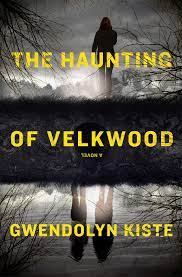
The Velkwood Vicinity was the topic of occult theorists, tabloid one-hour documentaries, and even some pseudo-scientific investigations as the block of homes disappeared behind a near-impenetrable veil that only three survivors could enter—and only one has in the past twenty years, until now.
Talitha Velkwood has avoided anything to do with the tragedy that took her mother and eight-year-old sister, drifting from one job to another, never settling anywhere or with anyone, feeling as trapped by her past as if she was still there in the small town she so desperately wanted to escape from. When a new researcher tracks her down and offers to pay her to come back to enter the vicinity, Talitha claims she’s just doing it for the money. Of all the crackpot theories over the years, no one has discovered what happened the night Talitha, her estranged, former best friend Brett, and Grace, escaped their homes twenty years ago. Will she finally get the answers she’s been looking for all these years, or is this just another dead end?
GRADE: A+
REVIEW:
I absolutely loved this novel. Usually, reading about hauntings isn’t my thing because books with ghosts tend to be so tropey- however, Kiste’s novel is so intriguing and fresh that it takes haunting to a whole new level. A whole neighborhood disappears with the people that lived there and no one can enter it except for the three friends that used to live there and are the only survivors. I love the idea of childhood friends that return to their original home to try to understand what exactly happened twenty years ago. I love the dynamic that Talitha and Brett had, you couldn’t help but root for these childhood friends that realized years ago that maybe their feelings verged more than friendship but in the world they lived in, their love couldn’t ever be front and center. This is a character driven novel, but the lush, Gothic atmosphere will completely seduce you too. I couldn’t put this book down and read it in two days! That’s to say that I was completely mesmerized by the story and just wanted to bask in it, and I loved that it had The Virgin Suicides vibes but being told from the female perspective instead of the male gaze.
I recommend this book if you love hauntings, ghosts, Gothic feels, queer characters, and mystery soaked in suspense.
*Thank you so much to NetGalley and Saga Press for the digital copy of this book in exchange for an honest review!
DID YOU ENJOY WHAT YOU JUST READ? IF YES, THEN SUBSCRIBE TO THE BLOG, GIVE THE POST A LIKE, OR LEAVE A COMMENT! NEW POSTS ARE UP EVERY TUESDAY & THURSDAY!
There is no body. A fact DC Clements finds both a problem and a tremulous, tantalizing possibility. She’s not a woman inclined to irrational hope, or even excessive hope. Any damned hope, really. At least, not usually.
Kylie Gillingham is probably dead.
The forty-three-year-old woman has been missing nearly two weeks. Ninety-seven percent of the 180,000 people a year who are reported missing are found within a week, dead or alive. She hasn’t been spotted by members of the public, or picked up on CCTV; her bank, phone and email accounts haven’t been touched. She has social media registered under her married name, Kai Janssen; they’ve lain dormant. No perky pictures of carefully arranged books, lattes, Negronis or peonies. Kylie Gillingham hasn’t returned to either of her homes. Statistically, it’s looking very bad.
Experience would also suggest this sort of situation has to end terribly. When a wife disappears, all eyes turn on the husband. In this case, there is not one but two raging husbands left behind. Both men once loved the missing woman very much. Love is just a shiver away from hate.
The evidence does not conclusively indicate murder. There is no body. But a violent abduction is a reasonable proposition—police-speak, disciplined by protocol. Kidnap and abuse, possible torture is likely—woman-speak, fired by indignation. They know Kylie Gillingham was kept in a room in an uninhabited apartment just floors below the one she lived in with husband number two, Daan Janssen. That’s not a coincidence. There is a hole in the wall of that room; most likely Kylie punched or kicked it. The debris created was flung through a window into the street, probably in order to attract attention. Her efforts failed. Fingerprints place her in the room; it’s unlikely she was simply hanging out or even hiding out, as there is evidence to suggest she was chained to the radiator.
Yet despite all this, the usually clear, logical, reasonable Clements wants to ignore statistics, experience and even evidence that suggests the abduction ended in fatal violence. She wants to hope.
There just might be some way, somehow, that Kylie—enigma, bigamist—escaped from that sordid room and is alive. She might be in hiding. She is technically a criminal, after all; she might be hiding from the law. She can hardly go home. She will know by now that her life of duplicity is exposed. She will know her husbands are incensed. Baying for blood. She has three largely uninterested half brothers on her father’s side, and a mother who lives in Australia. None of them give Clements a sense that they are helping or protecting Kylie. She will know who abducted her. If alive, she must be terrified.
Clements’ junior partner, Constable Tanner, burly and blunt as usual, scoffs at the idea that she escaped. He’s waiting for a body; he’d settle for a confession. It’s been four days now since Daan Janssen left the country. “Skipped justice,” as Tanner insists on saying. But the constable is wet behind the ears. He still thinks murder is glamorous and career-enhancing. Clements tries to remember: did she ever think that way? She’s been a police officer for nearly fifteen years; she joined the force straight out of university, a few years younger than Tanner is now, but no, she can’t remember a time when she thought murder was glamorous.
“He hasn’t skipped justice. We’re talking to him and his lawyers,” she points out with what feels like the last bit of her taut patience.
“You’re being pedantic.”
“I’m being accurate.”
“But you’re talking to him through bloody Microsoft Teams,” says Tanner dismissively. “What the hell is that?”
“The future.” Clements sighs. She ought to be offended by the uppity tone of the junior police officer. It’s disrespectful. She’s the detective constable. She would be offended if she had the energy, but she doesn’t have any to spare. It’s all focused on the case. On Kylie Gillingham. She needs to remain clear-sighted, analytical. They need to examine the facts, the evidence, over and over again. To be fair, Constable Tanner is focused too, but his focus manifests in frenetic frustration. She tries to keep him on track. “Look, lockdown means Daan Janssen isn’t coming back to the UK for questioning any time soon. Even if there wasn’t a strange new world to negotiate, we couldn’t force him to come to us, not without arresting him, and I can’t do that yet.”
Tanner knocks his knuckles against her desk as though he is rapping on a door, asking to be let in, demanding attention. “But all the evidence—”
“Is circumstantial.” Tanner knows this; he just can’t quite accept it. He feels the finish line is in sight, but he can’t cross it, and it frustrates him. Disappoints him. He wants the world to be clear-cut. He wants crimes to be punished, bad men behind bars, a safer realm. He doesn’t want some posh twat flashing his passport and wallet, hopping on a plane to his family mansion in the Netherlands and getting away with it. Daan Janssen’s good looks and air of entitlement offend Tanner. Clements understands all that. She understands it but has never allowed personal bias and preferences to cloud her investigating procedures.
“We found her phones in his flat!” Tanner insists.
“Kylie could have put them there herself,” counters Clements. “She did live there with him as his wife.”
“And we found the receipt for the cable ties and the bucket from the room she was held in.”
“We found a receipt. The annual number of cable ties produced is about a hundred billion. A lot of people buy cable ties. Very few of them to bind their wives to radiators. Janssen might have wanted to neaten up his computer and charger cords. He lives in a minimalist house. That’s what any lawyer worth their salt will argue.” Clements rolls her head from left to right; her neck clicks like castanets.
“His fingerprints are on the food packets.”
“Which means he touched those protein bars. That’s all they prove. Not that he took them into the room. Not that he was ever in the room.”
Exasperated, Tanner demands, “Well how else did they get there? They didn’t fly in through the bloody window, did they?” Clements understands he’s not just excitable, he cares. He wants this resolved. She likes him for it, even if he’s clumsy in his declarations. It makes her want to soothe him; offer him guarantees and reassurances that she doesn’t even believe in. She doesn’t soothe or reassure, because she has to stay professional, focused. The devil is in the detail. She just has to stay sharp, be smarter than the criminal. That’s what she believes. “She might have brought them in from their home. He might have touched them in their flat. That’s what a lawyer will argue.”
“He did it all right, no doubt about it,” asserts Tanner with a steely certainty.
Clements knows that there is always doubt. A flicker, like a wick almost lit, then instantly snuffed. Nothing is certain in this world. That’s why people like her are so important; people who know about ambiguity yet carry on regardless, carry on asking questions, finding answers. Dig, push, probe. That is her job. For a conviction to be secured in a court of law, things must be proven beyond reasonable doubt. It isn’t easy to do. Barristers are brilliant, wily. Jurors can be insecure, overwhelmed. Defendants might lie, cheat. The evidence so far is essentially fragile and hypothetical.
“I said, didn’t I. Right at the beginning, I said it’s always the husband that’s done it,” Tanner continues excitedly. He did say as much, yes. However, he was talking about Husband Number 1, Mark Fletcher, at that point, if Clements’ memory serves her correctly, which it always does. And even if her memory one day fails to be the reliable machine that it currently is, she takes notes—meticulous notes—so she always has those to rely on. Yes, Tanner said it was the husband, but this case has been about which husband. Daan Janssen, married to Kai: dedicated daughter to a sick mother, classy dresser and sexy wife. Or Mark Fletcher, husband to Leigh: devoted stepmother, conscientious management consultant and happy wife? Kai. Leigh. Kylie. Kylie Gillingham, the bigamist, had been hiding in plain sight. But now she is gone. Vanished.
“The case against Janssen is gathering momentum,” says Clements, carefully.
“Because Kylie was held captive in his apartment block.”
“Yes.”
“Which is right on the river, easy way to lose a body.”
She winces at this thought but stays on track. “Obviously Mark Fletcher has motive too. A good lawyer trying to cast doubt on Janssen’s guilt might argue that Fletcher knew about the other husband and followed his wife to her second home.”
Tanner is bright, fast; he chases her line of thought. He knows the way defense lawyers create murky waters. “Fletcher could have confronted Kylie somewhere in the apartment block.”
“A row. A violent moment of fury,” adds Clements. “He knocks her out cold. Then finds an uninhabited apartment and impetuously stashes her there.”
Tanner is determined to stick to his theory that Janssen is the guilty man. “Sounds far-fetched. How did he break in? This thing seems more planned.”
“I agree, but the point is, either husband could have discovered the infidelity, then, furious, humiliated and ruthless, imprisoned her. They’d have wanted to scare and punish, reassert control, show her who was boss.” They know this much, but they do not know what happened next. Was she killed in that room? If so, where is the body hidden? “And you know we can’t limit this investigation to just the two husbands. There are other suspects,” she adds.
Tanner flops into his chair, holds up a hand and starts to count off the suspects on his fingers. “Oli, Kylie’s teen stepson. He has the body and strength of a man…”
Clements finishes his thought. “But the emotions and irrationality of a child. He didn’t know his stepmum was a bigamist, but he did know she was having an affair. It’s possible he did something rash. Something extreme that is hard to come back from.”
“Then there’s the creepy concierge in the swanky apartment block.”
“Alfonzo.”
“Yeah, he might be our culprit.”
Clements considers it. “He has access to all the flats, the back stairs, the CCTV.”
“He’s already admitted that he deleted the CCTV from the day Kylie was abducted. He said that footage isn’t kept more than twenty-four hours unless an incident of some kind is reported. Apparently the residents insist on this for privacy. It might be true. It might be just convenient.”
Clements nods. “And then there’s Fiona Phillipson. The best friend.”
“Bloody hell. We have more suspects than an Agatha Christie novel,” says Tanner with a laugh that is designed to hide how overwhelmed and irritated he feels. His nose squashed up against shadowy injustice, cruel violence and deception.
“Right.”
“I still think the husband did it.”
“Which one?”
“Crap. Round and round in circles we go.” He scratches his head aggressively. “Do you want me to order in pizza? It’s going to be a long night.”
“Is anyone still doing deliveries? I don’t think they are,” points out Clements. “You know, lockdown.”
“Crap,” he says again, and then rallies. “Crisps and chocolate from the vending machine then. We’ll need something to sustain us while we work out where Kylie is.”
Clements smiles to herself. It’s the first time in a long time that Tanner has referred to Kylie by name, not as “her” or “the bigamist” or, worse, “the body.” It feels like an acceptance of a possibility that she might be somewhere. Somewhere other than dead and gone.
Did she somehow, against the odds, escape? Is Kylie Gillingham—the woman who dared to defy convention, the woman who would not accept limits and laughed in the face of conformity—still out there, somehow just being?
DID YOU ENJOY WHAT YOU JUST READ? IF YES, THEN SUBSCRIBE TO THE BLOG, GIVE THE POST A LIKE, OR LEAVE A COMMENT! NEW POSTS ARE UP EVERY TUESDAY & THURSDAY!
My poem “This Is War” appeared in a video for Mother
My short story “Across the Woods” was turned into a short film for the anthology Scribbles from the Crypt: A Journal of Horror and also won an award as a writer for Best Horror Movie for 8 ½ Films Awards
Whatever Happened to Peyton Rose? Short screenplay won Best Screenplay at Sarah of Horror Film Festival
My poem “The Photographer” appeared in The Horror Writer’s Association Poetry Showcase Vol. X
2024 GOALS
*Write a horror feature screenplay.
*Write a play.
*Find a publisher for TEAR YOU APART (the novelization of my Crush screenplay).
*Read at least 50 books.
*Post more frequently on Instagram.
*Try to merge my author site with this blog site so that it’s all one website (I know I wanted to do this last yr but life got busy)
*Work on my horror novel.
*Find a publisher for my novella CRY ME A RIVER.
What goals have you made for the new year?
DID YOU ENJOY WHAT YOU JUST READ? IF YES, THEN SUBSCRIBE TO THE BLOG, GIVE THE POST A LIKE, OR LEAVE A COMMENT! NEW POSTS ARE UP EVERY TUESDAY & THURSDAY!
“When Dad had been sentenced, I had been orphaned, practically and emotionally, at a much younger age than I had anticipated being parentless. I had been thrust into a new phase of life, a lonely phase, an unguided phase, which was both terrifying and oddly liberating.”
PLOT SUMMARY:
Morgan always knew her father, Owen, never murdered her mother, and has spent the last six years campaigning for his release from prison. Finally he is set free, but they can no longer live in the house that was last decorated by her mother’s blood. Salvation comes in the form of a tall, dark and notorious decorative granite tower on the Cornish coastline known only as ‘The Folly’. The owner makes them an offer: take care of the Folly, and you can live there. It’s an offer too good to refuse.
At first the Folly is idyllic, but soon a stranger arrives who acts like Morgan’s mother, talks like her mother, and wears her dead mother’s clothes. Is this stranger hell-bent on vengeance, in touch with her restless mother’s spirit itself, or simply just deranged? And, most importantly, what exactly happened the night Morgan’s mother died?
GRADE: A
REVIEW:
I usually enjoy Amor’s books, and this was no exception. I got invested really fast to the daughter/father relationship, especially since it explored a strained relationship caused by the father having been in jail for the murder of her mother for many years. However, Morgan never believed he was at fault. But once they begin to live at The Folly – a residence near a coastal town, strange things begin to happen. Morgan can’t figure out if her mother is trying to contact her through the possession of a stranger, or if the stranger is simply trying to mess with them. Family secrets left buried come to the surface and it changes everything. I liked this take on possession and I personally love it when someone can make a perfectly “happy-sounding” song creepy such as in the case of Abba’s Waterloo.
This was a fast read (because of impeccable pacing and short nature) so if you’re looking for a novella that explores father/daughter relationships, the meaning of family, grief, and a new take on possession then I recommend you pick this up as it’ll be the perfect read for you!
*Thank you so much to the author for the digital copy of this book in exchange for an honest review!
DID YOU ENJOY WHAT YOU JUST READ? IF YES, THEN SUBSCRIBE TO THE BLOG, GIVE THE POST A LIKE, OR LEAVE A COMMENT! NEW POSTS ARE UP EVERY TUESDAY & THURSDAY!








 The Inkblotters