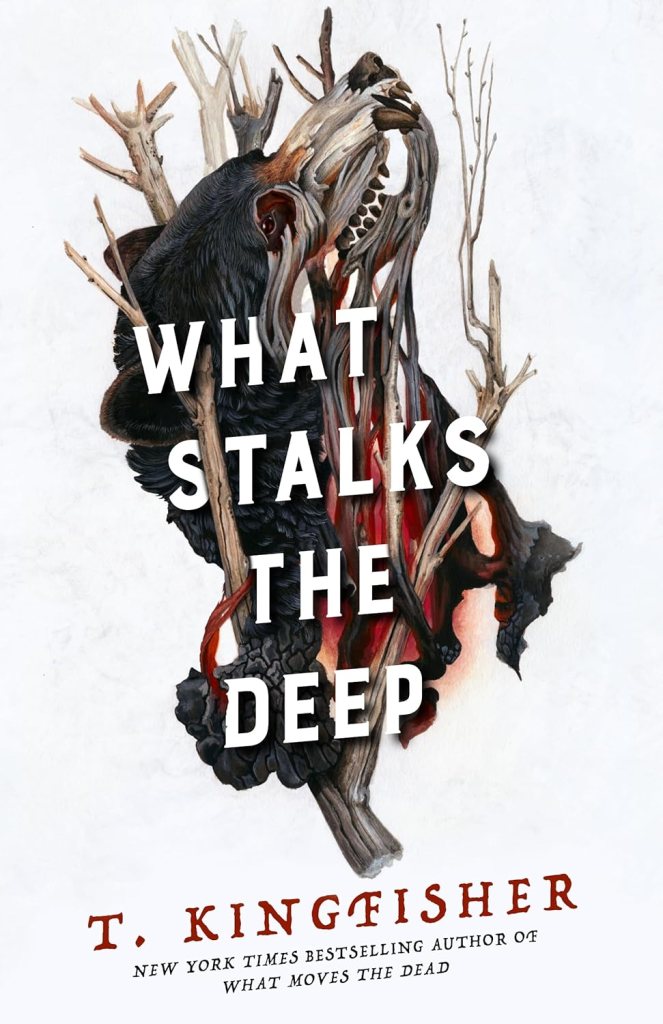
They particularly do not want to visit an abandoned coal mine in West Virginia with a reputation for being haunted.
But when their old friend Dr. Denton summons them to help find his lost cousin—who went missing in that very mine—well, sometimes a sworn soldier has to do what a sworn soldier has to do…
GRADE: A
REVIEW:
This third installment in the Sworn Soldier series delighted me from the start—especially with its eerie West Virginia setting. One of the things I adore about Kingfisher’s work is how she blends dark, gnarly horror with just the right amount of humor, and this book is no exception.
Like the previous entry, What Stalks the Deep introduces a cast of quirky, compelling characters and builds a mystery that pulls you in deeper with every chapter. Following Alex Easton on another wild adventure was a blast, and the shift into the claustrophobic world of the mines adds an extra layer of tension. Mines are unsettling on their own—add Kingfisher’s imagination, and they become downright terrifying.
The audiobook deserves special praise. The performance brings the atmosphere, characters, and creeping dread vividly to life. Honestly, I think it may be the best way to experience this story.
If you’ve enjoyed the earlier books in the series, this is an absolute must-read. It expands the world in exciting ways, leans into cosmic horror with a hint of sci-fi, and delivers another gripping, weird, wonderful journey with Easton at the helm.
*Thank you so much to NetGalley & Macmillan Audio for the audiobook copy of this book in exchange for an honest review!
DID YOU ENJOY WHAT YOU JUST READ? IF YES, THEN SUBSCRIBE TO THE BLOG, GIVE THE POST A LIKE, OR LEAVE A COMMENT! NEW POSTS ARE UP EVERY TUESDAY & THURSDAY!
Kinsey has the perfect job as the team lead in a remote research outpost. She loves the solitude, and the way the desert keeps her far away from the temptations teeming out in the civilian world.
When her crew discovers a mysterious specimen buried deep in the sand, Kinsey breaks quarantine and brings it into the hab. But the longer it’s inside, the more her carefully controlled life begins to unravel. Temptation has found her after all, and it can’t be ignored any longer.
One by one, Kinsey’s team realizes the thing they’re studying is in search of a new host—and one of them is the perfect candidate….
GRADE: B-
REVIEW:
This book is definitely one for the freaks—in the best possible way—as it boldly fuses horror with erotica. Imagine The Thing, but trade the Arctic ice for scorching desert sand. Kinsey’s research team stumbles upon a bizarre creature buried in the dunes and, against all common sense, brings it inside to study. That’s when the infection starts… and when the story takes its turn into unsettling, seductive territory.
Kinsey herself harbors a strange fetish: she craves the idea of being overtaken by a virus, of something alien curling its way inside her. As the infection spreads through the team, she finds herself terrifyingly close to getting exactly what she’s always fantasized about—if she’s willing to surrender to it.
It’s a weird, wild ride. I enjoyed the characters and the sheer audacity of the premise, but this is definitely not a universal crowd-pleaser. If you like your erotica served with a generous splash of body horror, this one might be right up your alley. Otherwise, consider yourself warned.
*Thank you so much to NetGalley & Macmillan Audio for the audiobook copy of this book in exchange for an honest review!
DID YOU ENJOY WHAT YOU JUST READ? IF YES, THEN SUBSCRIBE TO THE BLOG, GIVE THE POST A LIKE, OR LEAVE A COMMENT! NEW POSTS ARE UP EVERY TUESDAY & THURSDAY!
Two 30-something singles stuck in a time loop are forced to relive the worst days of their lives, so they team up to find a way to break the cycle. For fans of Palm Springs and Oona Out of Order, NOT YOU AGAIN offers a fresh new take on the Groundhog Day story.
In Julian, California, every day is April 22. Most people have accepted the loop—after all, reliving the same day every day, there’s nothing to lose. Day drinking until you pass out? Yes. Partner swapping? Why not.
But Carly has woken up at her dad’s funeral exactly 238 times, and she wants out. She doesn’t want to waste her life away reliving the worst day ever in the small town she always hated visiting. Carly wants to go back to writing film scripts in LA; she’s determined to find a way to break the cycle.
She discovers an unexpected kindred spirit in Adam, the mortician she met at her dad’s funeral. April 22 was also one of the worst days of his life: his fiancée admitted to cheating on him with his best friend. Every day Adam wakes up on April 22 to his ex-fiancée’s admission, starting each day with a breakup. April 22 was supposed to be his last day working for his parents at the funeral home, and the start of his new life as an astronomer. Adam is a man of science, and like Carly, he believes there must be a way out of the time loop.
Together, Carly and Adam team up to find out what’s causing the time loop. And in trying to find a way out, they also find their way to each other.
DID YOU ENJOY WHAT YOU JUST READ? IF YES, THEN SUBSCRIBE TO THE BLOG, GIVE THE POST A LIKE, OR LEAVE A COMMENT! NEW POSTS ARE UP EVERY TUESDAY & THURSDAY!
Well, if I’m being exceedingly honest with you – and I am trying – I was nothing at all, to begin with. Then I was my father’s testicles. Then the weaver of Fate itself, which is when the lying started. After that, it all got a bit complicated.
I was the daughter of Ouranos. The daughter of Zeus. The daughter of no one at all. A winner, a loser, though never much in between. The world standard of beauty and a crone, both. Olympus’ very own it-girl. Maybe the worst wife in all of history. A lover, a friend, a co-conspirator. A snitch. Selfless – once or twice. A bitch – more than twice. A monster, a villain, a victim – if you must. A good mother, a bad mother, a really bad mother. Lonely and famous and beloved and alone. Precious and worthless. A rival, a cheat. Afraid, often, and terrifying, also often. Oh, and I started a war. That’s very important.
The goddess Aphrodite. I was that too. I don’t think I am
anymore. Look, it’s all very knotted. Maybe I should start from the beginning.
First, there was Chaos, which meant something different then to what it does now. The time of Chaos was empty. It was a blank canvas for the optimists and an endless sinkhole for the pessimists. It was a time of absolutely nothing. I suppose I was nothing then, but we all were, so I won’t hold that against her.
Chaos was empty, until she met Nyx. I like to think that the two of them were in love, but I’ve never met my grandmothers, so I can’t say for certain. The two of them created the earth and the seas and the sky, and they had three children to gift them to.
Their daughters received the sea and the earth, and they were happy with them.
Their son wasn’t, as is the way of youngest children. He wanted to be the king of a world consisting of only five people, so they let him.
My father, given the world like a toy so he’d play nicely with his sisters. I suspect he was spoiled rotten, but then I quite like being spoiled, myself. And he did ask, before he took. He spoke with such conviction about the glittering future he would bring, the life he would spread across this world, that they believed him.
Ouranos became the first king of this world. He took his sister to be his wife and he made good on his promises. Together – let’s not give him all the credit; he didn’t carry their children – they filled the world with life. They brought forth the Titans, beings more powerful than even they were, who could control the elements around them more easily than breathing. And they brought forth the Cyclopes, and the Hecatonchires – the hundred-handed ones – who Gaia loved and who did not ask for power, only a life, which meant Ouranos did not respect them. He thought them irrelevant to the world, because they didn’t demand to own it. They lived between the oceans and created beautiful wonders with all the energy they saved from fighting.
I don’t know how many children they had together. It doesn’t matter. All that really matters is it was one child too many.
It’s always the youngest son who has the most to prove.
Their youngest was a Titan, Cronus. He wanted to be king too, only Ouranos wasn’t like his mothers. He didn’t want to give up what was his.
Cronus asked for power; his father said no. Cronus did not ask a second time.
So the world came to know a new word: war.
It didn’t last long, that first war. It couldn’t. All the Titans could be counted on fingers and toes.
Cronus armed himself. He went to the Cyclopes and asked for their support. He promised them positions in his new order, new lives beneath the sun instead of deep below the sea. He told them he would respect them as their father never did. And he let their conversation be heard just enough to build fear in his father.
It’s a bold strategy, to tell your enemy that you’re coming, but it works well with the men in my family. They’re so afraid of it, it eats away at them, into their very bones, and they forget that they’re anything other than the position they hold.
Ouranos ordered the Cyclopes sent to Tartarus, a prison in the underworld he’d had to create personally, because one had never been needed before.
(It’s a problem when you’re an immortal fighting other immortals. You have to be careful about who you piss off because there’s no getting rid of them. They’ll be there, hating you. Forever.)
How Cronus himself escaped being tied up in proto-damnation is beyond me, but he did. I suspect his mother helped. He promised her – how they promise! – he would free her sons, bring them to the power they deserved. When Cronus was king, everyone would live equally in a utopia, just below him.
He had his people behind him. He had his shining vision for the future. He had the weapons and the belief. It was only a matter of time.
He followed his father across the land, over the oceans, waited for the perfect storm to be whipping around them, for winds too loud for words – I know that for certain. I made my entrance soon enough.
I think it’s unlikely they’d have had much to chat about, anyway. When you get to weapons at dawn, what do you say?
I want power!
No, me!
No, me!
They were both armed, but Cronus’ reach was longer. That’s been true of every new generation I’ve seen, that they’re just a little bigger than their parents, trying to prove they’re better in the most
pointless of ways.
Cronus carried a sickle. I don’t know what my father’s weapon was. He lost.
There was no point in aiming to kill. There never has been, for us. Instead, Cronus thought of the worst shame he could possibly imagine, and he castrated his father.
Chopped his balls off.
De-testicled him.
I’ve heard every possible variation of the phrase, some with great solemnity and some with a snigger, and I’ve never been able to explain why I’m not laughing.
I can tell you now, though.
Those balls were me.
I grew from them. I was born from them. They were me and I am them and that will always be the truth. That is my beginning.
I made my debut at the end of the first great war, in a storm unlike any other, as the world turned itself upside down trying to find its way in the new order. All of this is true, yet my birth is reduced to a punchline.
I hid it for so long, not wanting my entire existence to be reduced to one man’s shame, but I’m over that now. I’m much more famous than him, after all.
I’ve always wondered how Cronus managed to castrate him so neatly. It was only my father’s testicles that made me – call my knowing that feminine intuition, if you want – but Cronus used a sickle.
How? Were they hanging so low? Was Ouranos’ stance so wide because he needed the world to see his mighty balls? What possible physical arrangement leads to one man being able to castrate another with a weapon made for cutting wheat?
Cronus would have had to practise, but he can’t have. Surely he had better things to do in the war, and I’ve met some of his generals. I can’t imagine them offering themselves up for the chop.
That one is a mystery for the ages, I’m afraid, but it doesn’t matter, because now I’m here. That’s it. All of the relevant history before I arrived. Done.
Cronus lifted his arms in mighty victory and bellowed so that all around him could cheer and crown him the new king of everything. Like his father, he went home and married his sister, ready to fill the world with people who looked just like him.
Ouranos, newly ball-less, gave an anguished cry.
‘You think yourself so smart, so powerful, but one day you will be just like me, dethroned by your own children.’
Cronus looked at his father’s crotch. ‘I will never be just like you, will I?’
He ordered Ouranos tied and bound in Tartarus, that prison of his own making, never to be seen again.1
So distracted were they by their respective shouting that the testicles fell into the ocean, instantly swallowed by the swells of the waves, pulled down into utter blackness, presumed lost.
Wrong.
1 For a certain value of never. We are immortals, after all. —A
DID YOU ENJOY WHAT YOU JUST READ? IF YES, THEN SUBSCRIBE TO THE BLOG, GIVE THE POST A LIKE, OR LEAVE A COMMENT! NEW POSTS ARE UP EVERY TUESDAY & THURSDAY!
Madeline and Wes Drake have invited two hundred of their closest friends and family to their sprawling horse ranch for the most anticipated event of the year: a “pistols and pearls” gender reveal party so sensational it is sure to make headlines. But the party descends into chaos when the celebratory explosive misfires, leaving one woman dead and a trail of secrets.
As the aftershocks of the bloody party ripple across the small town, Agent Jamie Saldano is brought on the scene to investigate. Battling his own demons from the past, Saldano unearths a web of deceit spun around the Drakes. The appearance of some unexpected houseguests only deepens the mystery. And as tensions mount, it becomes clear that the explosion wasn’t just an unlucky accident. But who was the target, and why? As the shadow of a killer looms, the happy parents-to-be must unravel the truth before it’s too late.
DID YOU ENJOY WHAT YOU JUST READ? IF YES, THEN SUBSCRIBE TO THE BLOG, GIVE THE POST A LIKE, OR LEAVE A COMMENT! NEW POSTS ARE UP EVERY TUESDAY & THURSDAY!
Victoria Rogers pressed her good arm to her very bruised, almost broken ribs. “Dad, don’t,” she said, trying to stay as still as possible. “You can’t be funny. It already hurts to breathe. It wasn’t a horse.”
Her father frowned. “I was told you were thrown off a horse.” “I was thrown out of a truck.”
“Then how’d you get the black eyes?”
“The ground was a little bit pissy when I hit it and punched me back.”
There wasn’t a part of her that didn’t hurt. The good news was that now that the medical staff had determined she didn’t have a head injury, they were going to give her drugs to help with the pain. She’d already said she didn’t want any of that weak-ass pill stuff. She wanted a nurse to give her a shot of something that would work instantly and let her rest. Because in addition to the bruised ribs, requisite scrapes and contusions, she had a broken left leg and a sprained wrist. Her previously dislocated shoulder also throbbed, but that was kind of the least of it.
As she lay in her hospital bed, feeling like death on a tortilla, she had the thought that maybe stunt work wasn’t for her. Injuries came with the job, but this was the third time in five years she’d landed in the hospital. The first time she’d messed up, so that was on her, but the other two had just been plain bad luck. The incident with the truck had come about because one of the tires had blown, causing the however many ton vehicle to jump the curb—an action that had sent her flying up and over the side. Gravity, being the bitch it was, had flung her onto the sidewalk. Hence the injuries.
Her father studied her, his brows drawn together in concern. “None of this makes me happy,” he told her.
The incongruous statement nearly made her laugh. She remembered—just in time—that her ribs wouldn’t appreciate the subsequent movement and they would punish her big-time.
“Today isn’t my favorite day either,” she admitted, trying not to groan. “I didn’t wake up with the thought that I should try to get thrown out of the back of a pickup.” Although technically getting thrown out of the truck had been the stunt. Just not when it had happened and without warning or a plan.
“I’m worried,” her father told her.
“I’ll be fine.”
“This time.”
She winced, and not from pain. “Now you sound like Mom.”
Her father, a handsome man only a few months from his sixtieth birthday, brightened. “Thank you, Victoria. That’s such a nice thing to say.”
Given her weakened condition, she let that comment slide. Honestly she didn’t have the strength to deal with it right now, even though she knew her father understood exactly what she’d been saying. He was only pretending to not get it.
“If you’re going to act like that, you should go,” she said, then amended what could be construed as a catty comment into something more kind. Mostly because she only had the emotional energy not to get along with one of her parents, and her mother had already claimed that prize. “Besides, they’ll be bringing my drugs any second. I plan to surrender to sleep, so I’m not going to be very conversational.”
As if to prove her point, one of the nurses walked in with a syringe. “Ready to feel better?” he asked cheerfully.
“Yes, and let me say, you’re my favorite person ever.”
He winked. “I get that all the time.”
He slowly injected whatever the medication was into her IV. Victoria drew in a shallow breath as she waited to feel that first blurring of the edges of the pain. Modern medicine was a miracle she intended to embrace.
The nurse left. Milton took her good hand in his.
“I’ll let you rest,” he told her. “But I’ll be back later tonight.” He squeezed her fingers. “Tomorrow, when you’re released, I’m taking you home.”
Ugh. Victoria knew that her father wasn’t talking about the pretty condo he’d bought her when she’d turned twenty-one. Instead he meant the house where she’d grown up. The one where her mother still resided.
“I don’t need to move back,” she protested, feeling the first telltale easing of the pain. “I have a few bumps and bruises.”
“Along with a broken leg. And what about your ribs? You can barely move without wincing.”
“I have zero pain tolerance. I’m a total wimp.”
He frowned. “You’re tough and stoic. If you’re showing signs of pain, it’s bad. You’ll stay with your mother and me until you’re well enough to be on your own.” He pointed at her. “I mean it, Victoria. You don’t get a vote.”
Her father was rarely stern with her, so his sharp tone warned her he wasn’t kidding. And she knew from twenty-four years of experience that arguing with the man would get her nowhere. Milton didn’t take a stand very often, but when he did, he was the immovable object.
“I wish you loved me less,” she murmured, feeling a little floaty and stumbling over her words. “Okay, I feel drugs. Let me enjoy the experience of breathing without, you know, wanting to die.”
Oh, baby girl. You’ve always been difficult.”
“I know. It’s one of my best qualities.” Her eyes drifted closed. “Love you, Dad.”
“Love you more.” He kissed her cheek. “I’ll see you tonight.”
DID YOU ENJOY WHAT YOU JUST READ? IF YES, THEN SUBSCRIBE TO THE BLOG, GIVE THE POST A LIKE, OR LEAVE A COMMENT! NEW POSTS ARE UP EVERY TUESDAY & THURSDAY!
Being a sugar baby isn’t all it’s cracked up to be. After a failed art career and a failed relationship, Baby has lost her way. She’s adrift in the post-Y2K, pre-Facebook world and stuck in her Florida hometown, selling stolen goods online and working as a sugar baby. Even though she’s hustling hard, there’s still never enough money to pay the bills, and her long-suffering roommate is ready to put her out on the streets. One night after a bad date with her sugar daddy, Baby is assaulted by a mysterious woman in a parking lot. The attack leaves her disoriented and exhausted, so Baby takes to her bed to lie there and rot, like, for real. With every passing day, Baby’s looks and health decline in strange and horrific ways. Soon, it becomes apparent that the strange woman who assaulted her had something to do with her declining state. Baby needs to find her attacker, reclaim her life and her beauty, and get her shit together once and for all. But at what cost?
Bed Rot Baby is a pink horror meditation of self-discovery through self-destruction, and the real cost of self-image, self-esteem, and beauty.
GRADE: A
REVIEW:
Bed Rot Baby is a strange, stylish little gem, eerie, satirical, and surprisingly tender. Wendy Dalrymple offers a fresh and unsettling take on themes of immortality and beauty, exploring what happens when the desire to stay young and untouched by time turns obsessive.
Rather than leaning on the usual tropes, Dalrymple injects the story with biting social commentary and dark humor. The idea of eternal youth is twisted into something claustrophobic, even grotesque, and the result is a story that feels both modern and mythic. It’s a clever reflection on sugar baby culture, the commodification of beauty, and the way society rewards women for staying small, still, and pretty forever.
The writing is sharp and compact, the tone shifting between dreamy and disturbing in all the right ways. It’s not a long read, but it lingers.
If you’re into offbeat horror with something to say, especially about the cost of being “perfect” forever Bed Rot Baby is well worth your time.
*Thank you so much to NetGalley & Quill & Crow Publishing House for a digital copy of this book in exchange for an honest review!
DID YOU ENJOY WHAT YOU JUST READ? IF YES, THEN SUBSCRIBE TO THE BLOG, GIVE THE POST A LIKE, OR LEAVE A COMMENT! NEW POSTS ARE UP EVERY TUESDAY & THURSDAY!
So standing here at the head of the conference table, expect-ant eyes of Very Important People all on her, was pretty much torture.
But Julia was the CEO of Starlight Cosmetics, this company was her baby, these VIPs the executives she hired to help grow the business. And the news she had to share with them was monumental.
She scanned her memory for the advice from her executive coach for this kind of situation. The only thing she could remember was, contrary to everything she’d ever been told before in her life, never try to picture your audience naked. It would make the nerves even worse.
And, of course, now that’s all Julia could think of.
She closed her eyes for a moment to clear her mind of all the unfortunate images fighting to run through her head.
What was that one thing her coach told her?
Squeeze your butt cheeks to hold the plank. Wait, no, that was her abs coach.
If the recipe calls for garlic, double it. Wrong again. That was her cooking coach.
Oh, screw it. What was the use of having all these people to help Julia better herself when she couldn’t call upon the advice when needed?
She cleared her throat and decided to wing it.
“I know you’re all busy, so I’ll make this quick. Look, it’s not how I wanted to do this . . .”
Her dream, rather, was to one day point at each of them and tell them an exorbitant dollar amount for a bonus. Enough money for them to buy new homes in the hills or on the beach, whichever they preferred.
“Wait—are you firing us?” someone cried out from the other end of the table.
Julia’s eyebrows shot up to her hairline. “What? No, of course not. Don’t be ridiculous.”
Always start with something personal and positive to get people excited about what you’re going to say. Oh yeah, that’s the brilliant advice her coach had mentioned.
“Oh gosh, I’m so sorry. I didn’t mean to sound so ominous.” Julia quickly backtracked. “It’s just that, well, at the risk of get-ting too squishy in a work meeting, I really wanted to thank you all for taking a chance on me way back when all of this was just an idea in my head.”
Julia swallowed the emotion building in her throat as she looked around at the team she’d put together to lead this company. They were the ones who took her idea to merge the best in the Korean skincare market with the high demands of the US consumer and built what was now one of the fastest- growing organic, clean K- beauty brands in America.
“I just want to tell you how much I appreciate your hard work and loyalty. I don’t know that any of us anticipated this kind of success. But honestly, none of it would have happened without each and every one of you and your contribution. And now, I have some really great news. As you know, Starlight’s Lotus Bamboo Essence was selected for Allure’s Best of Beauty awards. Which was a dream come true for us. But it doesn’t end there.”
Julia inserted the dramatic pause her public speaking coach had encouraged her to use. The looks of anticipation around the room fueled her excitement.
“I’m thrilled to share that the same Lotus Bamboo Essence has also been selected as one of this year’s Oprah’s Favorite Things!”
There was a silent pause of shock, followed by an eruption of applause and cheers, high fives, and hugs shared around the table.
“We’ll need to reforecast sales projections. We’re gonna blow up with the exposure . . .”
“We’re gonna have to update a comms plan . . .”
“We have to think of how we add this to the packaging design . . .”
“We need to make sure the supply chain can handle the increased distribution . . .”
“Oprah still has major influence on Gen X consumer spending. It’s a big win for a product . . .”
Yup, that was her team . . . no- nonsense, capable, loyal, honest . . . and the hardest- working, most talented people in the industry. And they were all business, just like her.
Her chest swelled as she watched them leave to get back to work, patting each other on the back as they walked out, taking the noise with them.
Julia started this company at only twenty- six years old. She’d disappointed her parents by changing her major from pre- med to business administration. She lived off ramen and PB&J sandwiches for a good year just to scrape by as she worked tirelessly to research the hadn’t exactly welcomed her with open arms. And she stomached the start- up community’s boys’ club as she tried to secure funding for the company.
And four short years later, they were on the verge of something huge. Hard work and dedication had brought them to this level of success. So yeah, she was proud of them, proud of herself. And at only thirty, she was finally in a position financially to take care of her family without worry.
When the last person left her office, Julia turned to look out the windows, the hustle and bustle of Santa Monica ten floors below. She took a deep breath.
“That’s right, motherfuckers,” she screamed, while pumping her fist. She shook her hips back and forth, adding in some aggressive hair throws and, why the heck not, followed it with a body roll. “Oh yeah, uh- huh . . .”
“Oh dear, that’s something I’m not likely going to forget seeing.”
Record scratch.
Julia halted her celebratory dance and quickly patted down her hair, trying to tuck her I- knew- I’d- regret-these bangs behind her ear as her assistant, Annette, entered the office.
“Unlike what your schedule says on paper, you’ve only actually attended that hot yoga class once. Should you really be try-ing to move your body like that?” Annette asked. “I wouldn’t want you to hurt yourself.”
“You’re fired.”
Annette passed her the cup of black coffee in the Morning Person mug that she knew was a lie, along with a multivitamin and a probiotic. Breakfast of champions.
“Just remember that I know where the bodies are hidden. Oh, and I have those pictures of you from that one holiday party . . .”
“Okay, fine, you can stay,” Julia conceded.
“Is it a good time to ask for a raise?”
Julia tried to shoot Annette a glare but couldn’t keep back the smile. It was a secret to no one that Annette was invaluable to the Starlight team, and most days she was the one bossing Julia around. Julia shook her head and took a seat at her desk. “Can you forward the O magazine email to the team so they know all the details?”
“You betcha,” Annette said. “Have you told your folks yet?”
“No, not yet. I don’t think they’d even understand what a big deal this is.”
“Make sure to tell them.” Annette wasn’t only her assistant, she was also her work- mother as well. “Oh, and here is the updated short list of investors we might want to approach for global expansion. One bad meeting doesn’t have to halt progress.”
One bad meeting was an understatement. The last time Julia had met with an investment firm for an informational meeting, they kept asking about her significant other, driving home that they were a family- run business built on traditional values. They looked at her as young and inexperienced not because of her age— she knew plenty of male CEOs who were thirty— but because she wasn’t married with children. In their eyes, Julia wasn’t reliable because she wasn’t settled . . . settled down, that is.
Her accomplishments, alone, weren’t enough.
I’ll show them, she thought to herself as she gritted her teeth. Julia grabbed the list from Annette with a little bit more force than necessary and nodded. “Thanks.”
“Hey.” Annette softened her voice like she so rarely ever did. The one word in that tone made Julia surprisingly emotional. “It’s a good day, boss lady. You should be proud.” She patted Julia on the shoulder before walking back to her desk just outside Julia’s office.
DID YOU ENJOY WHAT YOU JUST READ? IF YES, THEN SUBSCRIBE TO THE BLOG, GIVE THE POST A LIKE, OR LEAVE A COMMENT! NEW POSTS ARE UP EVERY TUESDAY & THURSDAY!
Fallon is a fixer. From planning prom to organizing her college applications, she’s got it all figured out…except for when her younger sister comes to her with very basic questions about sex. Shocked that she knows so little—and her fellow classmates even less—Fallon decides some practical education is in order. And Fallon isn’t above practicing a little civil disobedience by creating a secret underground off-campus group.
Shelby is a fighter. Having her nose broken is nothing new in her semiprofessional career…but this time it’s her boyfriend who threw the punch. Now her phone is blowing up with texts from a new guy who tells her she’s perfect, she’s special, she’s everything he’s ever wanted…except for a few small details. Shelby’s happy to adjust for him, because isn’t that what a healthy relationship is about?
Jobie is a failure. She doesn’t have enough followers and her posts never go viral, no matter how hard she crushes challenges and applies exactly the right filter. But a friendly DM from a good girl just like her points her in the direction of a whole new audience of admirers. Guys who just want to talk. Guys who give her the attention she’s always wanted.
The lives of all three girls intersect in Fallon’s secret class, rumors of which have parents up in arms. Fallon needs to keep herself anonymous, Shelby needs to keep her new boyfriend happy, and Jobie needs to keep her followers…who keep asking for more. Each girl finds herself trapped in an inescapable situation—that will leave one of them dead.
GRADE: B-
REVIEW:
Mindy McGinnis has been an auto-buy author for me for years — I absolutely love her writing and the bold stories she tells. That said, How Girls Are Made didn’t hook me the way her previous books have.
Set against the backdrop of a society that still struggles with how it defines and disciplines girlhood, the plot is timely and unflinching. McGinnis explores themes of bodily autonomy, trauma, identity, and power, all through the lens of a young girl navigating a system that often fails those who need the most protection. As always, her writing pulls no punches. It’s raw, honest, and at times difficult to read, but that’s exactly what makes it so impactful.
The themes are incredibly timely and important, and McGinnis never shies away from tough topics. But the pacing felt slow for much of the book, and it didn’t really hit its stride until about 90% in. That final stretch is powerful, though, and it’s what ultimately makes me recommend this one, especially for teen readers who can benefit from the message.
The characters are complex and real, whose voices ring with authenticity and strength even in their most vulnerable moments. McGinnis never talks down to her readers; instead, she challenges them to confront harsh truths with empathy and open eyes.
In an era where conversations about gender, control, and justice are more urgent than ever, How Girls Are Made couldn’t be more timely. It’s not an easy read, but it’s an important one.
Not my favorite from her, but still worth the read. Highly recommended for readers who appreciate bold storytelling with something to say.
*Thank you so much to NetGalley & Harper Collins for a digital copy of this book in exchange for an honest review!
DID YOU ENJOY WHAT YOU JUST READ? IF YES, THEN SUBSCRIBE TO THE BLOG, GIVE THE POST A LIKE, OR LEAVE A COMMENT! NEW POSTS ARE UP EVERY TUESDAY & THURSDAY!
C-L-I-N-T. That single short, sharp syllable has stood as an emblem of American manhood and morality and sheer bloody-minded will, on-screen and off-screen, for more than sixty years. Whether he’s facing down bad guys on a Western street (Old West or new, no matter), staring through the lens of a camera, or accepting one of his movies’ thirteen Oscars (including two for Best Picture), he is as blunt, curt, and solid as his name, a star of the old-school stripe and one of the most accomplished directors of his time, a man of rock and iron and brute force: Clint.
To read the story of Clint Eastwood is to understand nearly a century of American culture. No Hollywood figure has so completely and complexly stood inside the changing climates of post–World War II America. At age ninety-five, he has lived a tumultuous century and embodied much of his time and many of its contradictions.
We picture Clint squinting through cigarillo smoke in A Fistful of Dollars or The Good, the Bad and the Ugly; imposing rough justice at the point of a .44 Magnum in Dirty Harry; sowing vengeance in The Outlaw Josey Wales or Pale Rider or Unforgiven; grudgingly training a woman boxer in Million Dollar Baby; and standing up for his neighbors despite his racism in Gran Torino. Or we feel him present, powerfully, behind the camera, creating complex tales of violence, morality, and humanity, such as Mystic River, Letters from Iwo Jima, and American Sniper. But his roles and his films, however well cast and convincing, are two-dimensional in comparison to his whole life.
As Shawn Levy reveals in this masterful biography—the most complete portrait yet of Eastwood—the reality is richer, knottier, and more absorbing. Clint: The Man and the Movies is a saga of cunning, determination, and conquest, a story about a man ascending to the Hollywood pantheon while keeping one foot firmly planted outside its door.
GRADE: A
REVIEW:
Yes, this book is long — but when you’re covering the life of Clint Eastwood, a towering figure in Hollywood for over half a century, how could it not be?
I’ve always admired Eastwood’s work, both in front of and behind the camera, but I knew very little about the man himself. Clint pulls back the curtain on his personal life, revealing a complex and often controversial figure. Levy doesn’t shy away from Eastwood’s flaws, including his well-documented struggles with fidelity and the ruthless way he sometimes handled personal and professional relationships. (Just ask Sondra Locke.)
What really stood out to me, though, was the story of how Eastwood built his career. He wasn’t always taken seriously as an actor, in fact, many doubted his talent early on. But through a mix of grit, luck, and relentless ambition, he carved out a legendary place in film history. That journey is fascinating to follow.
If you’re a fan of Clint Eastwood or just love Hollywood history, this book is absolutely worth your time. Shawn Levy does a fantastic job digging deep and telling the full story, warts and all.
*Thank you so much to NetGalley & HarperAudio for the audiobook copy of this book in exchange for an honest review!
DID YOU ENJOY WHAT YOU JUST READ? IF YES, THEN SUBSCRIBE TO THE BLOG, GIVE THE POST A LIKE, OR LEAVE A COMMENT! NEW POSTS ARE UP EVERY TUESDAY & THURSDAY!



 The Inkblotters